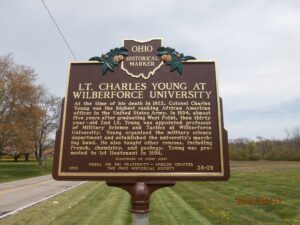
At the time of his death in 1922, Colonel Charles Young was the highest ranking African American officer in the United States Army. In 1894, almost five years after graduating West Point, then thirty year-old 2nd Lt. Young was appointed professor of Military Science and Tactics at Wilberforce University. Young organized the military science department and established the university’s marching band. He also taught other courses, including French, chemistry, and geology. Young was promoted to 1st lieutenant in 1896. (Continued other side)
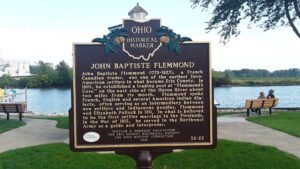
John Baptiste Flemmond (1770-1827), a French Canadian trader, was one of the earliest Euro-American settlers in what became Erie County. In 1805, he established a trading post at “Flemmond’s Cove” on the east side of the Huron River about two miles from its mouth. Flemmond spoke French, English and several American Indian dialects, often serving as an intermediary between new settlers and indigenous peoples. Flemmond wed Elizabeth Pollock in 1811, in what is believed to be the first settler marriage in the Firelands. In the War of 1812, he served in the Northwest Army as a guide and interpreter.
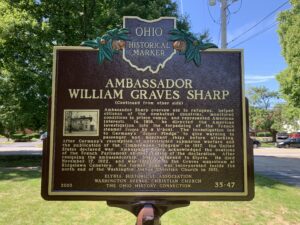
William Graves Sharp lived at this location before and after his tenure as Ambassador to France during World War I. He was born to George Sharp and Mahala Graves Sharp in Mount Gilead, Ohio, on March 14, 1859. As children, Sharp and his twin brother George moved to Elyria with their mother and grandparents, William and Ephra Graves. An Elyria High School graduate, Sharp earned a law degree from the University of Michigan in 1881. He was a journalist, lawyer, industrialist, and Lorain County Prosecutor. Serving three terms in the U.S. House of Representatives, Sharp introduced the first legislation providing for airmail service. Shortly before the outbreak of World War I, President Woodrow Wilson named Sharp as ambassador to France. He served from December 4, 1914, to April 14, 1919. (Continued on other side)
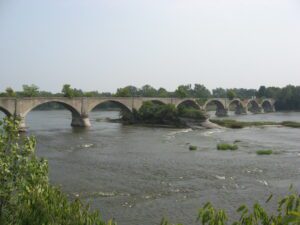
The Lima and Toledo Traction Company Bridge was construted in 1907 by the National Bridge Company of Indianapolis, and it was considered to be a revolutionary type of bridge construction. The Old Electric Bridge, as it was called, was built of steel reinforced concrete and filled with earth. In fact, for this period some considered the bridge to be the longest such railroad bridge in the world. Twelve spans of Roman aqueduct architectural design anchor the 1220-foot bridge in solid river bedrock. The bridge linked Lucas and Wood counties and connected a busy Toledo with points south by means of an electric trolley. This Interurban Bridge was placed on the National Register of Historic Places in 1972.
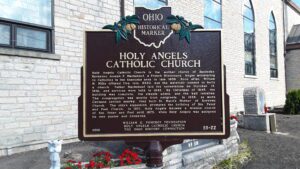
Holy Angels Catholic Church is the mother church of Sandusky. Reverend Joseph P. Machebeuf, a French Missionary, began ministering to Catholics in the Sandusky area in late 1839. Soon after, William H. Mills offered five lots, $530, and the materials needed to build a church. Father Machebeuf laid the cornerstone on October 13, 1841, and services were held in 1842. By Christmas of 1845, the building was complete, the steeple added, and the bell installed. The congregation was mostly Irish emigrants. In 1855, as more Germans settled nearby, they built St. Mary’s Mother of Sorrows Church. The city’s expansion prompted the building of Sts. Peter and Paul Church in 1871. Holy Angels became a mission church of Sts. Peter and Paul until 1875 when Holy Angels was assigned its own pastor and reopened.
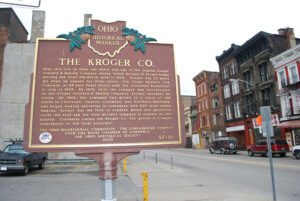
Near this site in Over-The-Rhine was one of the original Kroger Grocery & Baking Company stores, where Bernard H. Kroger began serving the Over-the-Rhine area in 1902. Kroger was 23 years old when he opened his first store, The Great Western Tea Company, at 66 East Pearl Street near the Cincinnati Riverfront in July of 1883. By 1902, when the company was incorporated as the Kroger Grocery & Baking Company, Kroger operated 40 stores. By 1908, the company had grown to a chain of 136 stores in Cincinnati, Dayton, Columbus, and Northern Kentucky, and began making deliveries to customers with 200 mule-drawn wagons. Kroger was the first to combine meats and groceries under one roof and the first grocery company to operate its own bakery. Currently called the Kroger Co., the grocer is a major contributor to the local economy.
William E. Telling (1869-1938) was one of ten children born in a farmhouse on this property. As a boy he sold strawberries and milk door-to-door and worked in a local sandstone quarry until at age 23 he purchased a milk route. He and four brothers formed the Telling Brothers Ice Cream Company in 1895 with William as president. A merger in 1915 formed the Telling Belle Vernon Dairy Company that was the first local distributor of pasteurized, glass-bottled milk. Their unique bacteriological laboratory (later Sealtest Laboratories) developed the baby food S.M.A. His recipe for success was “just work and work and work some more; do the work of two and draw the pay of one.”
Intersection of W Woodruff Avenue and Mt. Vernon Avenue
Toledo
, OH
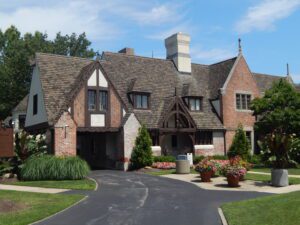
In 1915, real estate developers William B. Welles and Badger C. Bowen formed the Ottawa Park Realty Company and in 1917 platted 323 residential lots near Toledo, Ohio. Named “Westmoreland” for the similarities with the rolling landscapes of Westmoreland County, Virginia, the neighborhood was placed on the National Register of Historic Places in 1986. Westmoreland features 215 original homes, most representing architectural Revival styles of the early 20th century including those of the Colonial, Jacobethan/Tudor, Italianate, French, and Spanish Revivals. This marker commemorates the centennial of the founding of Westmoreland. (Continued on other side)