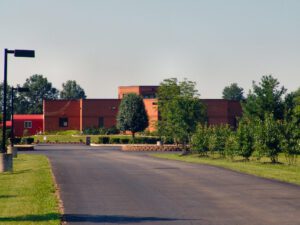
In 1985, Hindu immigrants from India formed a celestial organization, The Bharatiya Temple Society of Central Ohio, and through its membership adopted the Constitution and Bylaws and named the place of worship Bharatiya Hindu Temple. Later they bought a house at 3903 Westerville Road in Columbus for prayer and worship. In 1994, the membership moved to the current location and built this temple to serve the religious, spiritual, educational, and cultural needs of those who wish to live an active peaceful life in accordance with the Vedic dharma, philosophies, and traditions.
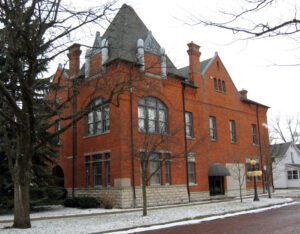
Completed in 1892 at the height of the region’s oil boom, the Pemberville Town Hall followed a late-1800s municipal trend to house many civic functions under one roof. The fire station, jail, and council chambers occupied the ground level, while the entire second floor hosted a public auditorium, or “opera house,” that seated 250. The 1897 debut of The Mikado featured new electric lighting. The ornate Opera House was the center of Pemberville’s social activities for decades, hosting dances, plays, socials, graduation ceremonies, political meetings, lectures, and husking bees. Traveling companies performed concerts, vaudeville, minstrel, and medicine shows. Following World War II the Opera House fell into disuse. It was restored in 1999 to both its former grandeur and its place in Pemberville’s cultural life.
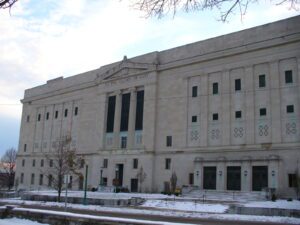
The first Masonic Lodge in Dayton was founded in 1808, located in the first Montgomery County Courthouse. Various other locations were home to Masons in Dayton, but by World War I, rapid growth of the Masonic community called for the creation of a new Lodge building. Masons of the time, including civic and business leaders of Dayton, conceived the idea of a new Masonic Center located on the hill at Belmonte Park North and Riverview Avenue. Ground was broken and construction of the $2.5 million Masonic Temple began on July 20, 1925. Through contributions from the Masonic community, the tremendous task of raising a majority of the building cost, $1.5 million, was accomplished in merely ten days in 1924. It is doubtful that the Temple could be duplicated given the fact that the large quantities of marble and mahogany and cherry woods used in construction would be difficult to procure today.
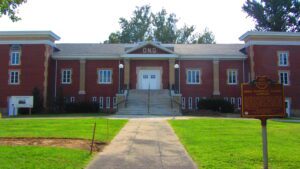
With a mission to protect citizens at home and aboard, the Ohio National Guard was originally established as the Northwest Territory Militia in Marietta on July 25, 1788, and has fought in every war since the War of 1812. Built in 1914, this Ohio National Guard Armory served both as Regimental and Company B, 7th Infantry, O.N.G. Headquarters. Later Company A, 166th Infantry, 37th Division, occupied the dual-purpose armory. The armory served Washington County as a departure point for soldiers leaving for service in World War I, World War II, and Korea. The armory also served the area in times of crisis and celebration, often used by the Red Cross, Marietta College, and other civic groups.
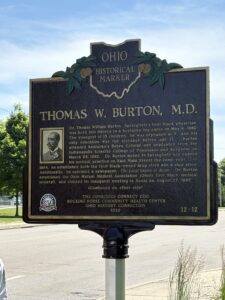
Dr. Thomas William Burton, Springfield’s first Black physician, was born into slavery in a Kentucky log cabin on May 4, 1860. The youngest of 15 children, he was orphaned at 9, and his only education was the alphabet before age 21. Burton attended Kentucky’s Berea College and graduated from the Indianapolis Eclectic College of Physicians and Surgeons on March 24, 1892. Dr. Burton moved to Springfield and opened his medical practice on East Main Street the same year. In 1894, he established both the first Black-owned drug store and a shoe store. Additionally, he operated a newspaper, The Loyal Legion of Honor. Dr. Burton established the Ohio Mutual Medical Association (Ohio’s first Black medical society), and chaired its inaugural meeting in Xenia on August 27, 1897. (Continued on other side)
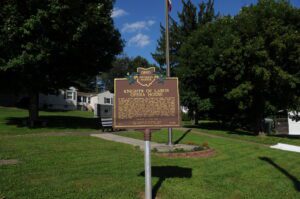
In 1869 a secret organization, The Knights of Labor, was founded in Philadelphia. The K.O.L. promoted an ideal society based on bettering life for others with the slogans, “labor was the first capital” and “an injury to one is the concern of all.” Shawnee’s Local Assembly #169 Knights of Labor was organized in 1876, and quickly became a powerful voice for labor in Ohio. National labor leader, William T. Lewis, later Labor Commissioner of Ohio, taught free grammer classes at night for the miners. Lewis initiated “The Ohio Plan,” the first free empployment bureaus in the United States. William H. Bailey, later head of National District Assembly #135 of Miners and T.L. Lewis, President of the United Mine Workers in 1910, also started their careers here. Meetings involving these leaders led to the formation of the United Mine Workers in 1890. (Continued on other side)
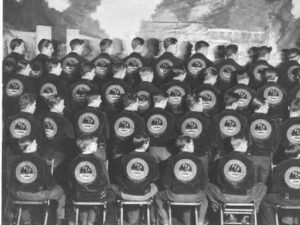
The blue corduroy jacket worn by members is a widely recognized symbol of the National FFA Organization, formerly Future Farmers of America. In 1933, Dr. J.H. “Gus” Lintner, a Fredericktown teacher and advisor to the local FFA chapter, commissioned a jacket for its members to wear to FFA’s national convention in Kansas City, Missouri. Impressed by the design, the organization adopted the jacket as part of FFA’s Official Dress. Millions of members have worn it since. Founded in 1928 to promote agricultural education, FFA continues its mission in 2018 in all 50 U.S. states and two territories.
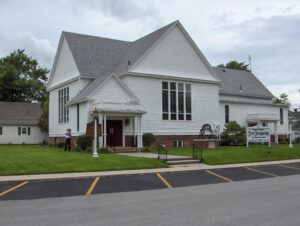
Organization of the congregation began in 1848 under the Rev. George Van Eman, and a charter was granted in 1854. The oldest Presbyterian church building in continuous use in Hancock County, the sanctuary was constructed in 1855-56. Members of the congregation included first Congressional Medal of Honor recipients John R. Porter and William Bennsinger, honored for their exploits as members of Andrews Raiders during the Civil War.