

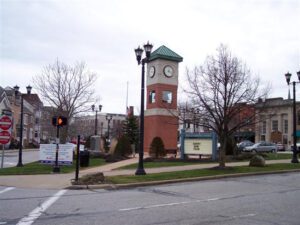
, OH
The Triangle, one of the most historic places in Berea, has been the center of the city’s civic life since the mid-19th century. Just beneath lie the solid layers of the famous Berea Sandstone that brought prosperity to Berea during its early years. Quarry owner and Berea Seminary founder John Baldwin obtained much of what is now Berea from Gideon Granger, Postmaster General under President Thomas Jefferson and original owner of Township 6, Range 14 (later Middleburg Township) of the Western Reserve. When the seminary trustees transferred the Triangle tract to the people of Berea in 1847, they designated it by deed as a public promenade. This farsighted stipulation preserved it from commercial development during the 20th century. (continued on other side)
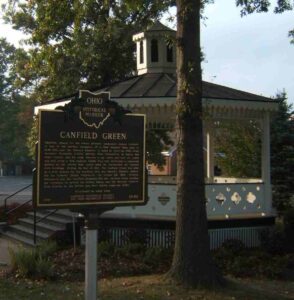
, OH
Canfield, named for the area’s primary landowner Judson Canfield, is one of the earliest examples of a New England town plan in both Ohio and the Western Reserve. It dates to April 20, 1798, when surveyor Nathaniel Church arrived from Connecticut to layout the town. Church and his team erected a log cabin and laid out roads and lots using a New England Green Plan that envisioned a communal ground at the center that would later be surrounded by various civil buildings. During the War of 1812, the Canfield Green was used as a drill ground for the Northern Ohio and Western Reserve militia, led by General Elijah Wadsworth. On August 23, 1812, General Wadsworth and the Canfield Dragoons left the Canfield Green heading for Cleveland to defend the United States and the Western Reserve from attacks by the British and their Native American allies. (Continued on other side)
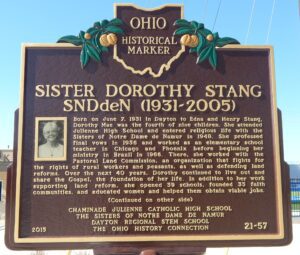
, OH
Born on June 7, 1931 in Dayton to Edna and Henry Stang, Dorothy Mae was the fourth of nine children. She attended Julienne High School and entered religious life with the Sisters of Notre Dame de Namur in 1948. She professed final vows in 1956 and worked as an elementary school teacher in Chicago and Phoenix before beginning her ministry in Brazil in 1966. There, she worked with the Pastoral Land Commission, an organization that fights for the rights of rural workers and peasants, as well as defending land reforms. Over the next 40 years, Dorothy continued to live out and share the Gospel, the foundation of her life. In addition to her work supporting land reform, she opened 39 schools, founded 35 faith communities and educated women and helped them obtain viable jobs. (Continued on other side)
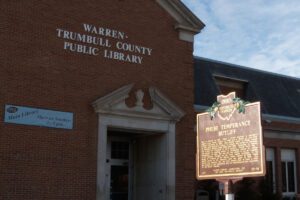
, OH
Born in Warren in 1859, Phebe T. Sutliff received a Bachelor’s degree from Vassar College in 1880 and a Master of Arts from Cornell University in 1890. Miss Sutliff taught at Hiram College in Ohio and Rockford College in Illinois and served as President of Rockford College from 1896 until 1901. Returning to Warren, she turned her attention to civic matters. During World War I, she started an evening school of citizenship classes for foreign immigrants. In 1924, she was the first woman to run for Congress in her district. Elected as the first woman president of the Board of Trustees of the Warren Public Library in 1938, Phebe Sutliff served in this capacity until her death in 1955. Miss Sutliff was inducted into the Ohio Women’s Hall of Fame in 1990. Her legacy to the community was the establishment and endowment of the Sutliff Museum.
, OH
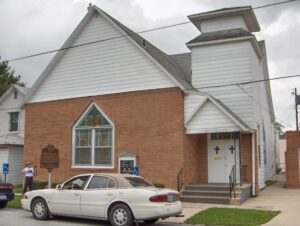
In spite of small numbers and being welcomed by the mostly white congregation of First Methodist Episcopal Church, African Americans in Findlay in the 1880s wanted to express their faith in ways that best reflected their freedoms and traditions. By the mid-1880s, the congregation was meeting in members’ homes and the Odd Fellows Hall, but began fund raising to build their own church in 1885. The congregation was admitted to the North Ohio Conference of the Third Episcopal District of the African Methodist Church in 1885, one of the first churches to be so admitted. The building on Liberty Street was well underway by the end of 1887 on a lot donated by Judge D. J. Cory. The original twenty foot by forty foot building cost $2,000 and immediately became a focal point for religion and social events for Findlay’s African American community. (Continued on other side)
, OH
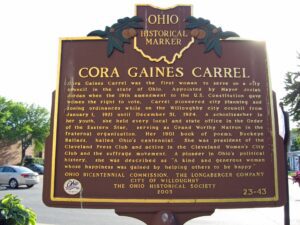
Cora Gaines Carrel was the first woman to serve on a city council in the state of Ohio. Appointed by Mayor Josiah Jordan when the 19th amendment to the U.S. Constitution gave women the right to vote, Carrel pioneered city planning and zoning ordinances while on the Willoughby city council from January 1, 1921 until December 31, 1924. A schoolteacher in her youth, she held every local and state office in the Order of the Eastern Star, serving as Grand Worthy Matron in the fraternal organization. Her 1901 book of poems, Buckeye Ballads, hailed Ohio’s centennial. She was president of the Cleveland Press Club and active in the Cleveland Women’s City Club and the suffrage movement. A pioneer in Ohio’s political history, she was described as “A kind and generous woman whose happiness was gained by helping others to be happy.”
, OH
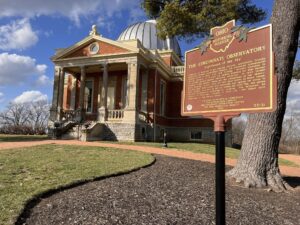
Prompted by response to his popular lectures, astronomer Ormsby MacKnight Mitchel (1809-1862) founded the Cincinnati Astronomical Society (CAS) in 1842. With CAS funding, Mitchel traveled to Munich, Bavaria, to acquire the optical elements for what became the world’s second largest refractor telescope. In 1843 former president John Quincy Adams laid the cornerstone of the observatory building, located upon the hill since known as Mount Adams. The Cincinnati Observatory was completed and opened for study in 1845. Mitchel, who died in service during the Civil War, was among the first to popularize astronomy in America. The telescope he brought to Cincinnati remains in daily use, the oldest such instrument in the United States.
, OH
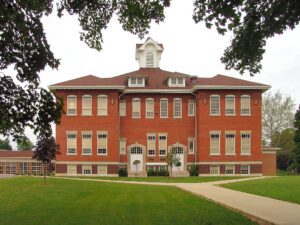
The first school in what is now Pataskala was a “subscription school” operated by Amariah Cubberly on the nearby banks of the South Fork of the Licking River in the 1820s. Subscription schools, which charged fees, were the forerunners of rural public schools in many parts of Ohio. By the 1830s several one-room public schools served the children of the area, but in 1870 the civic minded citizens of Pataskala provided a centralized building for grades one through twelve on Main Street, where the old Town Hall now stands. This school was moved to the new building on this site in 1908. When the Southwest Licking Local School District was established in 1953, Pataskala Elementary School continued in the building. Additions in 1968 and 2000 enhanced its educational capabilities. This 1908 Queen Anne architectural style building was listed on the National Register of Historical Places in 1983.