

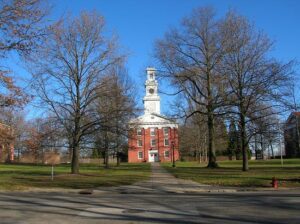
, OH
With the help of town founder, David Hudson, Western Reserve College and its Academy were founded in 1826. Often called “The Yale of the West,” the college saw success initially as all of its professors and college presidents were Yale College graduates. Nationally, Western Reserve College became involved with the Underground Railroad and anti-slavery movement 28 years before the Civil War began. Moreover, Western Reserve College established the Loomis observatory, named for Elias Loomis, a Yale tutor and WRC professor, which is now the second oldest observatory in the United States. The Western Reserve College moved to Cleveland in 1882 and eventually became Case Western Reserve University while the Academy remained in Hudson. Today, the Western Reserve Academy is one of the nation’s oldest and most respected independent college preparatory schools.
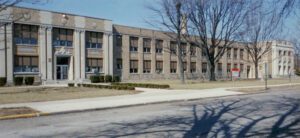
, OH
The North Baltimore Elementary and High School stood at 124 S. Second St. and was dedicated November 11, 1927. The tan and brown brick building replaced a school (built 1884) that a fire destroyed on January 26, 1926. The new school building, for children in grades 1-12, also included classrooms for home economics and business courses, as well as a 900-seat auditorium (including balcony), second floor cafeteria, gymnasium, administrative offices, and a public library. E.E. Leidy was the school’s superintendent and R. Vern Northup was the high school principal. The members of the board of education were Dr. E.A. Powell, President, D.B. Bushey, Vice President, C.G. Nigh, Clerk, and Nellie Roberts and R.E. Simon. Previously known as the “Independents,” the school’s sports teams became the “Tigers” in 1931. (Continued on other side)
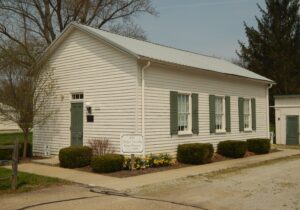
, OH
On April 20, 1857, the trustees of Morgan Township met in Okeana to obtain a lot for the township house. From a quarter mill tax levy, $850 was budgeted for a house and lot. Money expended on the project included $50 for the lot, $650 for the construction of the building, $41 for fencing, $12.60 for twelve chairs, and $10.25 for a table. Since its completion in 1858, this meeting house has been used for trustee meetings, a voting precinct, village singing schools and concerts, public school, bank, and township garage. The trustees moved to a new building across the street in 1972 and into their Chapel Road complex in 2000.
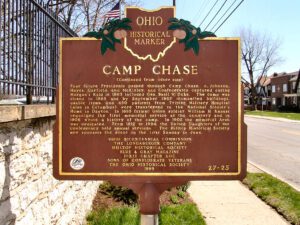
, OH
Camp Chase was a Civil War camp established in May 1861, on land leased by the U.S. Government. Four miles west of Columbus, the main entrance was on the National Road. Boundaries of the camp were present-day Broad Street (north), Hague Avenue (east), Sullivant Avenue (south), and near Westgate Avenue (west). Named for former Ohio Governor and Lincoln’s Secretary of the Treasury Salmon P. Chase, it was a training camp for Ohio soldiers, a parole camp, a muster-out post, and a prisoner-of-war camp. As many as 150,000 Union soldiers and 25,000 Confederate prisoners passed through its gates from 1861-1865. By February 1865, over 9,400 men were held at the prison. More than 2,000 Confederates are buried in the Camp Chase Cemetery.
, OH
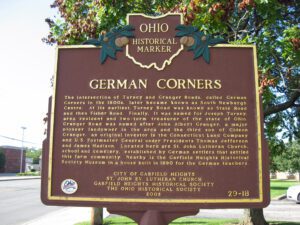
The intersection of Turney and Granger Roads, called German Corners in the 1800s, later became known as South Newburgh Centre. At its earliest Turney Road was known as State Road and then Fisher Road. Finally, it was named for Joseph Turney, area resident and two-term treasurer of the state of Ohio. Granger Road was named after John Albert Granger, a major pioneer landowner in the area and the third son of Gideon Granger, an original investor in the Connecticut Land Company and U. S. Postmaster General under Presidents Thomas Jefferson and James Madison. Located here are St. John Lutheran Church, school and cemetery, established by German settlers that settled this farm community. Nearby is the Garfield Heights Historical Society Museum in a house built in 1890 for the German teachers.
, OH
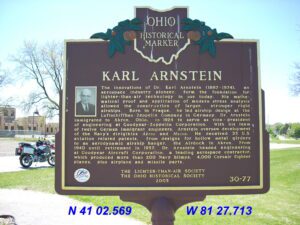
The innovations of Dr. Karl Arnstein (1887-1974), an aerospace industry pioneer, form the foundation for lighter-than-air technology in use today. His mathematical proof and application of modern stress analysis allowed the construction of larger, stronger rigid airships. Born in Prague, he led airship design at the Luftschiffbau-Zeppelin Company in Germany. Dr. Arnstein immigrated to Akron, Ohio, in 1924 to serve as vice-president of engineering at Goodyear-Zeppelin Corporation. With his team of twelve German immigrant engineers, Arnstein oversaw development of the Navy’s dirigibles Akron and Macon. He received 35 U.S. aviation related patents, from designs for hollow metal girders to an aerodynamic airship hanger, the Airdock in Akron. From 1940 until retirement in 1957, Dr. Arnstein headed engineering at Goodyear Aircraft Corporation, a leading aerospace contractor, which produced more than 200 Navy blimps, 4,000 Corsair fighter planes, plus airplane and missile parts.
, OH
On this site stood the home of Elisha and Polly Mygatt Whittlesey and their ten children. Also here was his law office and a records office that was moved in 1965 to Pioneer Village at the Canfield Fairgrounds. Already an attorney in his home state, Elisha (1783-1863) with Polly (1787-1855) emigrated from Danbury, Connecticut in June 1806 to Canfield in the Western Reserve where he was admitted to the Ohio bar and was prosecuting attorney from 1807 to 1823. During the War of 1812, Whittlesey was adjutant to Maj. Gen. Elijah Wadsworth and later a secretary to Gen. William Henry Harrison. Whittlesey opened a law office in Canfield in 1813, specialized in land cases, and was one of the founders of Norwalk, Ohio in 1815. In 1820, he was elected to the first of two terms in the Ohio General Assembly. (Continued on other side)
, OH
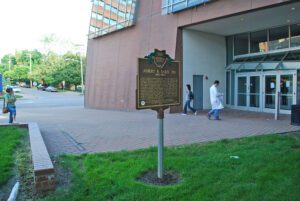
Albert B. Sabin developed the oral, live-virus polio vaccine at the University of Cincinnati College of Medicine and Children’s Hospital Research Foundation, where between 1939 and 1969, he conducted his most significant research. His vaccine has nearly eradicated the dreaded “infantile paralysis” that killed or maimed millions of children. Dr. Sabin, who considered Cincinnati his home, made many other significant medical discoveries here, particularly in the area of tropical diseases. Presidents and royalty worldwide honored him, including President Bill Clinton who said he was “one of the great heroes of American medicine.” His numerous awards include the U.S. National Medal of Medicine (1970), Presidential Medal of Freedom (1986), Medal of Liberty (1986), and Order of Friendship among Peoples awarded by the President of the Supreme Soviet of the U.S.S.R.