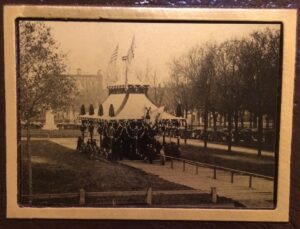
Abraham Lincoln visted Cleveland twice; once in life and the other in death. The first visit was on February 15-16, 1861, while in route to his presidential inauguration. The second, more solem visit was on April 28, 1865. Cleveland was one of twelve citiels to host a scheduled public viewing of the assassinated president’s remains. In addition to local officials, Lincoln’s cortege included a military escort of then current and former Union officers who were veterans of the Civil War. These officers would form the early membership of the organization known as the Military Order of the Loyal Legion of the United States. (continued on other side)
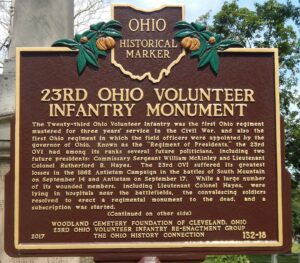
The Twenty-third Ohio Volunteer Infantry was the first Ohio regiment mustered for three years’ service in the Civil War, and also the first Ohio regiment in which the field officers were appointed by the governor of Ohio. Known as the “Regiment of Presidents,” the 23rd OVI had among its ranks several future politicians, including two future presidents: Commissary Sergeant William McKinley and Lieutenant Colonel Rutherford B. Hayes. The 23rd OVI suffered its greatest losses in the 1862 Antietam Campaign in the battles of South Mountain on September 14 and Antietam on September 17. While a large number of its wounded members, including Lieutenant Colonel Hayes, were lying in hospitals near the battlefields, the convalescing soldiers resolved to erect a regimental monument to the dead, and a subscription was started. (Continued on other side)
The building at 1380 E. 6th Street, designed by Walker and Weeks, served as the Cleveland Board of Education 1931-2013. During the 1950s and 1960s, the segregation of Cleveland Public Schools was the center of the city’s civil rights movement. Parents, like Daisy Craggett and Eddie Gill, protested relay classes and intact busing. The United Freedom Movement, a coalition of 50 civic, religious, and parent organizations, initiated demonstrations, sit-ins, and pickets, to galvanize the fight for education equality. On April 7, 1964, Reverend Bruce Klunder, vice president of Cleveland’s Congress of Racial Equality, was accidentally killed by a bulldozer at the future Stephen E. Howe Elementary School while he lay in a construction ditch to protest school re-segregation. His death ignited an April 20 boycott in which 85-95% of Cleveland’s Black students participated. (Continued on other side)