

, OH
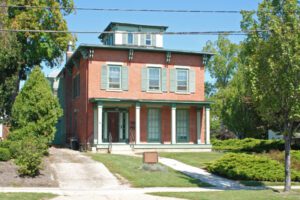
Aluminum pioneer Charles Martin Hall was born in 1863 in Thompson, Ohio (Geauga County), and moved with his family to Oberlin in 1873. Hall graduated from Oberlin College in 1885, studying chemistry under Professor Frank Fanning Jewett (1844-1926). Jewett, who lived in this house from 1884 to 1923, encouraged Hall’s interest in chemistry and aluminum, then a semi-precious metal. Hall discovered an electrochemical reduction process for producing metallic aluminum from aluminum oxide dissolved in molten cryolite in his woodshed laboratory at his family’s home at 64 East College Street on February 23, 1886. This process, the culmination of research with Jewett, became the basis for the aluminum industry in America. In 1888 Hall co-founded the Pittsburgh Reduction Company, later the Aluminum Company of America (ALCOA). Upon his death in 1914, Hall left one-third of his estate to Oberlin College.
, OH
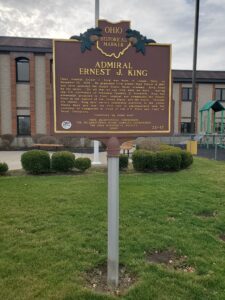
Fleet Admiral Ernest J. King was born in Lorain, Ohio, on November 23, 1878. He graduated from Lorain High School in 1897 and later attended the United States Naval Academy. King lived by his motto, “Do all that we can with what we have.” Having the full confidence of President Franklin D. Roosevelt, King was eventually promoted to Fleet Admiral and commanded the largest fleet in the history of the United States and the world. Through his career, King held various leadership positions in the United States Navy and was the first man to simultaneously hold the positions of Commander in Chief of the U.S. Fleet and Chief of Naval Operations. (continued on other side)
, OH
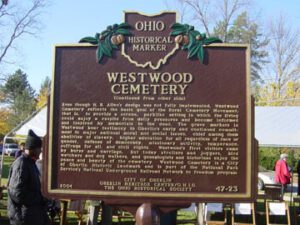
Shortly after Oberlin Colony was established in 1833, a two-acre burying ground was set aside south of Plum Creek in the area bounded by Main, Morgan, and Professor streets. By 1861, however, with the town and Oberlin College growing and the Civil War escalating, the need for a larger cemetery became clear. After an extensive search, 27.5 acres of land belonging to Henry Safford were acquired one mile west of the center of Oberlin. H.B. Allen was hired to create a design in the style of the Rural Cemetery Movement, and in July 1864 Westwood Cemetery was formally dedicated. Burials in Westwood had actually begun in August 1863, and over the next few years hundreds of remains were reinterred from Oberlin’s “Old Cemetery” and from burying grounds in surrounding communities. In the mid-1860s the cemetery was enlarged to its present 47 acres, and in 2004 burials and memorials were estimated to number almost ten thousand. (Continued on other side)
, OH
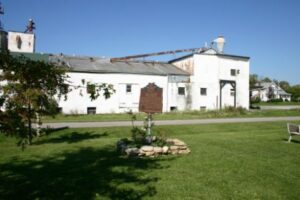
On April 19, 1891, a head-on collision between two trains of the Lake Shore and Michigan Southern Railway Company occurred at the Kipton depot. Eight people lost their lives, and the depot was heavily damaged. The crash occurred when a fast mail train heading east near Kipton and a passenger train going west from Elyria collided. The passenger train was supposed to let the mail train go by, but the conductor had not realized that his watch had stopped for four minutes and then restarted. As a result the passenger train was late getting to the stopping point. Looking into the matter, the railway company enlisted Webb C. Ball, a well-known Cleveland jeweler, to investigate time and watch conditions throughout its lines. Ball instituted the current railroad industry’s timekeeping program, which specified watches trainmen could use. His attention to accuracy and promptness led to the well-known saying, “Get on the Ball.”
, OH
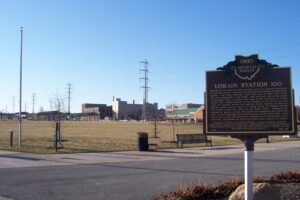
Prior to the Civil War, Ohio was a leading state for enslaved Americans of African decent traveling the Underground Railroad to freedom in Canada. For these fugitives, their final stop in Ohio was a Lake Erie port community in the north. One such port was at the mouth of the Black River in Lorain that came to be identified as Lorain Station 100, named because it was thought to be one of the last stops or stations before the fugitive slaves reached freedom in Canada. Many arrived here in a wagon driven by Robbins Burrell who owned a farm five miles up the Black River. Concealed by vegetables, grains, or hay, the slaves were smuggled into schooners, some of which belonged to Burrell’s cousin Captain Aaron Root. From Lorain Station 100, the determined travelers were transported across Lake Erie, completing the final leg of their long journey to freedom.
, OH
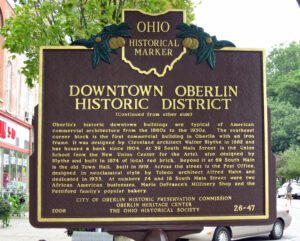
The intersection of Main and College streets has been the center of Oberlin since the town and college were founded in 1833. The first downtown buildings were made of wood and were destroyed by a series of spectacular fires. The first college building, Oberlin Hall, stood on the southwest corner of College and Main and included recitation rooms, a dining hall, chapel, offices, and lodging. In 1887, Akron architect Frank Weary designed the large brick building at numbers 5 to 13 West College. Number 23 West College (Gibson Block) once housed a silent movie theater on the second floor. East College Street’s historic buildings include the Apollo Theater, which showed Oberlin’s first talking movie on May 11, 1928. From 1897 to 1929, an interurban streetcar line connected Oberlin’s downtown to Cleveland. Oberlin’s downtown historic district was placed on the National Register of Historic Places in 2003.
, OH
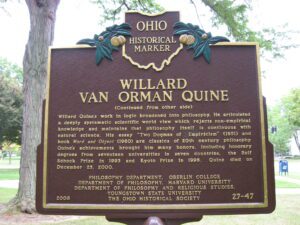
Willard Van Orman Quine was one of the greatest philosophers and logicians of the 20th century. Born in Akron on June 25, 1908, Quine studied philosophy and logic at Oberlin College (B.A. 1930). He received his Ph.D. in philosophy from Harvard University in 1932 and spent his entire career on the Harvard faculty, from 1956 to 1978 as Edgar Pierce Professor of Philosophy. Quine’s early research in logic led to his New Foundations system of set theory and to the Quine-McCluskey algorithm, used in computer science. His textbook Methods of Logic established the standards for undergraduate logic instruction. (Continued on other side)
, OH
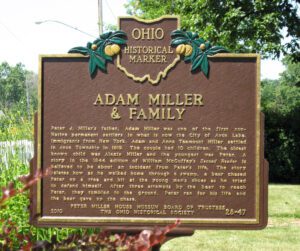
The Peter J. Miller House was constructed around 1830 and is one of the last remaining pre-Civil War lakefront houses in Lorain County. The architecture is Greek Revival. Peter Miller married Ruth Houseworth in 1828. They had five children. In 1851 Peter Miller died and it’s believed that his family continued to reside on the property until 1925. The City of Avon Lake purchased the property in 1962. The house was opened for tours, and restoration proceeded, as funds were available. In 1975 the water heating system burst and caused extensive damage. In 1985 a new committee took over and was successful in restoring the house. Volunteer trustees have overseen the operation of the house as a museum since September 1989.