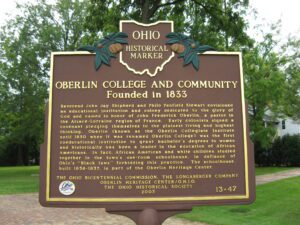
Reverend John Jay Shipherd and Philo Penfield Stewart envisioned an educational institution and colony dedicated to the glory of God and named in honor of John Frederick Oberlin, a pastor in the Alsace-Lorraine region of France. Early colonists signed a covenant pledging themselves to the plainest living and highest thinking. Oberlin (known as the Oberlin Collegiate Institute until 1850 when it was renamed Oberlin College) was the first coeducational institution to grant bachelor’s degrees to women and historically has been a leader in the education of African Americans. In fact, African American and white children studied together in the town’s one-room schoolhouse, in defiance of Ohio’s “Black laws” forbidding this practice. The schoolhouse, built 1836-1837, is part of the Oberlin Heritage Center.
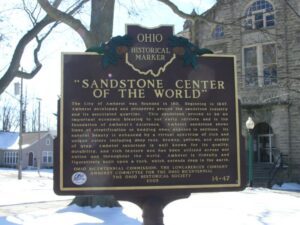
The City of Amherst was founded in 1811. Beginning in 1847, Amherst developed and prospered around the sandstone industry and its associated quarries. This sandstone proved to be an important economic blessing to our early settlers and is the foundation of Amherst’s existence. Amherst sandstone shows lines of stratification or bedding when exposed in sections. Its natural beauty is enhanced by a virtual spectrum of rich and unique colors including deep reds, browns, yellows, and shades of gray. Amherst sandstone is well known for its quality, durability, and rich texture and has been utilized across our nation and throughout the world. Amherst is literally and figuratively built upon a rock, which extends deep in the earth.
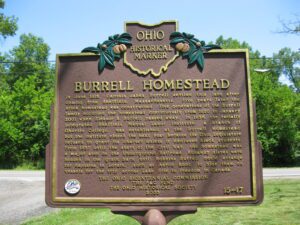
In June 1815, Captain Jabez Burrell settled this land after coming from Sheffield, Massachusetts. Five years later the brick homestead was constructed. Five generations of the Burrell family occupied the homestead continuously from 1820 to January 2001 when Eleanor B. Burrell passed away. In 1836, the racially integrated Sheffield Manual Labor Institute, a branch of Oberlin College, was established at the Burrell Homestead, but the Institute closed the next year because the Ohio Legislature refused to grant its charter unless it excluded black students. From 1837 until the start of the Civil War, the homestead was a major stop on the Underground Railroad. Runaway slaves were hidden in the grain barn until Robbins Burrell could arrange for captains in Lorain, such as Aaron Root, to hide them on vessels for the trip across Lake Erie to freedom in Canada.
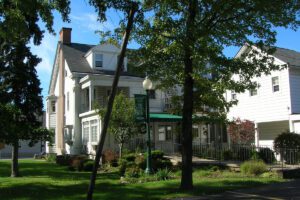
Monteith Hall was built in 1835 as the residence of Reverend John Monteith (1788-1868) and family. Before coming to Elyria as the first superintendent of the new high school, Rev. Monteith was an educator and minister in Detroit, Michigan. He was instrumental in founding the University of Michigan, originally located in Detroit, and became its first president. William Gates, Rev. Monteith’s grandson, enlarged Monteith Hall in 1897. Monteith Hall was a station on the Underground Railroad on the route that extended from Oberlin. A tunnel, which ran from the basement of the home to the Black River, was used to help slaves escape to the shore of Lake Erie. Rev. Monteith managed the network on the southern shore of Lake Erie, and aided fugitive slaves in boarding ships to cross the lake to Canada.
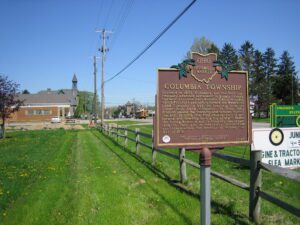
Founded in 1807, Columbia was the first continuously inhabited settlement in Lorain County. Harmon, Levi and Azor Bronson, Calvin Hoadley, Jared Pritchard and others formed the Waterbury Land Company to buy the township from the Connecticut Land Company. In 1808, Sally Bronson named the township and became its first teacher. In 1809, the first church society was formed and Hoadley built a log gristmill beside the Rocky River. A militia company was organized in 1810 and a two-story blockhouse was constructed for protection during the War of 1812.
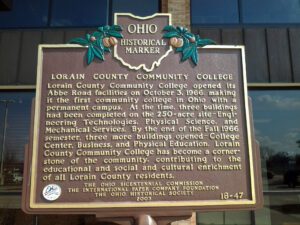
Lorain County Community College opened its Abbe Road facilities on October 3, 1966, making it the first community college in Ohio with a permanent campus. At the time, three buildings had been completed on the 250-acre site-Engineering Technologies, Physical Science, and Mechanical Services. By the end of the Fall 1966 semester, three more buildings opened-College Center, Business, and Physical Education. Lorain County Community College has become a cornerstone of the community, contributing to the educational and social and cultural enrichment of all Lorain County residents.
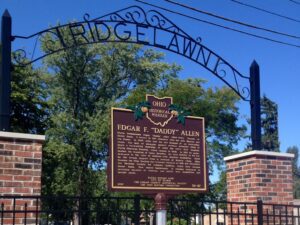
Elyria businessman Edgar “Daddy” Allen (1862 — 1937), founder of Easter Seals, is buried in this cemetery with his wife Blanche and son Homer. In 1907 Allen lost his son because of an interurban crash. The lack of adequate medical services prompted Allen to begin a fundraising campaign to build the city’s first hospital, Elyria Memorial Hospital, which opened in 1908. In 1915 he spearheaded the founding of Gates Hospital, the first facility in the U.S. dedicated to the care of children with physical disabilities. Aided by the strong support from a network of Rotary Clubs, Allen founded the Ohio Society for Crippled Children in 1919 and thereafter the National Society for Crippled Children, which later became Easter Seals. Now named Easterseals, it remains dedicated to providing services to children and adults with disabilities and special needs.
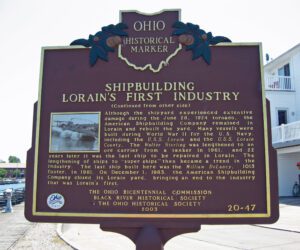
Lorain’s shipbuilding industry began when Augustus Jones and William Murdock began constructing wooden sailing vessels on the west side near the mouth of the Black River. The sloop General Huntington was the first boat launched from Lorain in 1819. In 1897, the shipbuilding industry moved to the east side of the river with the establishment of the Lorain yard of the Cleveland Shipbuilding Company, the precursor of the American Shipbuilding Company. In 1898, they were the largest dry dock on the Great Lakes. On April 13, 1898, the first steel ship, the Superior City, was launched. At the time, it was the largest vessel on fresh water. During the early years well-known passenger ships, railroad car ferries, tankers, self-unloaders, tugs, and barges were built here.