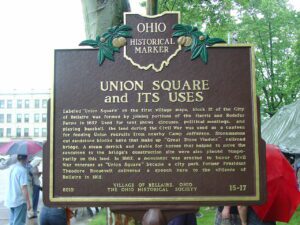
Labeled “Union Square” on the first village maps, block 12 of the City of Bellaire was formed by joining portions of the Harris and Rodefer Farms in 1857. Used for tent shows, circuses, political meetings, and playing baseball, the land during the Civil War was used as a canteen for feeding Union recruits from nearby Camp Jefferson. Stonemasons cut sandstone blocks here that make up “Great Stone Viaduct” railroad bridge. A steam derrick and stable for horses that helped to move the sandstone to the bridge’s construction site were also placed temporarily on this land. In 1882, a monument was erected to honor Civil War veterans as “Union Square” became a city park. Former President Theodore Roosevelt delivered a speech here to the citizens of Bellaire in 1912.
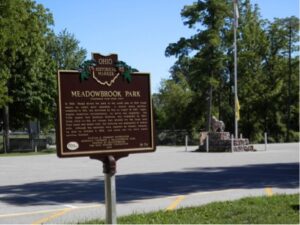
Meadowbrook Park began as a Tiffin, Fostoria & Eastern Electric Railway plan to draw weekend riders. Laura Stephenson Sneath, wife of a major company stakeholder, led the park development. Originally north of Wolf Creek, Meadowbrook included a baseball diamond and a 1902 dance pavilion. In 1923, William Richards purchased the buildings and leased the land from Henry Matthews of Matthews Boat Company. The pavilion was destroyed by fire under suspicious circumstances on October 12, 1925, but no one was charged. James Garfield Haugh, president of the Gem Manufacturing Company, purchased the land in 1925. (Continued on other side)
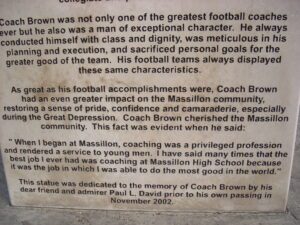
Paul E. Brown, born September 7, 1908 in Norwalk, Ohio, and raised in Massillon, is a member of the Professional Football Hall of Fame and was one of the greatest coaches in the history of football at all levels. From 1932 until 1940, he led Massillon High School to a record of 80-8-2. He coached Ohio State to the 1942 national collegiate championship, and joined the professional football ranks in 1946 as coach of the new franchise in Cleveland. He coached his namesake Cleveland Browns to seven league championships in 17 seasons.
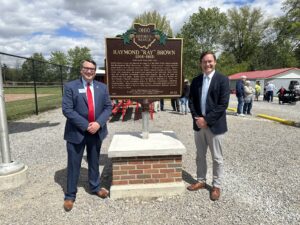
Raymond “Ray” Brown was a star in the Negro Leagues 1930-1948. Born in Alger on February 23, 1908, Brown graduated from Alger High School in 1926. He made his professional baseball debut playing for the Dayton Marcos in 1930. Brief stints with the Indianapolis ABCs and Detroit Wolves followed. In 1932, Brown joined Pittsburgh’s Homestead Grays mid-season and became a mainstay of their pitching staff for the next fourteen years. Utilizing a devastating curveball, he led the Grays to eight Negro National League pennants in a nine-year span (1937-1945). In 1938, he won the pitching triple crown and lead the league in wins, earned run average, and strikeouts. When the Negro League World Series was re-instituted in 1942, Brown’s team competed four straight years, winning twice. (Continued on other side)
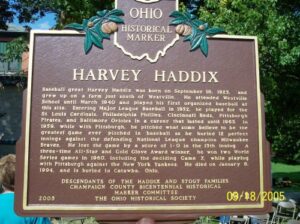
Baseball great Harvey Haddix was born on September 18, 1925, and grew up on a farm just south of Westville. He attended Westville School until March 1940 and played his first organized baseball at this site. Entering Major League Baseball in 1952, he played for the St. Louis Cardinals, Philadelphia Phillies, Cincinnati Reds, Pittsburgh Pirates, and Baltimore Orioles in a career that lasted until 1965. In 1959, while with Pittsburgh, he pitched what some believe to be the greatest game ever pitched in baseball as he hurled 12 perfect innings against the defending National League champion Milwaukee Braves. He lost the game by a score of 1-0 in the 13th inning. A three-time All-Star and Gold Glove Award winner, he won two World Series games in 1960, including the deciding Game 7, while playing with Pittsburgh against the New York Yankees. He died on January 8, 1994, and is buried in Catawba, Ohio.
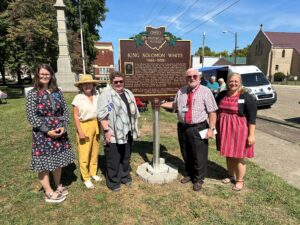
King Solomon “Sol” White was born in Bellaire on June 12, 1868. A Baseball legend, he was an all-around player, manager, and organizer in the Pre-Negro Leagues (1887-1912) and the Negro Leagues (1920-1926). White first played with integrated baseball clubs the Bellaire Globes (1884-1886) and Wheeling Green Stockings (1887). After 1887-1888 color barriers were imposed on baseball, White played on segregated minor league teams. They included: the Pittsburgh Keystones, Cuban Giants, York Colored Monarchs, Cuban X-Giants, Page Fence Giants, and Chicago Columbia Giants. As a coach, he helped organize and lead the powerhouse Philadelphia Giants to their 1904-1907 championships. White died on August 26, 1955, and was buried in an unmarked grave in Staten Island’s Frederick Douglas Memorial Cemetery. In 2006, “Sol” White was posthumously inducted into the Baseball Hall of Fame.
William Ellsworth “Dummy” Hoy was born in Houcktown on May 23, 1862. Although spinal meningitis as a toddler left him deaf and mute, Hoy became one of the great 19th century professional baseball players. He played centerfield for such teams as the Chicago White Stockings, Louisville Colonels, and Cincinnati Reds. In his 1888 Washington Senators season he led the league with 82 stolen bases and is one of the all-time leaders in that art. The defensive star’s record includes: 3,959 outfield putouts; 73 double plays; 2,054 hits; 40 home runs; 597 stolen bases; and, 210 strike-outs. Hoy is a member of the American Athletic Association for the Deaf Hall of Fame, as well as those of the Cincinnati Reds, Ohio Baseball, and Ohio School for the Deaf. He died in Cincinnati at the age of 99.
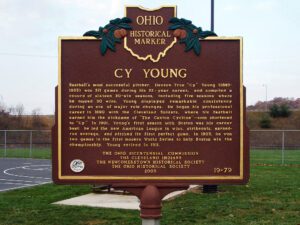
Baseball’s most successful pitcher, Denton True “Cy” Young (1867-1955) won 511 games during his 22-year career, and compiled a record of sixteen 20-win seasons, including five seasons where he topped 30 wins. Young displayed remarkable consistency during an era of major rule changes. He began his professional career in 1890 with the Cleveland Spiders, where his fastball earned him the nickname of “The Canton Cyclone”–soon shortened to “Cy.” In 1901, Young’s first season with Boston was his career best: he led the new American League in wins, strikeouts, earned-run average, and pitched its first perfect game. In 1903, he won two games in the first modern World Series to help Boston win the championship. Young retired in 1911.