

, OH
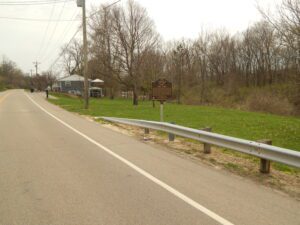
Thomas Burk Sr. purchased a quarter section of federal land here in 1804. A school house was erected on this purchase in 1809. That same year, a road from Williams’ Mill (Millville) was blazed and a saw mill was built on Indian Creek west of this marker. Obadiah Welliver opened a tavern on his purchase in 1812. Burk sold his grist mill in 1818 and it is thought that the hamlet around this mill was called Dogtown because of a vicious dogfight there. In 1825, Reily Post Office was established at Welliver’s Tavern. That year a woolen mill with textile production machinery was built by Elias Sayres, near the saw mill. Multi-millionaire Elias Jackson (“Lucky”) Baldwin (1828-1909), the founder of Santa Anita Racetrack near Los Angeles, was born here.
, OH
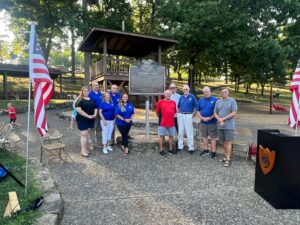
Tuscora Park, on land once owned by Jeremiah Reeves, opened as a private amusement park on June 1, 1907. Despite rain, the grand opening brought thousands of visitors to the park. Throughout the summer months, large crowds enjoyed such features as a swimming pool, sea wave, restaurant, dancing pavilion, and twice-daily free band concerts. The park also featured athletic facilities for running, tennis, baseball, and bowling. After Tuscora Park was sold in a November 1911 Sheriff’s sale, New Philadelphia’s City Council authorized its purchase along with additional surrounding acreage and received the deeds on June 21, 1912. Originally billed as the “Coney Island of Eastern Ohio,” Tuscora continues to operate as a city-owned park that draws both local residents and visitors to its picnic grounds, vintage rides, swimming pool, and athletic facilities. (Continued on other side)
, OH
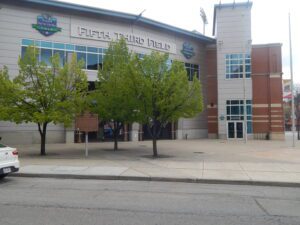
Moses Fleetwood Walker was born on October 7, 1856 in Ohio to Moses M. Walker, a physician, and Caroline, a midwife. He attended and played baseball at Oberlin College and the University of Michigan. In 1883, Walker joined the newly formed Toledo Blue Stockings and became the first African American major league ballplayer when Toledo joined the Major League-sanctioned American Association the following year. As a barehanded catcher, his biggest assets were his catching ability, powerful throwing arm, and aggressive base running. He endured racial prejudice from teammates, opponents, and baseball fans, and eventually left to become a writer, inventor, civil rights advocate, and entrepreneur. Walker was elected to the Ohio Baseball Hall of Fame in 1991. He died in 1924 and is buried in Stuebenville, Ohio in the family plot at Union Cemetery.
, OH
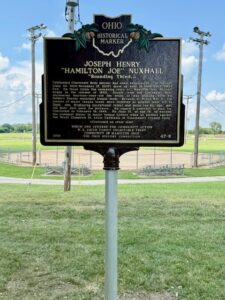
Celebrated Cincinnati Reds pitcher and radio broadcaster, Joe Nuxhall (July 30, 1928 – November 15, 2007) grew up here in Hamilton’s North End. On these fields the endearing story of “Hamilton Joe” Nuxhall began in the summer of 1943. Scouts from the Cincinnati Reds discovered fourteen-year-old Joe while he was playing with his father’s Sunday municipal league team. Because of World War II, the rosters of major league teams were depleted as players went off to fight. Joe, displaying exceptional talent and poise for his age, met the Reds’ dire need for pitchers. He signed a contract to play for Cincinnati on February 18, 1944. On June 10, at age 15, he became the youngest player in major league history when he pitched against the World Champion St. Louis Cardinals at Cincinnati’s Crosley Field. (Continued on other side)
, OH
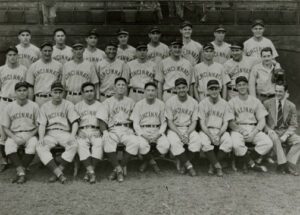
The 1869 Cincinnati Red Stockings made history not only as the most dominant baseball club of its time, but also as the first band of professional ballplayers. Cincinnati’s decision to pay players proved to be a success, and other cities soon began establishing their own professional clubs throughout America. In 1876, the Reds joined the newly formed National League. Baseball soon became one of Cincinnati’s most popular entertainment venues, aided in part by the team’s World Series titles in 1919 and 1940. Cincinnati’s “Big Red Machine,” featuring players such as Johnny Bench, Joe Morgan, and Pete Rose, dominated baseball in the 1970s, picking up additional titles in 1975 and 1976. A surprise wire-to-wire title again in 1990 strengthened the Reds’ legacy and helped ensure future generations of Reds fans.
, OH
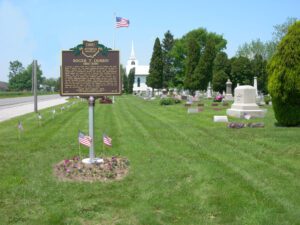
According to fellow World War II veteran and U.S. Senator Bob Dole, Roger T. Durbin was “the public persona—the beacon—of the drive to build a National World War II Memorial in our nation’s capital.” It started with a conversation between Mr. Durbin and Congresswoman Marcy Kaptur at a local fish fry in February 1987. Enlisting Kaptur’s support, the work to create the memorial began. Described as a “gentleman with a square jaw, twinkling eyes, and churlish grin,” Mr. Durbin committed himself to serving others. He was a rural letter carrier, Richfield Township trustee, and coached Little League baseball. He was a veteran of the Tenth Armored (Tiger) Division and saw action at the Battle of the Bulge. The National WWII Memorial was dedicated May 29, 2004. Although Mr. Durbin did not live to see that day, his determination is the reason it stands.
, OH
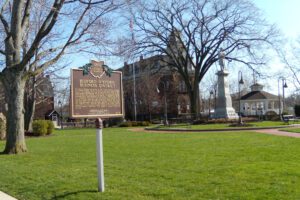
The town of Bedford was settled in 1837. Early residents, Hezekiah and Clarissa Dunham donated the land that serves as Bedford Public Square. The Dunhams built one of the area’s first homes in 1832, which stands at 729 Broadway with the letters H & D above the doorway. Early settlers were attracted to the area by the abundance of natural resources and a large waterfall for mill sites. Bedford also served as a stagecoach stop on the route from Cleveland to Pittsburgh. The road or Turnpike Road as it was called was originally part of the Mahoning Indian Trail. By 1895 the road was renamed Main Street (and later Broadway) when the Akron, Bedford, and Cleveland Railway Company (ABC) traversed the middle of the street carrying passengers. The interurban is called “America’s first high speed long distance electric interurban” with speeds in excess of 60 miles per hour. [continued on other side]
, OH
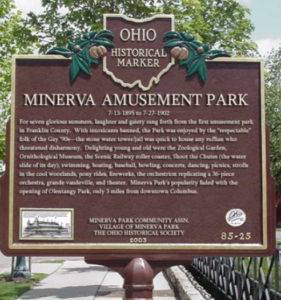
For seven glorious summers, from July 13, 1895 to July 27, 1902, laughter and gaiety rang forth from the first amusement park in Franklin County. With intoxicants banned, the Park was enjoyed by the “respectable” folk of the Gay ’90s – the stone water tower/jail was quick to house any ruffian who threatened disharmony. Delighting young and old were the Zoological Garden, Ornithological Museum, the Scenic Railway roller coaster, Shoot the Chutes (the water slide of its day), swimming, boating, baseball, bowling, concerts, dancing, picnics, strolls in the cool woodlands, pony rides, fireworks, the orchestrion replicating a 36-piece orchestra, grande vaudeville, and theater. Minerva Park’s popularity faded with the opening of Olentangy Park, only 3 miles from downtown Columbus.