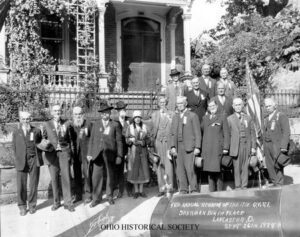
The 17th Infantry, created by Congress in 1812 and formed with personnel from western states, was the only Regular Army regiment in General James Winchester’s column of the Army of the Northwest’s campaign to regain Detroit. During the War of 1812, the 17th fought at Frenchtown, Fort Meigs, Fort Stephenson, and Thames River. In 1815, the 17th was consolidated with the 5th, 19th, and 28th Infantry to form the 3rd Infantry. In May 1861, the 17th Infantry was again organized as a Regular Army regiment and has since served continuously with distinction.
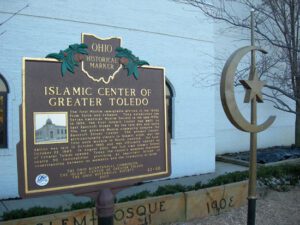
The first Muslim immigrants arrived in the 1900s from Syria and Lebanon. They established the Syrian American Muslim Society in the late 1930s. In 1954, the first Islamic Center was built on East Bancroft Street. By the late 60s and early 70s, the growing Muslim community outgrew the Bancroft Street Center. The present Center, architecturally classic in Islamic style, was the first such mosque in North America. Its foundation was laid in October 1980 and was officially opened on October 22, 1983. In August 2001, the full time Islamic School of Greater Toledo opened. Today, the Center’s members represent nearly 30 nationalities, providing an important bridge of understanding between its members and the community at large.
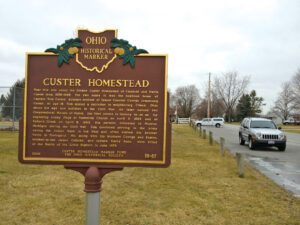
Near this site stood the former Custer Homestead of Emanuel and Maria Custer from 1856-1865. For two years it was the boyhood home of Captain Tom Custer, younger brother of famed General George Armstrong Custer. At age 16, Tom misled a recruiter in neighboring Gilead, Ohio about his age and enlisted in the Civil War. He later earned two Congressional Medals of Honor, the first person in history to do so, for capturing enemy flags at Namozine Church on April 3, 1865 and at Sailor’s Creek on April 6, 1865. His parents relocated to Monroe, Michigan during the Civil War. Tom continued serving in the Army during the Indian Wars in the West and often visited his brother Nevin in Tontogany. He, along with his brothers George and Boston, brother-in-law James Calhoun, and nephew Harry Reed, were killed at the Battle of the Little Bighorn in June 1876.
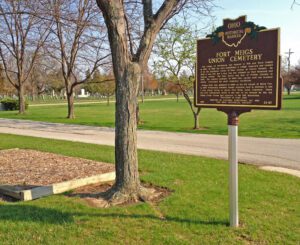
The village of Perrysburg was founded in 1816 and Wood County in 1820. In 1822 the town established a village cemetery and located it on the southwest corner of West Indiana at Cherry Streets. By 1848 it was full and a new one was created on West Boundary and Indiana Avenue. The first burial was that of William Cassady in 1849. The cholera epidemic of 1854 that caused over one hundred deaths, overloaded the small cemetery workforce. Potters Field was designed in 1868 on the NW corner of Block Two. In 1877 Perrysburg Township bought adjacent land in sections K and L and joined forces to create Fort Meigs Union Cemetery. There are nine underground vaults in the side of the terrace by the old Ewing Creek stream bed adjacent to the 1912 mausoleum.
The site of Owens Community College, the Rossford Army Ordnance Depot played a supporting role in the United States’ victory in World War II and in national defense during the Cold War. From 1942 until 1945, the Rossford Ordnance Depot served as a distribution center for military vehicles during World War II. The complex also housed an ammunition storage depot. Virtually a city within itself, it featured an extensive railroad and road grid. Following World War II, the Depot remained a major site for military vehicles but expanded its mission to include tool storage and distribution. On July 1, 1963, General Orders No. 28 deactivated the facility from the United States Army Material Command.
The North Baltimore Elementary and High School stood at 124 S. Second St. and was dedicated November 11, 1927. The tan and brown brick building replaced a school (built 1884) that a fire destroyed on January 26, 1926. The new school building, for children in grades 1-12, also included classrooms for home economics and business courses, as well as a 900-seat auditorium (including balcony), second floor cafeteria, gymnasium, administrative offices, and a public library. E.E. Leidy was the school’s superintendent and R. Vern Northup was the high school principal. The members of the board of education were Dr. E.A. Powell, President, D.B. Bushey, Vice President, C.G. Nigh, Clerk, and Nellie Roberts and R.E. Simon. Previously known as the “Independents,” the school’s sports teams became the “Tigers” in 1931. (Continued on other side)