

, OH
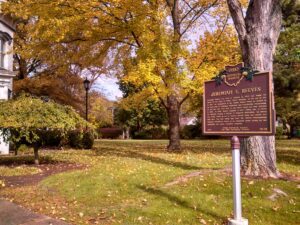
Jeremiah Reeves was born in England in 1845 and began his career in the mills of Wales, United Kingdom, at the age of ten. In 1867, he immigrated to the United States where he worked in the steel mills of Cleveland, Pittsburgh, and Connellsville, Pennsylvania. He met his wife Jane Rees in the latter place and they married in 1869. In 1883, Reeves acquired a steel rolling mill in Dover for $14,000. Despite a history of financial difficulties, the Reeves Iron Works would go on to expand several times and employ over 800 men. The iron works and later the Reeves Manufacturing Company established Dover as an industrial center during the late nineteenth and early twentieth centuries.
, OH
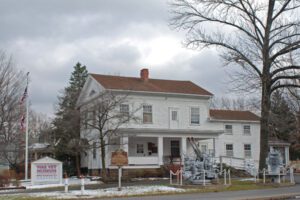
The Canfield War Vet Museum was chartered in 1988 by American Legion Post 177 and Ladies Auxiliary to collect and preserve items and history from American wars. The building that houses the museum was built in 1809 by Comfort S. Mygatt, a Revolutionary War veteran, and later, passed through several generations of the Church family. Colonel James Madison Nash, a Civil War officer, lived here for a time, giving the house its nickname, “The Colonel’s House.” The structure stands as the oldest building in Canfield on its original site. The carding barn on the rear of the property was built in 1810 to process sheep wool. The Wall of Honor at this site honors war veterans, in particular, the Revolutionary War veterans interred in Canfield cemeteries and the 18 Canfield men who lost their lives in World War II.
, OH
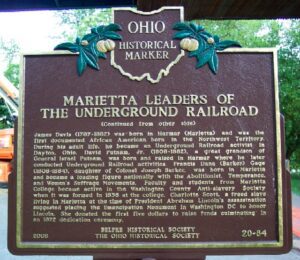
People living in Marietta and along the Muskingum River shared a history of slavery opposition. Manasseh Cutler, from Massachusetts and an Ohio Land Company agent, helped draft the Ordinance of 1787 that prohibited slavery in the Northwest Territory. General Rufus Putnam, Captain Jonathan Stone, and other Ohio Land Company Revolutionary War veterans, founded Marietta at the mouth of the Muskingum River in 1788 bringing with them their anti-slavery sentiments. A proposal to legalize slavery in the proposed state of Ohio was vetoed largely due to the efforts of Marietta’s Ephraim Cutler and General Putnam at the 1802 Ohio Constitutional Convention. These conditions were precursors toward the formation of the Underground Railroad as fugitive slaves crossed the Ohio River seeking freedom. From 1812 through 1861, large numbers of fugitive slaves fleeing toward Canada, were aided by descendants of early settlers who operated Underground Railroad Stations along the Muskingum River. (Continued on other side)
, OH
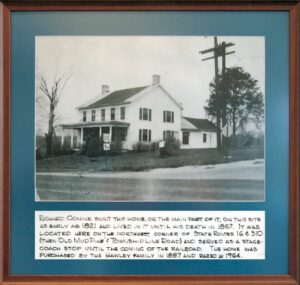
Born in New Jersey, Richard and Sarah Conine, the founders of the village of Pataskala, moved to Lima Township and lived on this site as early as 1821 when Richard established a grist mill nearby. Their homestead also served as a stagecoach stop on the mud pike between Columbus and Newark prior to the coming of the railroad. Richard platted “Conine Town” south and west of here in 1851, and the town was renamed Pataskala soon after. The public-spirited Conines contributed to the building of several area schools and churches and donated land for the Pataskala Cemetery. After their deaths, Sarah’s nephew Jacob Van Dorn inherited the property. John Hawley purchased the home in 1887 and for many years it was known as “The Hawley House.” It was demolished in 1964 to make way for commercial development.
, OH
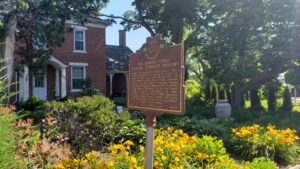
In 1809-1811, Magdalene Strader Borror, widow of Revolutionary War veteran Jacob Borror Jr., moved to this area from Virginia with her seven children (Martin, Jacob, Myomi, Solomon, Christine, Issac, and Absalom). Originally clearing and settling 400 acres of land given to Magdalene by her father, Christopher Strader, the family eventually prospered throughout the entire township. After her death in 1838, Magdalene was buried in nearby Scioto Cemetery, the resting place of more than seventy of her descendants.
, OH
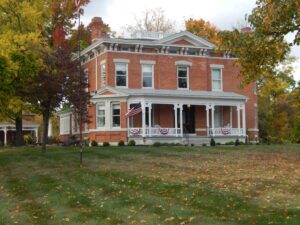
Built of bricks of clay from the Little Miami River, the King Mansion has stood majestically overlooking the town of Kings Mills since 1885. The home of industrialist Ahimaaz King and the first house in Kings Mills, this 12-room, three-story Italianate-style house is crowned with a widow’s walk and features stained-glass windows, distinctive fireplaces, and a tack room. The carriage house included a milking operation for cows on the lower level, stables on the main level, and carriage storage on the upper level. A cast iron fountain in the yard gave the name “Fountain Square” to the area. Occupied by three generations of Kings until 1988, the mansion was added to the National Register of Historic Places in 2008 and is a reminder of Ahimaaz King’s importance to the history of Kings Mills.
, OH
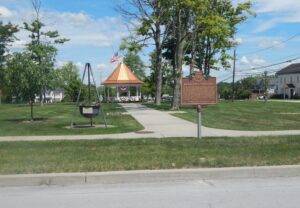
In 1798, Judge Samuel Hinckley of Northampton, Massachusetts, drew the 72nd draft in the land lottery held by the Connecticut Land Company and received 15,305 acres in Township 4, Range 1, for which he paid $12,903.23, less than one dollar per acre. The area had been inhabited for many years by trappers, missionaries, and Native Americans. One of the earliest settlers was James McMullen, who acquired the first 160-acre parcel from Hinckley in 1801. Brookfield Township became the crown jewel of Hinckley’s holdings. Hinckley named Brookfield after a city in England and set aside land for the village green and the cemetery stating that they were for public use forever. During the mid-1820s the Overland Stage Line had a run through Brookfield, linking it to Salem, Warren, and Youngstown in Ohio and Erie, Pennsylvania and Dunkirk, New York. (Continued on other side)
, OH
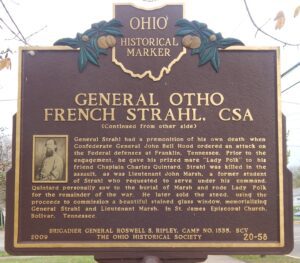
Born in 1832, Otho French Strahl grew up in Malta Township, Morgan County, Ohio. After attending Ohio Wesleyan University and teaching in a schoolhouse that stood on this site, he moved to Tennessee, becoming a successful attorney and landowner. Following the attack on Fort Sumter and President Abraham Lincoln’s call to arms, Strahl chose to stay and fight with his adopted state. Despite his northern roots, he was elected Captain of the Dyers Guards, his local volunteer unit in Tennessee. Two years later, he attained the rank of brigadier general in the Confederate army and served with distinction in some of the bloodiest battles of the Civil War. At the age of 32, Strahl was one of six Confederate generals killed or mortally wounded at the Battle of Franklin. He is buried in Old City Cemetery in Dyersburg, Tennessee. (continued on other side)