

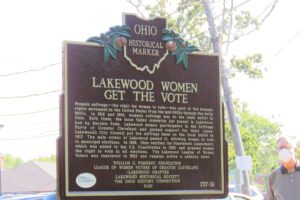
, OH
Women’s suffrage–the right for women to vote–was part of the women’s rights movement in the United States from the mid-1800s through the early 1900s. In 1912 and 1914, women’s suffrage was on the state ballot in Ohio. Both times, the issue failed statewide but passed in Lakewood. Led by Bernice Pyke, Lakewood women participated in the Suffrage Party of Greater Cleveland and gained support for their cause. Lakewood’s City Council put the suffrage issue on the local ballot in 1917. The male voters of Lakewood passed it, allowing women to vote in municipal elections. In 1919, Ohio ratified the Nineteenth Amendment, which was added to the U.S. Constitution in 1920 and granted women the right to vote in all elections. The Lakewood League of Women Voters was chartered in 1922 and remains active a century later.
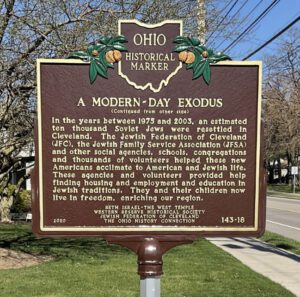
, OH
Here in 1963 congregants of Beth Israel-The West Temple, led by Louis Rosenblum, Herb Caron, and Rabbi Daniel Litt, founded the Cleveland Committee (later Council) on Soviet Anti-Semitism, the first American organization created to advocate for freedom for Soviet Jews. In 1970 this work led to the formation of the Union of Councils for Soviet Jews (UCSJ) under the leadership of Louis Rosenblum. The UCSJ, whose national office was located here 1970-1973, became the largest independent Soviet Jewry organization in the world. By the turn of the 21st century, the efforts begun here helped 1.6 million Jews leave the former Soviet Union. (Continued on other side)
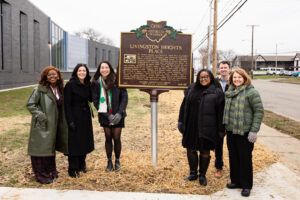
, OH
Dr. Harley Manuel and Charles E. Jones were frustrated by the restrictive covenants and redlining that kept Black residents from purchasing homes in desirable Columbus neighborhoods. Deciding to create their own neighborhood, the two men purchased 10.5 acres of farmland in March 1945. They divided it into 42 lots that became Livingston Heights Place. The first lots were sold to pharmacist Waldo W. and Harriet Tyler in 1946. Other early residents included Edward J. Cox, William and Esther Toler, David D. White, Dr. William K. Allen, and Dr. Harry Jefferson. Later residents were Dr. John H. Rosemond, Llewellyn (Jack) A. Coles, Captain Amos A. Carter Jr., Sammy Hopkins, William “Bill” Willis, and Dr. Richard Ruffin. Twenty homes were built between 1948 and 1967 within the subdivision’s boundaries of Johnson Park, Livingston, Byron, and Waverly.
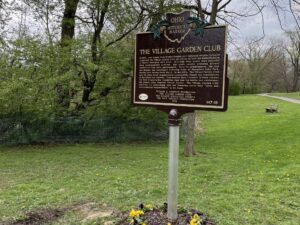
, OH
In 1930, nine women from Shaker Heights and Cleveland Heights formally organized The Village Garden Club and set as its goal the beautification of Shaker Parklands with trees. At a time when women were excluded from environmental activism, the club’s careful planning allowed members to lead civic improvements. Since its establishment, the club has planted and maintained flowering trees at Horseshoe Lake Park, pausing only during World War II. In the 1960s, The Village Garden Club and 34 other local organizations successfully fought the construction of the Clark-Lee Freeway. Club member Mary Elizabeth Croxton chaired the Park Conservation Committee that won the battle and established the Shaker Lakes Regional Nature Center. The Village Garden Club continues its stewardship over the flowering grove with “civic and environmental responsibility” as its focus.
, OH
Civil unrest rocked the Hough neighborhood for five nights during the summer of 1966.When the white owners of the Seventy-Niners Cafe refused to serve a Black customer a glass of water, a sign bearing a racial epithet subsequently appeared outside the bar. Decades of institutionalized racial practices that had caused Hough’s substandard and overcrowded housing, high unemployment, economic exploitation, lack of access to quality education, and systemic police harassment sparked an urban uprising in response on July 18. Angry crowds gathered outside the bar only to be confronted by the owners brandishing firearms. When the police belatedly responded, tensions escalated into targeted firebombing, looting, and vandalism. On Tuesday night, July 19, Cleveland’s Mayor Ralph Locher requested that the Ohio National Guard restore order. (Continued on other side)
, OH
The Greater Abyssinia Baptist Church (GABC) organized with 250 members on December 16, 1945, at a Phillis Wheatley Association meeting. Led by its first pastor, Rev. John Rollins Plummer, the congregation raised $47,000 to purchase the Jewish Synagogue at East 105th Street and Tacoma Avenue from the Beth Hamedrosh Hagodel Beth Israel Congregation in 1946. It later purchased a parsonage, land for parking, and created a Federal Credit Union. Tragically, Rev. Plummer was killed in a car accident on October 22, 1951. The church’s lower auditorium was remodeled and dedicated as J.R. Plummer Memorial Hall. Honoring its missionary and pastoral care foundations, the church built a $3M senior citizens complex nearby. An endowment fund, instituted by its pastor’s savings in 1995, ensures that this commitment to civic leadership endures.
, OH
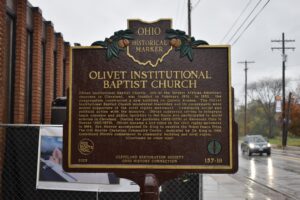
Olivet Institutional Baptist Church, one of the largest African American churches in Cleveland, was founded in February 1931. In 1950, the congregation constructed a new building on Quincy Avenue. The Olivet Institutional Baptist Church ministerial leadership and its congregants were ardent supporters of the civil rights movement. Combining social and political action with the ministry, Olivet supported sit-ins to integrate lunch counters and public facilities in the South and participated in social activism in Cleveland. During the pastorate (1952-1973) of Reverend Odie M. Hoover (1921-1973), Olivet became a key voice in the civil rights movement. In 1964, Rev. Hoover accompanied Dr. King to receive the Nobel Peace Prize. The O.M. Hoover Christian Community Center, dedicated by Dr. King in 1966, symbolized Olivet’s commitment to community building and civil rights. (Continued on other side)
, OH
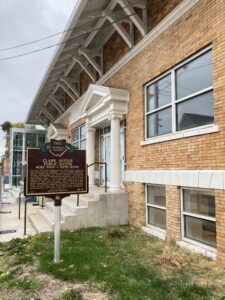
In the early 20th century, the City of Cleveland began opening public bath houses as a way to address the unsanitary living conditions of its overcrowded immigrant neighborhoods. Opened in January 1908, the Clark Avenue Bath House was Cleveland’s third public bath house. It cost $32,000 to build and was designed by prominent Cleveland architect Charles F. Schweinfurth. The semi-Colonial building featured heavy Ionic columns that framed the two entrances marked for “Men” and “Women” overhead. Clark Avenue Bath House had 35 private shower “cabinets,” two group showers, locker rooms, and a gymnasium with a spectator gallery. By 1921, seven such bath houses served the city. Today, five remain and four continue to offer public services to their neighborhoods as Neighborhood Resource and Recreation Centers.