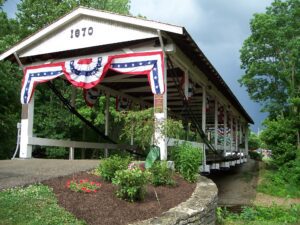
Restored in 1963, the Germantown Covered Bridge on East Center Street, spanning Little Twin Creek, was 93 years old and is reputed to be the only existing covered bridge of its kind in the world. For 41 years this unique inverted bow string truss covered bridge spanned Little Twin Creek on the Dayton Pike in Germantown, Ohio. In 1911 it was removed to its present location where it has been restored and beautified as a link with Ohio’s early history. It is a symbol of individual initiative in America’s early history.
Intersection of S. Sandusky Street & Olentangy Avenue
Delaware
, OH
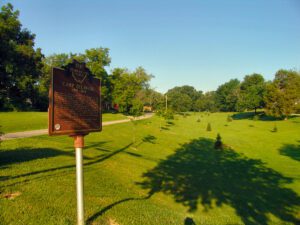
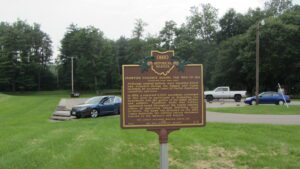
Near this site, the Union army established two camps on either side of the Olentangy River during the Civil War. Both were known as Camp Delaware. The first camp, situated on the west side of the river in the summer of 1862, was where the white recruits of the 96th and 121st regiments of Ohio Volunteer Infantry were mustered into service. A second camp, on the east side of the Olentangy, was established in the summer of 1863 and became the rendezvous point for most African-American Ohioans joining the army. The 127th Regiment of Ohio Volunteer Infantry-later renamed the 5th Regiment United States Colored Troops, the 27th U.S. Colored Troops, and members of other African-American units were mustered into service at Camp Delaware.
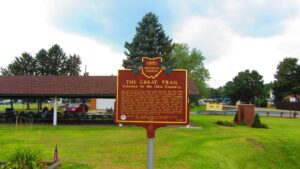
The ancient trail that passed near this spot was the major overland route entering the Ohio Country from the east through the 1700s. Also known as the Tuscarawas Path, the Great Trail was used by Native Americans, European explorers, fur traders, missionaries, military expeditions, land agents-and settlers after Ohio became a state. In January 1761, during the French and Indian War, Major Robert Rogers and thirty-eight rangers passed en route to Fort Pitt after taking Fort Detroit from the French. In 1764, during “Pontiac’s Conspiracy,” Colonel Henry Bouquet crossed here with an army of 1,500 men on his way to Goshachgunk (Coshocton), where he treated with the Delaware and freed captives. During the American Revolution, the Continental Army under General Lachlan McIntosh camped here for two days in November 1778.
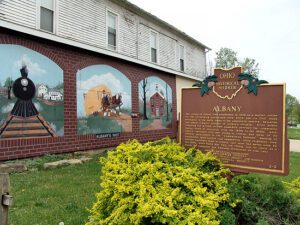
The village of Albany was established in 1838 as a market center for the surrounding agricultural area, which saw its first white settlement in the early years of the nineteenth century. Education was always a major concern of Albany’s citizens. Since public schooling was minimal, private academies provided the community various levels of education from the 1840s to the 1880s. Anti-slavery sentiment also was strong in Albany, and many of its citizens participated in the “Underground Railroad.” Because of educational opportunities and sympathetic white neighbors, free African-Americans came to Albany, but most had moved away by the 1930s. After World War Two, the village lost its status as a center for commerce and business.
Tensions between Native Americans and Euro-American settlers remained high on the Ohio frontier during the War of 1812. Grievances mounted rapidly following the forced removal of the Greentown Delawares to Piqua in the late summer of 1812. On September 10, British-allied Indians attacked and killed the Frederick Zimmer family and neighbor Martin Ruffner one mile north of here. Five days later, on September 15, Reverend James Copus and three militiamen–George Shipley, John Tedrick, and Robert Warnock–were killed while defending Copus’ family from a raiding party one mile south of this site. (continued on other side)
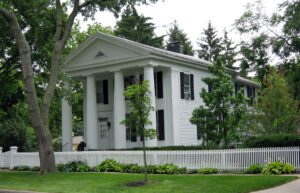
Theodore Dreiser wrote in 1900 his famous novel, Sister Carrie, in this house. It was built in 1835 and altered to Greek Revival Style in 1844. Dreiser acquired it in 1899. The house possesses most of the features typical of the American “classic temple” including four Doric columns rising the full length of the structure. In 1967 the house is owned by the William M. Hankins family.
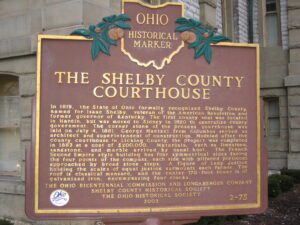
In 1819, the State of Ohio formally recognized Shelby County, named for Isaac Shelby, veteran of the American Revolution and former governor of Kentucky. The first county seat was located in Hardin, but was moved to Sidney in 1820 to centralize county government. The corner stone of the present courthouse was laid on July 4, 1881. George Maetzel from Columbus served as architect and superintendent of construction. Modeled after the county courthouse in Licking County, the project was completed in 1883 at a cost of $200,000. Materials, such as limestone, sandstone, and marble arrived by canal boat. The French Second Empire style building has four symmetrical sides facing the four points of the compass, each side with pillared porticoes approached by broad stone steps. A figure of Lady Justice holding the scales of equal justice surmounts each facade. The roof is classical mansard, and the center170-foot tower is of galvanized iron, encompassing four clocks.
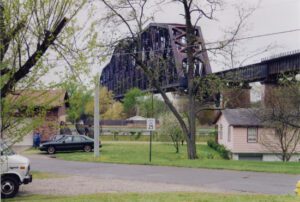
Sciotoville Bridge, 1917, designed and built by two famous American Civil Engineers, Gustav Lindenthal, D.Sc. (1850-1935), the Consulting Engineer (and) David Barnard Steinman, D.Sc. (1887-1960), the designer and stress analyst. A double track railroad bridge of twin spans each 775 feet long, it remained until 1935 the longest continuous truss bridge in the world and stands today as the prototype for continuous structures. Its construction marked a major advance in the art of bridge engineering and was a pioneer achievement in continuous truss analysis. In beauty of design, size and erection techniques it stands as a landmark of progress in man’s mastery of his environment.