

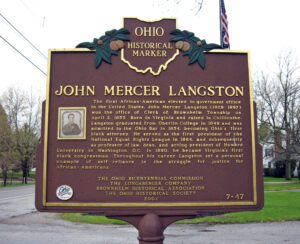
, OH
The first African-American elected to government office in the United States, John Mercer Langston (1829-1897) won the office of Clerk of Brownhelm Township on April 2, 1855. Born in Virginia and raised in Chillicothe, Langston graduated from Oberlin College in 1849 and was admitted to the Ohio Bar in 1854, becoming Ohio’s first black attorney. He served as the first president of the National Equal Rights League in 1864, and subsequently as professor of law, dean, and acting president of Howard University in Washington, D.C. In 1890, he became Virginia’s first black congressman. Throughout his career Langston set a personal example of self-reliance in the struggle for justice for African-Americans.
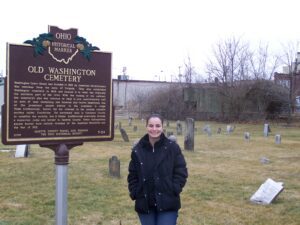
, OH
Washington Court House was founded in 1810 by American Revolutionary War veterans from the state of Virginia. They also established Washington Cemetery in 1810 and located it in what was originally the southern part of the town. With the coming of the railroad, the cemetery’s size was reduced to what is now approximately half an acre of land containing one hundred and twelve headstones. One of the prominent people buried in the cemetery is Judge Wade Loofborough, known for his interest in the utopian socialist society called Fourierism. He purchased land in Clermont County to establish the society, but it failed. Loofborough eventually became a respected judge and lawyer in Fayette County. Other distinguished people buried here include veterans of the American Revolution and the War of 1812.
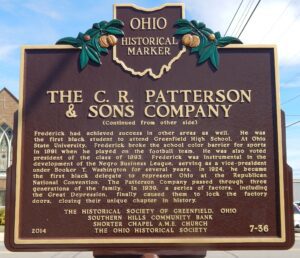
, OH
The factory of the C. R. Patterson & Sons Company once stood near here at 138 N. Washington Street. Established in the mid-nineteenth century by the black businessman Charles Richard (C. R.) Patterson and his white partner, J. P. Lowe, the business, originally known as J. P. Lowe & Company, became a successful carriage firm. Patterson became the sole owner in 1893 and changed the name to C. R. Patterson & Sons. After succeeding his father as owner, C. R.’s son, Frederick, became the first known African-American automobile manufacturer. Under his leadership, the company transitioned from building carriages to automobiles, then to trucks and buses to keep up with the changing demands of the transportation industry. (Continued on other side)
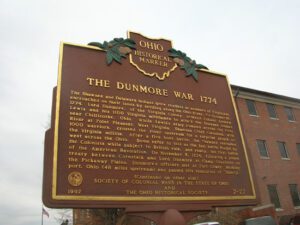
, OH
The Shawnee and Delaware Indians grew restless as numbers of Virginians encroached on their lands by settling along the Ohio River. On October 10, 1774, Lord Dunmore, of the Virginia Colony, ordered Colonel Andrew Lewis and his 1100 Virginia militiamen to attack the Shawnee Indians near Chillicothe, Ohio. While Lewis’s army camped across the Ohio River at Point Pleasant, West Virginia, Shawnee Chief Cornstalk, with 1000 warriors, crossed the river upstream for a surprise attack on the Virginia militia. After a five hour battle, the Shawnee retreated west across the Ohio. Some refer to this as the last battle fought by the Colonists while subject to British rule, and really, the first battle of the American Revolution. On November 5, 1774, following a peace treaty between Cornstalk and Lord Dunmore at Camp Charlotte on the Pickaway Plains, Dunmore’s officers met at Fort Gower, Hockingport, Ohio (48 miles upstream) and passed this resolution of “liberty”: (continued on other side)
, OH
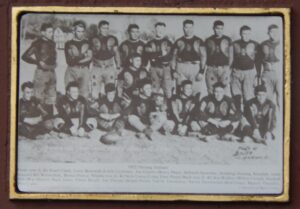
The Oorang Indian football team was founded by LaRue native Walter Lingo (1890-1966), owner of the Oorang Airedale Dog Kennels. The team, comprised of Native American Indians, played in the National Football League (NFL) in 1922-23. The star player and coach was Jim Thorpe (1887-1953), a Sac and Fox Indian. Thorpe gained international fame as a two-time gold medal winner (decathlon and pentathlon) in the 1912 Olympics and was acclaimed as the “World’s Greatest Athlete.” The team gave LaRue the distinction of being the smallest community ever to have an NFL franchise.
, OH
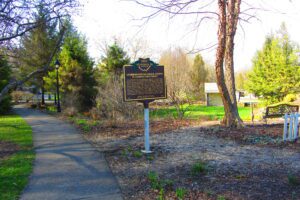
The Muskingum River forms at the confluence of the Tuscarawas and Walhoning rivers at Roscoe Village and flows south approximately 100 miles to the Ohio River at Marietta. During the first half of the nineteenth century, fugitive slaves from Virginia crossed the Ohio River and followed the Underground Railroad lines north toward Canada. Four Underground Railroad lines converged in Roscoe Village on the Muskingum River. The first followed the river north out of Marietta through Rainbow and Waterford. An Ohio River crossing at Belpre connected runaways with the Muskingum River at Putnam in Muskingum County. Two others came from the west through Granville in Licking County and New Concord in Muskingum County. From Roscoe Village, fugitive slaves sometimes traveled from station to station along the Ohio-Erie Canal that was completed in 1825. The canal ended at Lake Erie where the runaway slaves were assisted in crossing into Canada.
, OH
In 1817 the United States government signed a treaty with a number of Native American tribes in northern Ohio, including the Seneca Indians. The Fort Meigs or Maumee Rapids Treaty bound the Seneca tribe to cede all claims to land north of the Greenville Treaty line, and in return they received a 40,000 acre reservation at Lower Sandusky (Fremont) and a $500 annuity to be paid each year in perpetuity. The reservation’s boundary began 1.5 miles north of here and extended 6.5 miles to the south. The width of the reservation was 8 miles with the western boundary at the Sandusky River. Beginning in 1830, with a policy of Indian removal developed by the administration of Andrew Jackson, tribes east of the Mississippi River were pressured to move to reservations in the West. The Seneca Indians moved to northeast Oklahoma in 1831.
, OH
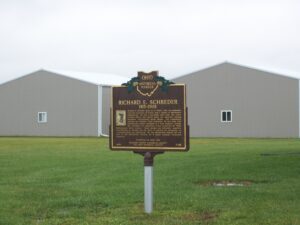
Richard E. Schreder grew up in Toledo, Ohio and graduated from the University of Toledo with a degree in Mechanical Engineering. He was a decorated navy pilot and iconic aviation figure who helped shape the American soaring movement, international glider design, and competitive soaring and piloting flight strategies. He also made high performance gliders available to a wide audience through the affordable kit production of his distinctive HP (High Performance) glider designs. These designs and Schreder’s numerous contributions to aviation and the sport of soaring are recognized as “groundbreaking and pioneering” by the Smithsonian Museum and are part of the Smithsonian National Air & Space Museum’s permanent collection. (continued on other side)