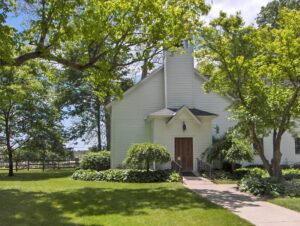
The first religious society organized in Liberty Township was formed in 1810 by Elders Thomas Cellar, Josiah McKinnie, and Leonard Monroe. Cellar and McKinnie came to Delaware in 1802. In 1820, The Elders and others built Liberty Church and laid out a cemetery on land provided by Thomas Cellar. Along with the Cellar and McKinnie families, early settlers, church and community leaders are buried here. In 1855, John F. Cellar deeded the three acres on which the church was located to Liberty for one dollar. The land was to be used only for the Church, burying ground, and schoolhouse. In the 1990s, the congregation outgrew the old meeting house. A Barn Church was constructed by builder John Redding, assisted by Amish men Josie and son, Junior Miller and their crew. It was constructed in 1996 near the old Liberty Church.
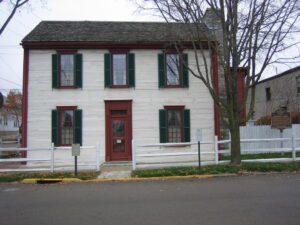
Benjamin Overfield (1774-1831), son of a Revolutionary War soldier, opened his tavern in this log house on September 13, 1808. Never moved, it is the oldest surviving building in Troy. The tavern provided food, lodging and space for business and social gatherings. Overfield agreed to let the county use a room on the second floor of the building as a temporary courtroom. Behind the tavern, Benjamin built a small log cabin that was home to his family. He prospered here until 1825 when he moved to the Public Square. Today’s structure includes the tavern, the cabin, and later additions. Used as a dwelling from 1825 until 1948, the building now houses the Overfield Tavern Museum. Benjamin Overfield and his first wife Mary are buried in Rose Hill Cemetery.
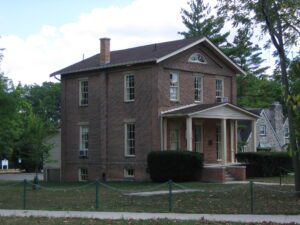
Reverend Lorenzo Langstroth, renowned as “The Father of American Beekeeping,” lived in this simple two-story, eight-room house with his wife, Anne, and their three children from 1858 to 1887. Unchanged externally, the Greek Revival cottage features brick pilasters and pediments and a fan-shaped front window. In his garden workshop, Langstroth made experimental beehives, established an apiary, and on the ten acres that surrounded his home, grew buckwheat, clover, an apple orchard, and a “honey garden” of flowers. He imported Italian queen bees in efforts to improve native bees and shipped his queens to keepers across the United States and around the world. The Langstroth Cottage was placed on the National Register of Historic Places in 1976 and designated a National Historic Landmark in 1982. (Continued from other side)
“I say white brother, because I believe that to be the proper phrase, inasmuch as I believe in the principle of the fatherhood of God and the brotherhood of all mankind no matter what the color of his skin may be.” Richard L. Davis championed the cause of racial equality throughout the eastern coalfields, calling for an end to the color line and for all miners to unite against wage slavery. He was born in Roanoke County, Virginia in 1862 and arrived in racially integrated Rendville in 1882, where he became an organizer for the Knights of Labor. In 1886, a year after the Great Hocking Valley Strike, Davis wrote his first letters to the editor of the National Labor Tribune, establishing himself as voice for miners in the labor movement. (Continued on other side)
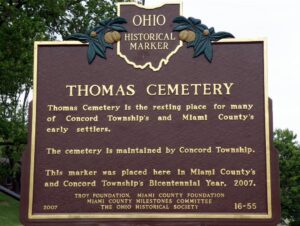
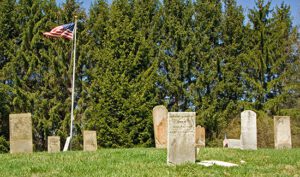
Thomas Cemetery is the resting place for many of Concord Township’s and Miami County’s early settlers. The cemetery is maintained by Concord Township. This marker was placed here in Miami County’s and Concord Township’s Bicentennial Year, 2007.
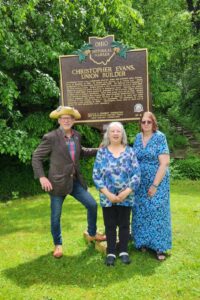
Christopher Evans was a celebrated district, state, and national union builder. Born in England in 1841, he began coal mining as a young boy. Evans immigrated to Pennsylvania around 1869-1870. By 1874 he was president of his local mining union. Evans moved to New Straitsville between 1875-1877, where he organized union meetings in Robinson’s Cave. During the miners’ strike of 1884-1885, Evans served as president of the Hocking Valley District of Ohio and its Relief Committee. After area mines were set on fire, miners were forced to abandon New Straitsville when its mines closed forever. Evans helped organize the United Mine Workers of America in 1890 and later authored a two-volume history of the movement. He remained in union leadership until retiring in 1908. Christopher Evans died in 1924 and is buried in New Straitsville Joint Cemetery.
Smith’s Burying Ground was established in 1814 when John Smith (born 1742), Revolutionary War Veteran, died and was buried here. John Smith and four of his sons and their families made the six week, six-hundred-mile journey from New Jersey with ox teams the previous year. John Clouse (1758-1822), Dutch immigrant and Revolutionary War veteran, is also buried here. (Continued on other side)
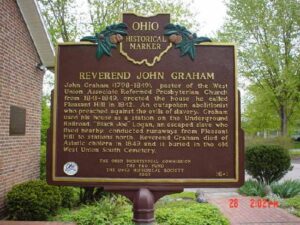
John Graham (1798-1849), pastor of the West Union Associate Reformed Presbyterian Church from 1841-1849, erected the house he called Pleasant Hill in 1842. An outspoken abolitionist who preached against the evils of slavery, Graham used his house as a station on the Underground Railroad. “Black Joe” Logan, an escaped slave who lived nearby, conducted runaways from Pleasant Hill to stations north. Reverend Graham died of Asiatic cholera in 1849 and is buried in the old West Union South Cemetery.