

, OH
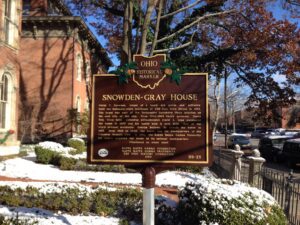
Philip T. Snowden, owner of a fancy dry goods and millinery, built the Italianate-style residence at 530 East Town Street in 1852. The house was part of the fashionable University Place addition on the east side of the city. From 1862-1864 Ohio’s governor, David Tod, lived here. Columbus philanthropist David S. Gray purchased the house in 1870 and his family held it until 1922. One of the city’s premier architects, George Bellows, Sr. rebuilt the house in 1872. From 1923 to 1940, the house was the headquarters of the Columbus Women’s Club. In 1951, the Kappa Kappa Gamma fraternity for women acquired the house as its national headquarters. (Continued on other side)
, OH
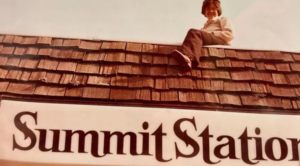
2210 Summit Street once housed one of Ohio’s longest-running lesbian bars. In 1970, a lesbian bartender at Jack’s A Go Go recognized that while Columbus had bars for gay men, it needed one geared toward lesbian clientele. Patrons knew the bar as “Jack’s,” Logan’s Off Broadway, and Summit Station. Staff welcomed women from small towns, women working in trades, women of color, butch/femme lesbians, and transgender people. Regulars recall that stepping through the door felt like finally entering a place of true belonging. Women could dance, “get together,” break up, sing karaoke, party with friends, and celebrate birthdays and holidays. Summit Station remained a safe public space, despite ongoing police harassment of its gender non-conforming regulars. A sign posted outside declared: “Ladies Night, Every Night. Men $5.” (Continued on other side)
, OH
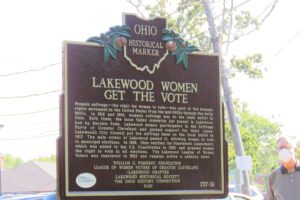
Women’s suffrage–the right for women to vote–was part of the women’s rights movement in the United States from the mid-1800s through the early 1900s. In 1912 and 1914, women’s suffrage was on the state ballot in Ohio. Both times, the issue failed statewide but passed in Lakewood. Led by Bernice Pyke, Lakewood women participated in the Suffrage Party of Greater Cleveland and gained support for their cause. Lakewood’s City Council put the suffrage issue on the local ballot in 1917. The male voters of Lakewood passed it, allowing women to vote in municipal elections. In 1919, Ohio ratified the Nineteenth Amendment, which was added to the U.S. Constitution in 1920 and granted women the right to vote in all elections. The Lakewood League of Women Voters was chartered in 1922 and remains active a century later.
, OH
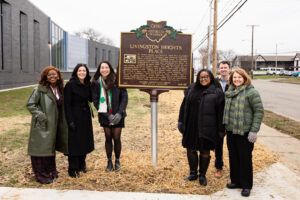
Dr. Harley Manuel and Charles E. Jones were frustrated by the restrictive covenants and redlining that kept Black residents from purchasing homes in desirable Columbus neighborhoods. Deciding to create their own neighborhood, the two men purchased 10.5 acres of farmland in March 1945. They divided it into 42 lots that became Livingston Heights Place. The first lots were sold to pharmacist Waldo W. and Harriet Tyler in 1946. Other early residents included Edward J. Cox, William and Esther Toler, David D. White, Dr. William K. Allen, and Dr. Harry Jefferson. Later residents were Dr. John H. Rosemond, Llewellyn (Jack) A. Coles, Captain Amos A. Carter Jr., Sammy Hopkins, William “Bill” Willis, and Dr. Richard Ruffin. Twenty homes were built between 1948 and 1967 within the subdivision’s boundaries of Johnson Park, Livingston, Byron, and Waverly.
, OH
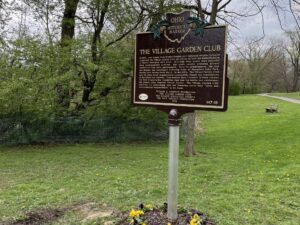
In 1930, nine women from Shaker Heights and Cleveland Heights formally organized The Village Garden Club and set as its goal the beautification of Shaker Parklands with trees. At a time when women were excluded from environmental activism, the club’s careful planning allowed members to lead civic improvements. Since its establishment, the club has planted and maintained flowering trees at Horseshoe Lake Park, pausing only during World War II. In the 1960s, The Village Garden Club and 34 other local organizations successfully fought the construction of the Clark-Lee Freeway. Club member Mary Elizabeth Croxton chaired the Park Conservation Committee that won the battle and established the Shaker Lakes Regional Nature Center. The Village Garden Club continues its stewardship over the flowering grove with “civic and environmental responsibility” as its focus.

, OH
Civil unrest rocked the Hough neighborhood for five nights during the summer of 1966.When the white owners of the Seventy-Niners Cafe refused to serve a Black customer a glass of water, a sign bearing a racial epithet subsequently appeared outside the bar. Decades of institutionalized racial practices that had caused Hough’s substandard and overcrowded housing, high unemployment, economic exploitation, lack of access to quality education, and systemic police harassment sparked an urban uprising in response on July 18. Angry crowds gathered outside the bar only to be confronted by the owners brandishing firearms. When the police belatedly responded, tensions escalated into targeted firebombing, looting, and vandalism. On Tuesday night, July 19, Cleveland’s Mayor Ralph Locher requested that the Ohio National Guard restore order. (Continued on other side)
, OH
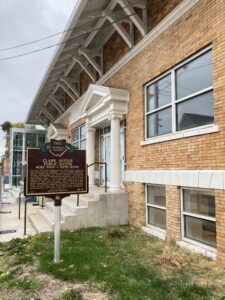
In the early 20th century, the City of Cleveland began opening public bath houses as a way to address the unsanitary living conditions of its overcrowded immigrant neighborhoods. Opened in January 1908, the Clark Avenue Bath House was Cleveland’s third public bath house. It cost $32,000 to build and was designed by prominent Cleveland architect Charles F. Schweinfurth. The semi-Colonial building featured heavy Ionic columns that framed the two entrances marked for “Men” and “Women” overhead. Clark Avenue Bath House had 35 private shower “cabinets,” two group showers, locker rooms, and a gymnasium with a spectator gallery. By 1921, seven such bath houses served the city. Today, five remain and four continue to offer public services to their neighborhoods as Neighborhood Resource and Recreation Centers.
, OH
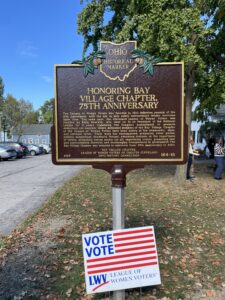
The Bay Village Chapter of the League of Women Voters was established in Spring 1948, with Dorothy M. Austin as president. The goal of the chapter was to ensure all citizens of Bay Village had the information they needed to cast an educated vote. They first met in the Cahoon family homestead, which then served as the city library and later as Rose Hill Museum. Gladys H. Luecke led the group on its first study, a city charter form of government for the village. Voters approved the charter on April 12, 1949, and the Village of Bay officially became the “City of Bay Village” in 1951. Since its founding, the Bay Village Chapter has made an educated voter its first priority by supporting citizen participation in government and influencing public policy through education and advocacy.