

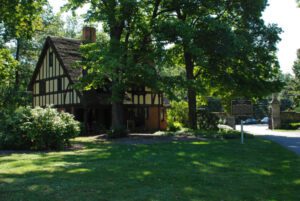
, OH
Completed in 1915, the Gate Lodge is one of several service buildings located at Stan Hywet Hall dedicated to the operations of the estate. Located at the front entrance gates, this two-story Tudor Revival structure was designed by the Seiberlings’ architect Charles S. Schneider. Originally, the Gate Lodge served as a residence for the estate’s superintendent. The first to fill this role was William Dennis who moved in with his family to the Gate Lodge after its completion and resided there until his death in 1923. Between 1923 and 1944, Fred, the eldest child of F.A. and Gertrude Seiberling, lived in the Gate Lodge with his wife Henrietta and their three children. In 1935, Henrietta brought here the two men who would formally found Alcoholics Anonymous, Bill Wilson of New York and Dr. Bob Smith of Akron.
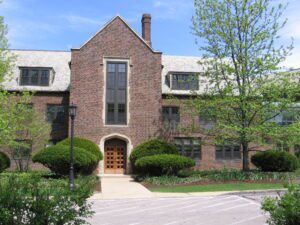
, OH
Florence E. Allen (1884-1966) was nicknamed “first lady of the law” for her many firsts as a woman in the legal profession. After graduating from Western Reserve College for Women, she taught at Laurel School from 1906 to 1909. She then became a crusader for women’s rights, and in 1913 received a law degree from New York University. Allen was appointed as an assistant Cuyahoga County prosecutor in 1919, the first woman in the country to hold such a position. In 1920, she was elected to Cleveland’s Court of Common Pleas, advancing, in 1922, to the Ohio Supreme Court, where she served two terms. In 1934, President Franklin D. Roosevelt appointed Allen to the nation’s second highest tribunal, the United States Sixth Circuit Court of Appeals, where she became its first female member. In 1958, she was elevated to Chief Justice of that body and retired in 1965.
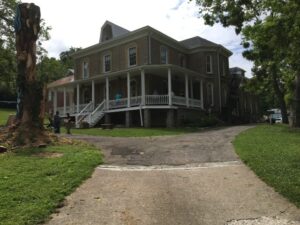
, OH
The Civil War created orphaned and impoverished children across the nation. To establish a home for area children, a group of Hamilton women met with Reverends Thane Miller and Benjamin W. Chidlaw in January 1869. By May, the women had rented a house on North C Street. Five years later, a new house was needed. Local businessmen Clark Lane and Elbridge G. Dyer pledged a combined $10,000 to purchase the property at 425 South D Street. One condition of the gift was that home’s operators had to raise an additional $2,000 to cover expenses. The newer, larger home opened in September 1875. In 1902, Robert and Eleanor Beckett McKinney donated funds to build a hospital on the property, named Ruth Hospital, to honor their deceased infant daughter. Mrs. McKinney and her mother, Martha Beckett, had long supported the home’s work. (Continued on other side)
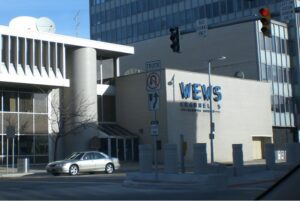
, OH
One of America’s most admired women, pioneer television newscaster Dorothy Snell Fuldheim (1893-1989) began her career as a lecturer in the 1920s and entered broadcasting with a biographical series on WTAM radio in Cleveland. In 1947, Fuldheim joined Ohio’s first commercial television station, WEWS, becoming the first woman in the United States to anchor a news show. Her later work included the long-running “One O’clock Club” live interview show and regular news commentary. During her six-decade career in an often youth-dominated profession, Fuldheim conducted over 15,000 interviews-including Adolf Hitler, Benito Mussolini, the Duke of Windsor, Albert Einstein, and Helen Keller-in a unique and erudite style. She retired in 1984 at the age of 91.
, OH
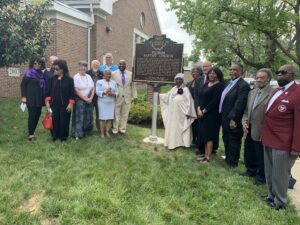
On January 9, 1919, a group of eight men and three women, being led by the Holy Spirit, met at a house on Wallace Street to form a new black Missionary Baptist Church in Hamilton, Ohio. The group quickly raised $150 to make the down payment on a two-story brick building at 333 Chestnut Street being sold for $1,850. The building was occupied on March 25, 1919, and the name Pilgrim Baptist Church was suggested and accepted. On May 11, 1919, a special council requested admittance into the Western Union Baptist Association, a district association now affiliated with the Ohio Baptist General Convention. Requirements for admission were met and Pilgrim Baptist Church was recognized as a Missionary Baptist Church. In 2019, Pilgrim Baptist Church celebrated a centennial of faithfulness in Hamilton.
, OH
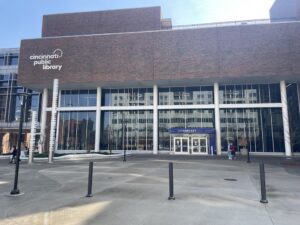
Among the first in America, Cincinnati’s public library dates from March 14, 1853. A public reading room opened in 1856, but funding remained a problem until 1867, when local school board president Rufus King II secured legislation for a renamed Cincinnati Public Library. In 1869, King lured leading librarian William Frederick Poole to organize Cincinnati as a national model for the growing public library movement. Poole designed 19th century America’s most advanced library at 629 Vine Street, which fully opened in 1874. Becoming a countywide system in 1898, the Public Library of Cincinnati and Hamilton County was a pioneer in the 20th century with special services for the blind and for children, bookmobile services, and circulation of audiovisual materials. (continued on other side)
, OH
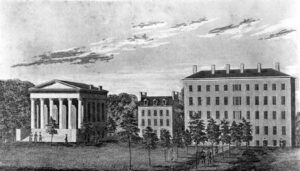
The Lanes, Baptist merchants from New Orleans, and the Kempers, a Presbyterian family from Cincinnati, gave money and land respectively for Cincinnati’s first manual labor theological seminary and high school, which opened in suburban Walnut Hills in 1829. The Reverend Lyman Beecher came from Boston as its first president. The president’s house, now known as the Stowe House after Beecher’s daughter Harriet Beecher Stowe, author of Uncle Tom’s Cabin, still remains at Gilbert and Foraker. Lane Theological Seminary, bound by present day Gilbert, Chapel, Park, and Yale streets, continued to educate Presbyterian ministers until 1932, when it was merged with McCormick Theological Seminary in Chicago.
, OH
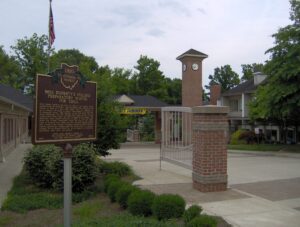
Mary Harlan Doherty was born in 1862 in the Dayton Street neighborhood of Cincinnati. She graduated from Woodward High School in 1880 at a time when women were not expected to go to college, but rather to marry, raise children, and take care of household duties. Miss Doherty, as she was known, saw the world differently. She felt strongly that women should not only possess solid social skills, but also be prepared for college. She graduated from Cornell University in 1899. In 1906 she established the College Preparatory School for Girls in the former home of Superior Court Judge and Ohio Governor George Hoadley, with a class of 125 students. Enrollment doubled by 1920, with Miss Doherty guiding her students under the school’s motto, Ad Summum, meaning “To the Highest Point,” or, as she viewed it, to strive for excellence, hard work, and service.