

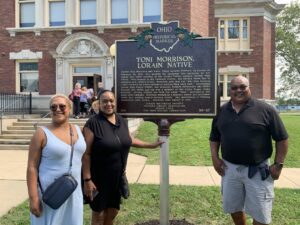
, OH
Author Toni Morrison was born, Chloe Ardelia Wofford, in Lorain on February 18, 1931. Her passion for language was nurtured by her family and while working at the Lorain Public Library during high school. Then housed in the Carnegie Center, the library hired her to reshelve and catalog books. Morrison said that she “was slow because I kept reading the books instead of putting them back fast.” Graduating Lorain High School (1949), she attended Howard University (BA 1953), Cornell (MA 1955), and she was a member of the Alpha Kappa Alpha sorority. During college she took the name “Toni,” shortening her saint name Anthony. Morrison worked as a literary editor and professor while also writing award-winning novels. She maintained a lifelong connection with Lorain. Morrison died August 5, 2019.
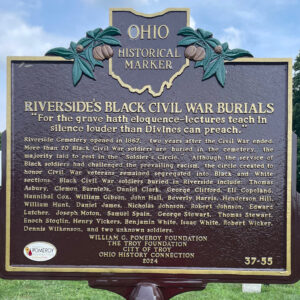
, OH
Black soldiers played a major role in the Civil War and more than 5,000 free Black Ohioans served in Union forces. While prejudice marginalized the Black man’s ability to serve early in the war, an 1862 Act of Congress authorized their admission into the Union Army and Navy. President Abraham Lincoln’s 1863 Emancipation Proclamation welcomed all freed men to join the fight. About 300 Black Ohioans joined the 54th and 55th Massachusetts (Colored) Volunteers – the first all-Black regiments raised in the North. Although offered $13 per month, the new recruits had to wait eighteen months to receive equal pay. In June 1863, Ohio’s Governor David Tod authorized a regiment of Black soldiers. The 127th Ohio Volunteer Infantry (OVI), the state’s first Black regiment, became known as the 5th U.S. Colored Troops (USCT).
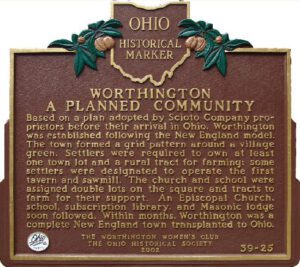
, OH
The Scioto Company, led by James Kilbourn (Kilbourne) of Granby and Berlin, Connecticut, founded Worthington in 1803, the year that Ohio became a state. The Scioto Company was organized as a land company in 1802 with 38 original proprietors from Connecticut and Massachusetts. They purchased 16,000 acres of land along the Olentangy River for $1.25 per acre. The name Worthington was adopted in honor of Thomas Worthington, Territorial Land Commissioner, United States Senator, and future Ohio governor. He advised Kilbourn on the location for the settlement and his name provided recognition for the community.
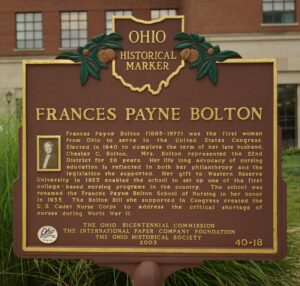
, OH
Frances Payne Bolton (1885-1977) was the first woman from Ohio to serve in the United States Congress. Elected in 1940 to complete the term of her late husband, Chester C. Bolton, Mrs. Bolton represented the 22nd District for 28 years. Her life long advocacy of nursing education is reflected in both her philanthropy and the legislation she supported. Her gift to Western Reserve University in 1923 enabled the school to set up one of the first college-based nursing programs in the country. The school was renamed the Frances Payne Bolton School of Nursing in her honor in 1935. The Bolton Bill she supported in Congress created the U.S. Cadet Nurse Corps to address the critical shortage of nurses during World War II.
, OH
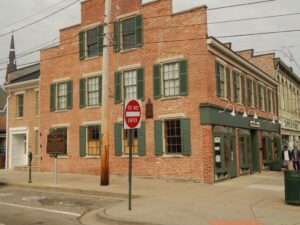
Thomas Cowan Bell, James Parks Caldwell, Daniel William Cooper, Isaac M. Jordan, William Lewis Lockwood, Benjamin Piatt Runkle, and Franklin Howard Scobey met in a second floor room of this building to found Sigma Chi (ΣΧ) in early 1855. All but Lockwood had been members of Delta Kappa Epsilon (ΔΚΕ) but left over a disagreement as to who should be elected poet of Erodelphian, one of Miami University’s literary societies. Runkle and Caldwell, who lived here, designed Sigma Chi’s badge, the White Cross. Reflecting the ideals of Friendship, Justice, and Learning, the Brothers donned the badge and established Sigma Chi on Commencement Day, June 28, 1855. The founding of Sigma Chi completed the Miami Triad, which includes Alpha (founding) chapters of Beta Theta Pi (ΒΘΠ, 1839) and Phi Delta Theta (ΔΘ, 1848). Miami University and Union College in Schenectady, New York are known as the “Mother of Fraternities.” (Continued on other side)
, OH
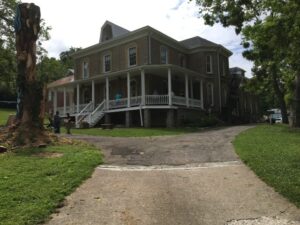
The Civil War created orphaned and impoverished children across the nation. To establish a home for area children, a group of Hamilton women met with Reverends Thane Miller and Benjamin W. Chidlaw in January 1869. By May, the women had rented a house on North C Street. Five years later, a new house was needed. Local businessmen Clark Lane and Elbridge G. Dyer pledged a combined $10,000 to purchase the property at 425 South D Street. One condition of the gift was that home’s operators had to raise an additional $2,000 to cover expenses. The newer, larger home opened in September 1875. In 1902, Robert and Eleanor Beckett McKinney donated funds to build a hospital on the property, named Ruth Hospital, to honor their deceased infant daughter. Mrs. McKinney and her mother, Martha Beckett, had long supported the home’s work. (Continued on other side)
, OH
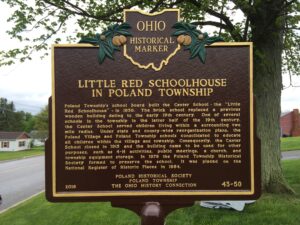
Poland Township’s school board built the Center School- the “Little Red Schoolhouse”- in 1858. The brick school replaced a previous wooden building dating to the early 19th century. One of several schools in the township in the latter half of the 19th century, the Center School served children living within a surrounding two mile radius. Under state and county-wide reorganization plans, the Poland Village and Poland Township schools consolidated to educate all children within the village and township. Consequently, the Center School closed in 1915 and the building came to be used for other purposes, such as 4-H activities, public meetings, a church, and township equipment storage. In 1979 the Poland Township Historical Society formed to preserve the school. It was placed on the National Register of Historic Places in 1984.
, OH
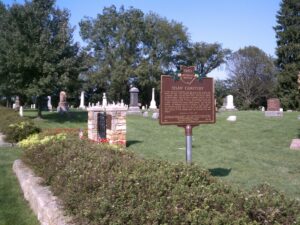
In 1829, Samuel and Charlotte Hale Shaw came to Bath Township from Bristol, New York. They purchased 145 acres of land where Samuel, a carpenter, built a two-story frame house. They had six children; two died in infancy. Their two year old daughter, Charlotte, was the first to be buried in Shaw Cemetery. They conveyed one half acre of land to the township for a “burying ground” in 1836. Samuel died in 1836; Charlotte then married Lyman Doolittle. They had five children; two daughters survived to adulthood. In 1892, Virgil E and Genevieve Doolittle Shaw sold one acre to Bath Township to expand Shaw Cemetery. Samuel’s parents, Constant and Mercy Pitts Shaw, migrated to Bath Township along with his brothers and their families.