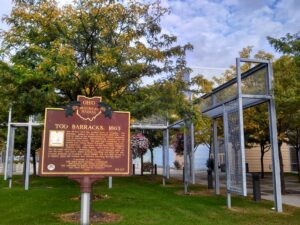
One of five Civil War military posts in Columbus, Tod Barracks, named in honor of Governor David Tod, was built in 1863 as the headquarters for military administration in central Ohio. Necessitated by Lincoln’s call for 300,000 new troops, the post was constructed in two months with United States Engineer, Captain John Tod, as supervisor. Carpenters of the 88th Ohio Volunteer Infantry from Camp Chase, three miles west, built it. Tod Barracks served as a recruiting depot, a rendezvous point for new recruits, and place where soldiers mustered-out after the war. Located adjacent to Columbus’ Union Station, the post also served as a transfer point for soldiers and officers traveling through Ohio. (continued on other side)
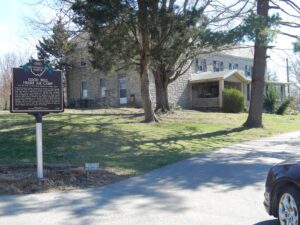
Reverend Richard E. Scully, founder of the Cincinnati Goodwill operated a Fresh Air Camp for women and children in the 1930s and 40s. The camp was part of a 100-acre site with vegetable fields, a swimming pool, tennis courts and horseshoe pits. The farm house on site was used as lodging for visitors. Men who worked at the camp received food and other forms of relief for their families. Vegetables produced on site were distributed at the Goodwill location at Ninth Street and Freeman Avenue in Cicinnati. According to family stories, Ruth Ann Eldridge, the frist child of Edison and Anna Eldridge, was buried on the site of the camp in 1933. Rev. Scully had officiated at Edison and Anna’s wedding and was a friend of the family.
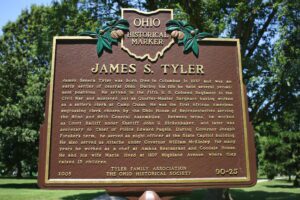
James Seneca Tyler was born free in Columbus in 1837 and was an early settler of central Ohio. During his life he held several prominent positions. He served in the Fifth U.S. Colored Regiment in the Civil War and mustered out as Quarter-Master Sergeant having worked as a sutler’s clerk at Camp Chase. He was the first African American engrossing clerk chosen by the Ohio House of Representatives serving the 62nd and 66th General Assemblies. Between terms, he worked as Court Bailiff under Sheriff John U. Rickenbaker, and later was secretary to Chief of Police Edward Pagels. During Governor Joseph Foraker’s term, he served as night officer at the State Capitol building. He also served as Attache under Governor William McKinley. For many years he worked as a chef at Ambos Restaurant and Goodale House. He and his wife Maria lived at 1107 Highland Avenue where they raised 13 children.
Pleasant Litchford was born into slavery in Virginia in 1789. He purchased his freedom and moved his family to Ohio by 1831. A master blacksmith, Litchford bought a small farm four miles north of Columbus in 1833. By the time of his death in 1879, he was the fourth largest landowner in Perry Township. Described as “a man of iron constitution,” Litchford served as a lay-preacher, founding member, and deacon at Second Baptist Church. The church and James Poindexter, its pastor in 1847, provided an important voice during the anti-slavery movement. In 1869, Litchford sold, for $1, a parcel of land to establish a school for African American children. He was married three times and was survived by seven living children, twenty-five grandchildren, and three great-grandchildren. Pleasant Litchford was buried in the Litchford Family Cemetery.