Approximately 700′ south of Albany Street on S Edwin C Moses Blvd
Dayton
, OH
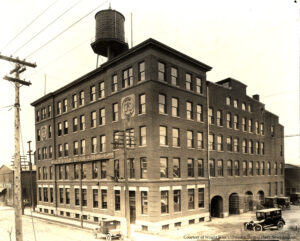
Green & Green Company invented the Cheez-It in the 1920s. John Green and his son Weston founded their company in 1897 to produce a hard cracker recipe created by Dr. William Wolf of Dayton. Originally based in Chicago, the Greens moved production to their hometown two years later, opening a small factory above downtown Dayton’s Victory Theater. In 1907, Green & Green built a new bakery on the corner of Cincinnati and Concord streets in the Edgemont neighborhood. As their “Wolf” or “Dayton” cracker grew in popularity, Green & Green added the flakier line of “Edgemont” Crackers, which included the Cheez-It. In 1921, Weston Green applied for a trademark patent on the name “Cheez-It,” and the popular snack was born. (Continued on other side)
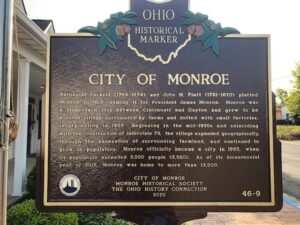
Nathanial Sackett (1768-1854) and John H. Piatt (1781-1820) platted Monroe in 1817, naming it for President James Monroe. Monroe was a stagecoach stop between Cincinnati and Dayton and grew to be a rural village surrounded by farms and dotted with small factories, incorporating in 1907. Beginning in the mid-1950s and coinciding with the construction of Interstate 75, the village expanded geographically, through the annexation of surrounding farmland, and continued to grow in population. Monroe officially became a city in 1995, when its population exceeded 5,000 people (5,380). As of its bicentennial year of 2017, Monroe was home to more than 13,000.
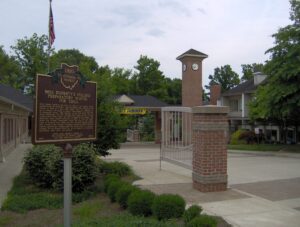
Mary Harlan Doherty was born in 1862 in the Dayton Street neighborhood of Cincinnati. She graduated from Woodward High School in 1880 at a time when women were not expected to go to college, but rather to marry, raise children, and take care of household duties. Miss Doherty, as she was known, saw the world differently. She felt strongly that women should not only possess solid social skills, but also be prepared for college. She graduated from Cornell University in 1899. In 1906 she established the College Preparatory School for Girls in the former home of Superior Court Judge and Ohio Governor George Hoadley, with a class of 125 students. Enrollment doubled by 1920, with Miss Doherty guiding her students under the school’s motto, Ad Summum, meaning “To the Highest Point,” or, as she viewed it, to strive for excellence, hard work, and service.
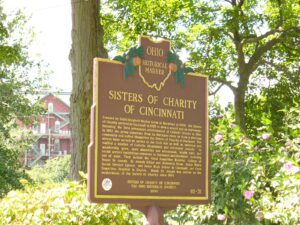
Founded by Saint Elizabeth Bayley Seton in Maryland in 1809, the Sisters of Charity arrived in Cincinnati in 1829 to open a school and an orphanage, becoming the first permanent establishment of Catholic sisters in Ohio. In 1852 the group separated from its Maryland roots to form a diocesan community and called themselves the Sisters of Charity of Cincinnati. The sisters later served as nurses in the Civil War as well as operated and staffed a number of Catholic elementary and secondary schools. As membership grew, their ministries and educational, health care, and social service institutions expanded in Cincinnati and elsewhere, including out of state. They include the Good Samaritan Hospital, College of Mount St. Joseph, St. Joseph Infant and Maternity Home, Santa Maria Social Service Agency, and Seton High School in Cincinnati and Good Samaritan Hospital in Dayton. Mount St. Joseph has served as the motherhouse of the Sisters of Charity since 1884.