

, OH
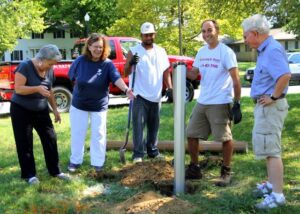
In 1798, Articles of Confederation Congress provided land to British Canadians who lost property because of loyalty to American revolutionaries during the American War of Independence (1775-1783). This land was part of the Refugee Tract and the present-day Truro Township. In 1850, Henry Stanbery, first Attorney General of Ohio, purchased a portion of this land. In 1923, Charles Johnson bought a section of this land and had it platted as the Eastmoor Addition by the Jennings-Lawrence Company with the polo field at the center. Eastmoor has houses ranging in age from the 1920s to the early 21st century, including Lustron homes built after WWII.
, OH
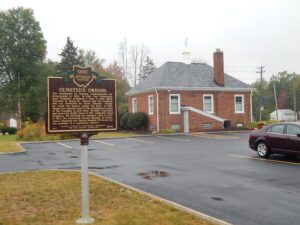
The community of Olmsted commemorated its bicentennial in 2014. In 1795, the Connecticut Land Company auctioned a tract of land called Township 6, Range 15. Almost half the northern side was purchased by Aaron Olmsted, though he would die before seeing the land. In 1814, James Geer cleared a plot in the southeastern corner of the township to grow corn. He built a log house and moved his family there. Originally called Kingston, the township was renamed Lenox in 1823. In 1829, the settlement became Olmsted; in return, Aaron Olmsted’s son Charles donated 500 books for the creation of a community library.
, OH
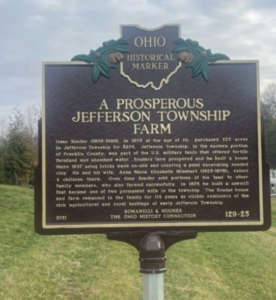
Isaac Souder (1809-1889), in 1835 at the age of 26, purchased 225 acres in Jefferson Township for $674. Jefferson Township, in the eastern portion of Franklin County, was part of the U.S. military lands that offered fertile farmland and abundant water. Souder’s farm prospered and he built a house there 1837 using bricks made on-site and creating a pond excavating needed clay. He and his wife, Anna Maria Elizabeth Minehart (1825-1878), raised 4 children there. Over time Souder sold portions of his land to other family members, who also farmed successfully. In 1874 he built a sawmill that became one of two permanent mills in the township. The Souder house and farm remained in the family for 114 years as visible reminders of the rich agricultural and rural heritage of early Jefferson Township.
, OH
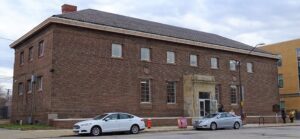
City architect Frederic H. Betz designed the St. Clair Avenue Public Bath House and it was constructed in 1919-1920 at a cost of $320,000. The facility included a large gymnasium, swimming pool, and laundry, in addition to showers. City Council dedicated the newly completed building to the late, beloved Cleveland Indians shortstop Raymond Chapman in 1920. The St. Clair Recreation Center, as it was later known, was in the impact zone and survived the East Ohio Gas Company disaster on October 20, 1944. The facility was remodeled in 1949 and subsequent renovations demonstrate the utility of the building. Edward J. Kovacic (1910-1974) was the superintendent of the bathhouse from 1933-1934 and served on the City Council from 1940-1953. In 1977, the facility was renamed to honor Kovacic’s contributions to the citizens of the St. Clair neighborhood and to the city. (Continued on other side)
, OH
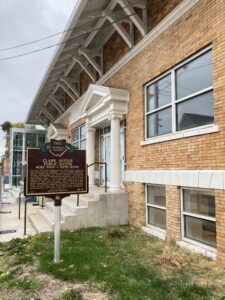
In the early 20th century, the City of Cleveland began opening public bath houses as a way to address the unsanitary living conditions of its overcrowded immigrant neighborhoods. Opened in January 1908, the Clark Avenue Bath House was Cleveland’s third public bath house. It cost $32,000 to build and was designed by prominent Cleveland architect Charles F. Schweinfurth. The semi-Colonial building featured heavy Ionic columns that framed the two entrances marked for “Men” and “Women” overhead. Clark Avenue Bath House had 35 private shower “cabinets,” two group showers, locker rooms, and a gymnasium with a spectator gallery. By 1921, seven such bath houses served the city. Today, five remain and four continue to offer public services to their neighborhoods as Neighborhood Resource and Recreation Centers.

, OH
The Central Avenue Public Bath House was designed by Frederic Betz, the City of Cleveland’s first appointed architect. Opened in February 1920, it served the Black population in the congested Central neighborhood. The brick building featured symmetrical windows and entrances at either end that led into men’s and women’s waiting rooms and individual shower rooms. Larger group showers for children were in the basement. The second floor featured club rooms as well as a physician’s room and a nurse’s room. In 1926, a swimming pool and gymnasium were added. In 1940, as the need for public bathing facilities waned, Central Avenue Public Bath House was converted into a recreation center. One of Cleveland’s five remaining Bath Houses, Central Avenue stands as a manifestation of the city’s commitment to the health and welfare of its citizens.
, OH
Prominent architect William S. Lougee designed the Woodland Public Bath House that opened in 1915 at a cost of approximately $90,000. The first floor of the facility included separate shower baths for men and women, an office, waiting rooms, and a gymnasium with a 53-yard running track. The second story was divided into four rooms: a club room, a small city library branch, a baby dispensary, and clinic. The basement featured an indoor swimming pool popular among adults and children. Like other public bath houses in Cleveland, the Woodland Bath House was an invaluable social space for its diverse community of largely Hungarian, but also Slovak, Bohemian, Italian, Lithuanian, and Jewish residents. In 1918, the City estimated that 254,508 residents had used Woodland Bath House facilities, enjoying classes, camps, baths, and clinics.