Constitution Park-Just N of Intersection of OH 725 and US 42
Spring Valley
, OH
In 1779 John Bowman’s forces followed the east bank to Glady Run, then north to the Indian village of Old Chillicothe. In 1780 and 1782 militia commanded by George Rogers Clark, and guided by Simon Kenton and Daniel Boone, crossed the river and camped two miles north of Caesar’s Creek, then marched on the villages near Springfield, Piqua, and Bellefontaine.
A group of Freemasons, inspired by the concepts of a new country, of Freedom with Responsibility, Brotherly Love, and Truth, formed Harmony Lodge near this site in 1809, the first Masonic lodge in western Ohio. Meetings were held in the log court house, located on Lot 174, East Court Street, and also in Dayton and Springfield.
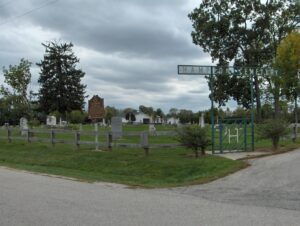
On September 8, 1803, the year that Ohio became a state, the Associate Judges of Franklin County ordered that a road be constructed “leading from the Public Square in Franklinton to Springfield, Greene County.” This road came to be known as The Old State Road or Ludlow’s Road. On this spot in the summer of 1822, the Village of New Hampton was laid out, the road being Main Street of the village. New Hampton was the forerunner of West Jefferson. It fell into oblivion eight to nine years later when West Jefferson was developed along the National Road. All that remains of New Hampton is the cemetery and this part of the road.
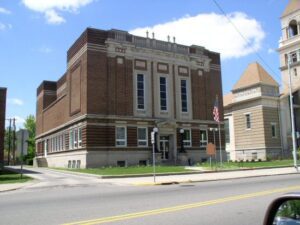
In 1910, the Ohio Electric Railway Company opened this terminal, formerly the Interurban Building, which served interurban passengers until 1937. Along with offices, it contained space for express and baggage handling, ticket windows, a newsstand, a lunch counter, and waiting rooms. Three tracks were laid at the rear of the building. At its peak, Ohio Electric radiated from Lima to Springfield, Toledo (via Ottawa), Defiance, and Fort Wayne. Its competitor, The Western Ohio Railway (“Lima Route”) connected Dayton and Toledo (via Findlay). The interurban network in and around Lima led to the creation of suburbs, linked industrial and residential areas, and promoted the creation of amusement parks and small lake resorts. With decreased passenger traffic due in part to personal automobiles and the Great Depression, the interurban and street railway era in Lima ended in 1939, 52 years after it had begun as Ohio’s first successful electric streetcar system.
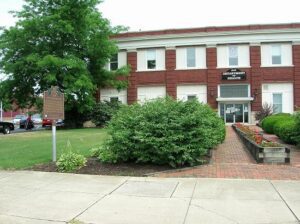
A. B. Graham, superintendent of Springfield Township Rural schools in Clark County, established the Boys and Girls Agricultural Experiment Club, which revolutionized agricultural education and non-formal youth development methods. The first meeting of the club, said to be the nation’s first farm club for young people, was held at this site on January 15, 1902 in the basement of the Clark County Courthouse. This was the start of what would be called a 4-H Club a few years later. Through the years, the overall objective of A.B. Graham and 4-H has remained the same: the development of youth as individuals and as responsible and productive citizens.
Acclaimed author and illustrator of juvenile literature Lois Lenski was born in Springfield in 1893, grew up in Anna, and graduated from Sidney High School. In 1915, Lenski graduated from The Ohio State University and moved to New York City to work and study art. After illustrating several children’s books in the early 1920s, she began writing and illustrating her own stories. Lenski specialized in historical fiction and regional themes–eventually publishing nearly one hundred carefully-researched books.
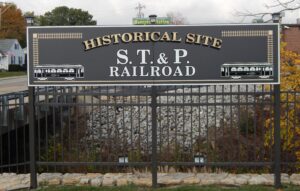
Asa Bushnell, former Governor of Ohio, encouraged by the light grade of the land, decided to establish the Springfield, Troy, and Piqua Railway (ST&P) in July 1904. The interurban traction line utilized sixty-pound rail and traveled over only one bridge. With direct current electricity generated in Springfield, the ST&P used four double-ended fifty-foot cars, each with a railroad roof, arch windows, GE-57 engines, and fifty-horsepower motors. The ST&P traveled from Springfield’s Fountain Square to Maitland, Hill Top, Lawrenceville, Bushnell, North Hampton, Dialton, Thackery, Proctors, Christiansburg, Brights, and Casstown and ended at Troy’s North Market Street Bridge. Later rights were granted to travel over the Great Miami River into Troy in conjunction with the Cincinnati, Hamilton, and Dayton Railway. The northwest right-of-way from Casstown to Piqua was secured but never built.
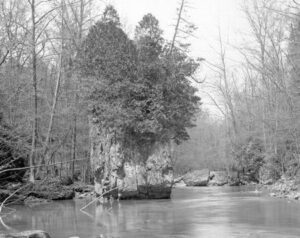
This historic village was a hub for early Ohio industry and travel. The natural geography of the area provided ideal conditions for the establishment of a variety of mills. Col. Robert Patterson, an ancestor of the founder of National Cash Register in Dayton, John Patterson, chose Clifton for the site of a woolen mill, which furnished material for the American army during the War of 1812. Davis Mill, established in 1802 and in operation today as Clifton Mill, produced meal and flour for Civil War troops. A major stop on the stagecoach trail, “The Accommodation Line,” which ran from Springfield to Cincinnati from 1827 to 1840, the village bustled with the commotion of travelers. The once flourishing industry of Clifton faded as railroad traffic bypassed the village and manufacturers left the area.