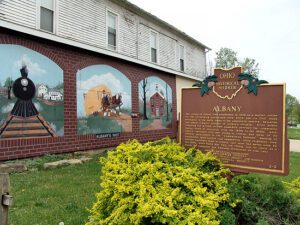
The village of Albany was established in 1838 as a market center for the surrounding agricultural area, which saw its first white settlement in the early years of the nineteenth century. Education was always a major concern of Albany’s citizens. Since public schooling was minimal, private academies provided the community various levels of education from the 1840s to the 1880s. Anti-slavery sentiment also was strong in Albany, and many of its citizens participated in the “Underground Railroad.” Because of educational opportunities and sympathetic white neighbors, free African-Americans came to Albany, but most had moved away by the 1930s. After World War Two, the village lost its status as a center for commerce and business.
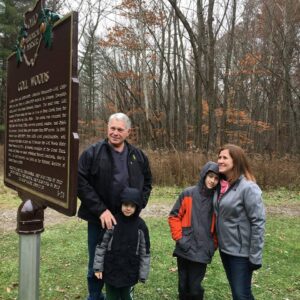
Two Deputy U.S. General Land Office Surveyors traversed Goll Woods: Benjamin Hough in 1815 and Captain James Riley in 1821. Hough (1772-1819) established the Michigan Meridian in 1815 and was county and state office holder in Ohio. Riley’s life was more tumultuous. Riley (1777-1840) captained the merchant ship Commerce, which wrecked off the Saharan coast in 1815. Riley and crew were enslaved for four months until ransomed by British diplomat William Willshire. In 1817, Riley published a famous account of his time in North Africa, and, in 1819, was appointed a surveyor by Surveyor General Edward Tiffin. Moving to Northwest Ohio, Riley named the village he founded in 1822, Willshire, for his deliverer. Riley returned to New York in 1826 and to the sea, where he died. Riley’s book went through more than twenty editions by 1860 and Abraham Lincoln credited the account as one that influenced him deeply.
In 1942 Cedar Bog became the first nature preserve in Ohio purchased with state funds. Efforts to set this wetland aside began in the 1920s through the efforts of Florence Murdock and her daughter. Efforts intensified in the mid 1930s with help from Walter Brigham Evens, Jr., and finally came to fruition in 1941 due to the interests of Champaign County Common Pleas Judge Owens, Governor John Bicker, and Dr. Edward S. Thomas of the Ohio Historical Society. This relatively small parcel is an outstanding example of a prairie/fen complex known as Cedar Swamp that once covered 7,000 acres of the Mad River Valley. Approximately one quarter of the plant species in Ohio are found here. Cedar Bog also has a large number of rare species, two of which, the Small Yellow Lady’s Slipper Orchid and Prairie Valerian, occur in Ohio only at Cedar Bog or one other site.
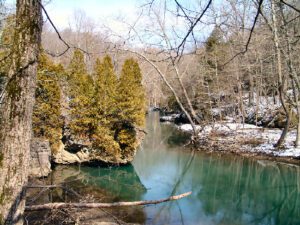
Clifton Gorge is a classic example of a canyon cut into dolomite and shale bedrock that dates to the Silurian Period 400 million years ago. Created by meltwater released from the retreating continental glacier some 15,000 years ago, the cool, moist gorge has maintained a diversity of native plants, such as the red baneberry bush, that are now rare elsewhere in Ohio. The Little Miami River powered grist and cotton mills, paper factories, and breweries in the gorge during the nineteenth century. In 1973 the upper gorge became a state nature preserve.
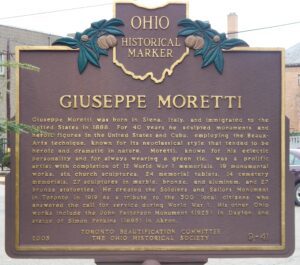
Giuseppe Moretti was born in Siena, Italy, and immigrated to the United States in 1888. For 40 years he sculpted monuments and heroic figures in the United States and Cuba, employing the Beaux-Arts technique, known for its neoclassical style that tended to be heroic and dramatic in nature. Mor etti, known for his eclectic personality and for always wearing a green tie, was a prolific artist with completion of 12 World War I memorials, 19 monumental works, six church sculptures, 24 memorial tablets, 14 cemetery memorials, 27 sculptures in marble, bronze, and aluminum, and 27 bronze statuettes. He created the Soldiers and Sailors Monument in Toronto in 1919 as a tribute to the 300 local citizens who answered the call for service during World War I. His other Ohio works include the John Patterson Monument (1925) in Dayton and statue of Simon Perkins (1895) in Akron.
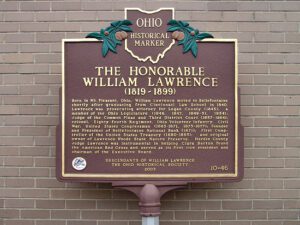
Born in Mt. Pleasant, Ohio, William Lawrence moved to Bellefontaine shortly after graduating from Cincinnati Law School in 1840. Lawrence was prosecuting attorney for Logan County (1845); a member of the Ohio Legislature (1846, 1847, 1849-51, 1854); Judge of the Common Pleas and Third District Court (1857-1864); colonel, Eighty-fourth Regiment, Ohio Volunteer Infantry, Civil War; United States Congressman (1865-1871, 1873-1877); Founder and President of Bellefontaine National Bank (1871); First Comptroller of the United States Treasury (1880-1885); and original owner of Lawrence Woods State Nature Preserve, Hardin County. Judge Lawrence was instrumental in helping Clara Barton found the American Red Cross and served as its first vice president and chairman of the Executive Board.
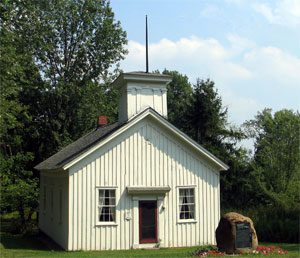
Called the “Cradle of Equal Suffrage” and “Free Speech Chapel,” Union Chapel was to be “…open and free for all denominations, but to be monopolized by no one or to the exclusion of anyone.” Built in 1858 or 1859 on land donated by Anson Matthews, the chapel reputedly exists in response to incident triggered by James A. Garfield, then principal of the Western Reserve Eclectic Institute (now Hiram College) and later president of the United States. He was scheduled to speak at the Congregationists’ “Brick Church” in December 1857. Because of the supposed controversial nature of Garfield’s speech, however, the invitation was withdrawn. (Continued on other side)
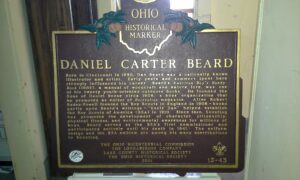
Born in Cincinnati in 1850, Dan Beard was a nationally known illustrator and artist. Early years and summers spent here strongly influenced his career. Beard’s American Boy’s Handy-Book (1882), a manual of woodcraft and nature lore, was one of his twenty youth-oriented outdoors books. He founded the Sons of Daniel Boone circa 1906, a boys’ organization that he promoted as editor of Recreation magazine. After Robert Baden-Powell founded the Boy Scouts in England in 1908-based partly upon Beard’s writings-“Uncle Dan” helped establish the Boy Scouts of America (BSA) in 1910. Since then, Scouting has promoted the development of character, citizenship, physical fitness, and environmental awareness for millions of boys. Beard served as the BSA’s first commissioner and participated actively until his death in 1941. The uniform design and the BSA emblem are among his many contributions to Scouting.