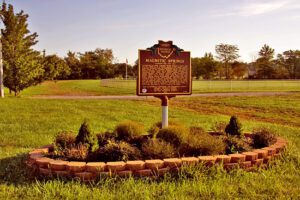
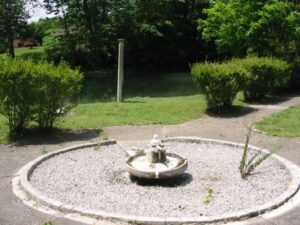
Near this site in 1879, J.E. Newhouse discovered a magnetic spring in his park, Green Bend Gardens. It was found that a knife blade dipped in the water could pick up small metal objects like a magnet. The spring became known for its curative powers and was advertised as a treatment for ailments including rheumatism, gout, insomnia, and diseases of the kidneys, bladder, and nerves. To share the health-giving water, Mr. Newhouse opened the Magnetic Bath House, which became famous for its water cures. To reach a larger market, the magnetic water was sterilized and bottled and sold under the Magnetic Springs label. Advances in medicine after World War II led to the decline in the popularity of mineral baths.
In 1772-73 missionary David Jones visited Blue Jacket’s Town, a settlement of 12 cabins downstream on the east bank and Pickaweekee, a Shawnee town, on the west bank. Deercreek Methodist Circuit Deacon, Dr. Edward Tiffin, met settlers after 1798. Dr. Tiffin was later elected first governor of Ohio. A station of Virginia bounty-land settlers, “Williams Town,” assembled here around 1797. Mill sites, established before Pickaway County, flourished in the dense oak forest of Deercreek Township. Frontier hotels in Williamsport prospered due to the “healthful” sulphur springs.
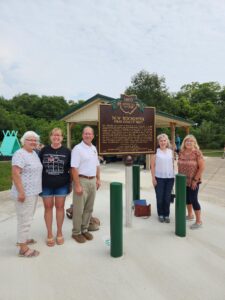
New Rochester was platted in 1835 in an area recognized as a vital transportation hub through the Great Black Swamp. The 18-acre plat was situated on a high bluff overlooking the Maumee River. A 2009 archaeological survey discovered stone tools and evidence of 4,000 years of habitation. When Paulding County was organized in March 1839, New Rochester was designated as its county seat. On November 21, 1839, three associate judges of the common pleas court appointed a clerk pro tem and sheriff. As no courthouse was built by April 1840, the court convened in a room above H.N. Curtis’s General Store. At that time, New Rochester was a flourishing village with thirty to forty families, three hotels, three stores, two blacksmiths, a post office, a school, and three taverns. (Continued on other side)
In 1817 the United States government signed a treaty with a number of Native American tribes in northern Ohio, including the Seneca Indians. The Fort Meigs or Maumee Rapids Treaty bound the Seneca tribe to cede all claims to land north of the Greenville Treaty line, and in return they received a 40,000 acre reservation at Lower Sandusky (Fremont) and a $500 annuity to be paid each year in perpetuity. The reservation’s boundary began 1.5 miles north of here and extended 6.5 miles to the south. The width of the reservation was 8 miles with the western boundary at the Sandusky River. Beginning in 1830, with a policy of Indian removal developed by the administration of Andrew Jackson, tribes east of the Mississippi River were pressured to move to reservations in the West. The Seneca Indians moved to northeast Oklahoma in 1831.
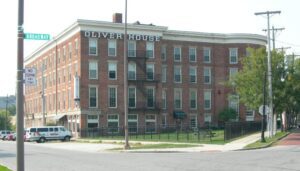
Overlooking the “Middlegrounds,” an early site of railroad, immigration, and commercial activity, the Oliver House opened in 1859 as Toledo’s premier hotel. It was designed by nationally prominent architect Isaiah Rogers, in the Greek Revival style, and built by the family of William Oliver for whom the hotel was named; owner of this land, Oliver was one of Toledo’s earliest real estate investors. (Continued on other side)
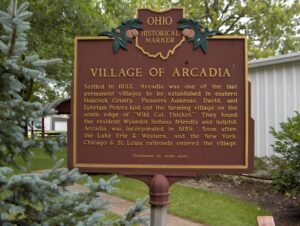
Settled in 1833, Arcadia was one of the last permanent villages to be established in eastern Hancock County. Pioneers Ambrose, David, and Ephriam Peters laid out the farming village on the south edge of “Wild Cat Thicket.” They found the resident Wyandot Indians friendly and helpful. Arcadia was incorporated in 1859. Soon after, the Lake Erie & Western, and the New York Chicago & St. Louis railroads entered the village. (Continued on other side)
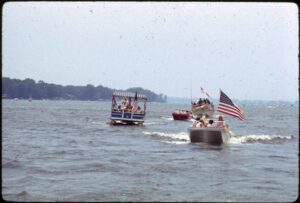
Using a four-mile long dam, the state of Ohio impounded the Licking Summit Reservoir in the mid-1820s to supply water for the Ohio and Erie Canal. In 1894, the state renamed it Buckeye Lake and developed it for recreational use. The Columbus, Buckeye Lake, and Newark Traction Company developed an “electric park” here, bringing in excursionists on interurban cars between 1904 and 1929 and creating one of the region’s most popular resorts. Hotels and summer cottages proliferated on leased ground. Nine acres in size, the park featured daily free admission during the summer. (continued on other side)
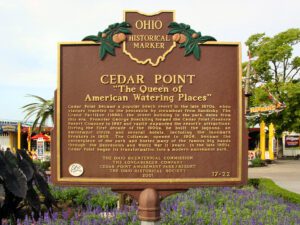
Cedar Point became a popular beach resort in the late 1870s, when visitors traveled to the peninsula by steamboat from Sandusky. The Grand Pavilion (1888), the oldest building in the park, dates from this era. Promoter George Boeckling formed the Cedar Point Pleasure Resort Company in 1897 and vastly expanded the resort’s attractions. During the first decade of the 1900s, he built the lagoons, an amusement circle, and several hotels, including the landmark Breakers in 1905. The Coliseum, opened in 1906, became the centerpiece of the park and hosted many of the famous big bands through the Depression and World War II years. In the late 1950s, Cedar Point began its transformation into a modern amusement park.