

, OH
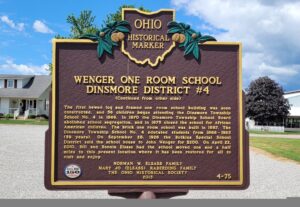
Dinsmore Township School District #4 was formed in 1865following a decision by the township’s board of education that a school would be built in the center of every four sections of land, or every four square miles. This placement of school buildings gave township children the opportunity to attend school close to home and the chance at receiving a public education up to the eighth grade, Nine districts were created for the children of white households, and an additional district was formed to educate the children of the African American families, for a total of ten districts in the township. On June 11, 1866, the Dinsmore Township School Board purchased land from George Wenger to build the District #4 school near the intersection of Ohio Route 274 and Wenger Road. (Continued on other side)
, OH
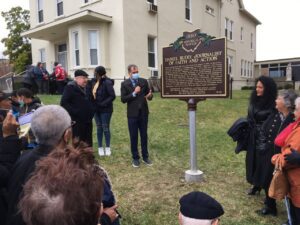
Daniel Arthur Rudd was born into slavery on August 7, 1854, in Bardstown, Kentucky. He became a newspaperman, lecturer, publicist, and tireless advocate for the Roman Catholic Church. After the Civil War Rudd moved to Springfield. Baptized and raised in Catholicism, he joined St. Raphael Parish, where the philosophy of racial equality offered by the church solidified his vision of justice. By 1885 he had established his own weekly newspaper, The Ohio State Tribune. He rebranded it The American Catholic Tribune (ACT) after moving to Cincinnati. Rudd claimed ACT was the only Catholic newspaper owned by an African American. At the height of its popularity in 1892, the publication had a circulation of 10,000. In 1893 Rudd was asked to chair the Afro-American Press Association, representing more than 200 black-owned newspapers.
, OH
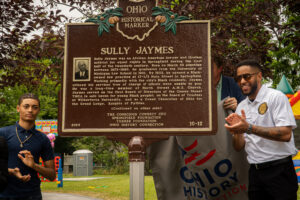
Sully Jaymes was an African American lawyer and tireless activist for equal rights in Springfield during the first half of the twentieth century. Born on March 30 sometime between 1875-1880, he graduated from the University of Michigan Law School in 1901. By 1903, he opened a Black-owned law practice at 17-1/2 Main Street in Springfield. Working primarily with the city’s Black residents, Jaymes offered his services free of charge if clients were unable to pay. He was a long-time member of North Street A.M.E. Church. Jaymes served on the first Board of Directors of the Center Street YMCA (a safe-haven for young Black people), on the Board of Trustees at Wilberforce University, and as a Grand Chancellor of Ohio for the Grand Lodge, Knights of Pythias. (Continued on other side)
, OH
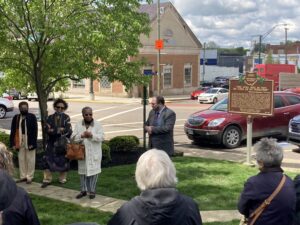
Ellamae Simmons, born and raised in Mount Vernon, became the first African American woman physician to specialize in asthma, allergy, and immunology in the country. Graduating in the top of her high school class, she dreamed of attending Ohio State University to become a nurse but was rejected as that program “did not have the facilities for training” the young black girl. Whenever Simmons encountered a barrier in life she refused to accept rejection, tenaciously steered the course of her own life, and blazed new trails for others. She ultimately earned degrees in nursing (Hampton, 1940), pre-med biological sciences (OSU, 1948), social work (OSU, 1950), and medicine (Howard University, 1959). Dr. Simmons again broke gender and racial barriers when hired by Kaiser Permanente in 1965. She practiced there until retiring in 1989. Simmons died aged 101.
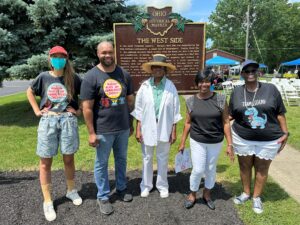
, OH
In the early twentieth century, Marion’s West Side was dominated by the Erie Railroad switchyards, a major hub of employment. During World War I, the railroad recruited Black workers from the South for jobs in its yards and roundhouses. In Marion, these workers made their homes in a West Side encampment that became the target of white suspicion and violence. In February 1919, following the unsolved murder of a white roundhouse worker’s wife and a separate alleged assault, a 300-man lynch mob smashed windows and occupied the West Side. All Black residents were ordered to leave the city by 6:00 pm the next day. Despite pleas to Governor Cox, at least 200 Black residents were forced to flee Marion. Marion’s anti-Black violence foreshadowed the nationwide “Red Summer” of 1919.
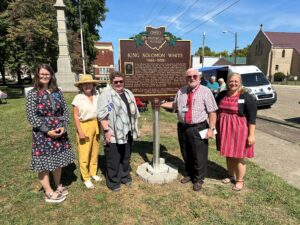
, OH
King Solomon “Sol” White was born in Bellaire on June 12, 1868. A Baseball legend, he was an all-around player, manager, and organizer in the Pre-Negro Leagues (1887-1912) and the Negro Leagues (1920-1926). White first played with integrated baseball clubs the Bellaire Globes (1884-1886) and Wheeling Green Stockings (1887). After 1887-1888 color barriers were imposed on baseball, White played on segregated minor league teams. They included: the Pittsburgh Keystones, Cuban Giants, York Colored Monarchs, Cuban X-Giants, Page Fence Giants, and Chicago Columbia Giants. As a coach, he helped organize and lead the powerhouse Philadelphia Giants to their 1904-1907 championships. White died on August 26, 1955, and was buried in an unmarked grave in Staten Island’s Frederick Douglas Memorial Cemetery. In 2006, “Sol” White was posthumously inducted into the Baseball Hall of Fame.
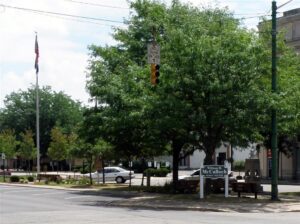
, OH
William McCulloch was born in Holmes County where he was educated in a one-room schoolhouse before moving to Wooster to attend high school and the College of Wooster. He attained prominence as Ohio’s Speaker of the House from 1939-1943 and House member from the Fourth Ohio Congressional District from 1948-1973. During his time in Washington, McCulloch was best known as a co-sponsor and staunch advocate of the Civil Rights Act of 1964. He was recognized by President Lyndon Johnson as the prime mover for passage of this landmark legislation. As a conservative Republican voice in the House, he was instrumental in championing other civil rights legislation, including fair housing and public accommodations. McCulloch was a founding partner in 1928 of the Piqua law firm that bears his name.
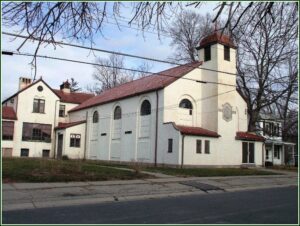
, OH
Eckstein Elementary School operated on this site from 1915 to 1958, serving Glendale’s Negro children from Kindergarten through eighth grade. The school was named in honor of Eleanor Eckstein, who taught the children at various locations in the village during the time of segregation in America. Upon completing eighth grade, Eckstein School’s students were integrated with their white counterparts in grades nine through twelve at Congress Avenue School. The Eckstein School building evolved from a single family dwelling into its present structure through a series of expansions, the last of which was the addition of the gymnasium in 1928. In the mid-1950s Glendale became a part of the Princeton School District. A new consolidated high school opened in 1958, the Congress Avenue School became Glendale Elementary, and Eckstein was closed. This commemorative text was composed by alumni of the Eckstein School.