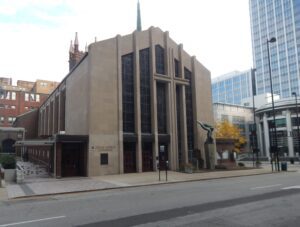
In 1817 twenty-two men, including future President William Henry Harrison, chartered Cincinnati’s first Episcopal parish, Christ Church. In 1835 members erected a Gothic Revival-style church on this site. The neighborhood evolved as the city grew with the influx of immigrants. Parish women raised funds to teach, feed, clothe, and shelter tenement families, and alleviate suffering during floods and disease outbreaks. In 1883 the women helped establish what became Cincinnati Children’s Hospital. In 1909 members opened the Late Gothic-style Parish House, a community center with kitchen, classrooms, library, auditorium, clinic, gymnasium, and bowling alley. By the parish’s centennial in 1917, music had expanded beyond worship to public concerts. In 1940 the annual Boar’s Head Festival of music and pageantry began. Since the 1960s, members have collaborated with local agencies to advocate for social and economic justice, a mission continuing into the 21st century. (Continued on other side)
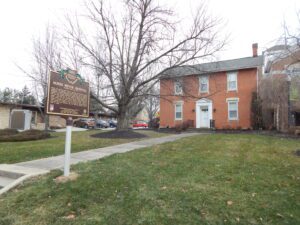
The house at this location, 110 South State Street, was the childhood home of Agnes Meyer Driscoll (1889-1971). Known as “the first lady of naval cryptology,” her career spanned from World War I to the Cold War. Driscoll attended Otterbein University before graduating from the Ohio State University, with majors in physics, math, music, and foreign languages. During World War I, she enlisted in the U.S. Navy as a chief yeoman, the highest rank possible for a woman at the time. After the war, Driscoll rose to become the chief civilian cryptanalyst for the U.S. Navy, breaking major Imperial Japanese Navy codes prior to World War II. (Continued on other side)
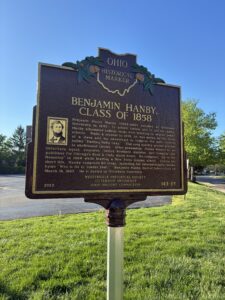
Benjamin Russel Hanby (1833-1867) enrolled at Otterbein University in 1849. To afford tuition and to aid his family, Hanby alternated college terms with teaching in nearby public schools. While a student in 1856, he was moved by the story of a slave and his sweetheart to compose the anti-slavery ballad “Darling Nelly Gray.” The song quickly proved popular in abolitionist circles. After graduation, Hanby worked as an Otterbein agent, educator, United Brethren minister, and compiler and publisher for Chicago’s Root & Cady music house. He composed “Up on the Housetop” in 1864 while leading a New Paris singing school. During his short life, Hanby composed 80 songs, including the internationally-known hymn “Who is He in Yonder Stall.” Benjamin Hanby died of tuberculosis on March 16, 1867. He is buried in Otterbein Cemetery.