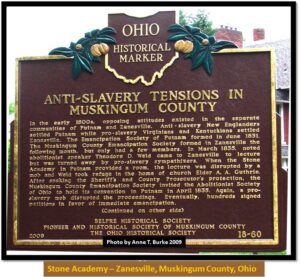
In the early 1800s, opposing attitudes existed in the separate communities of Putnam and Zanesville. Anti-slavery New Englanders settled Putnam while pro-slavery Virginians and Kentuckians settled Zanesville. The Emancipation Society of Putnam formed in June 1831. The Muskingum County Emancipation Society formed in Zanesville the following month, but only had a few members. In March 1835, noted abolitionist speaker Theodore D. Weld came to Zanesville to lecture but was turned away by pro-slavery sympathizers. When the Stone Academy in Putnam provided a room, the lecture was disrupted by a mob and Weld took refuge in the home of church Elder A.A. Guthrie. After seeking the Sheriff’s and County Prosecutor’s protection, the Muskingum County Emancipation Society invited the Abolitionist Society of Ohio to hold its convention in Putnam in April 1835. Again, a pro-slavery mob disrupted the proceedings. Eventually, hundreds signed petitions in favor of immediate emancipation. [continued on other side]
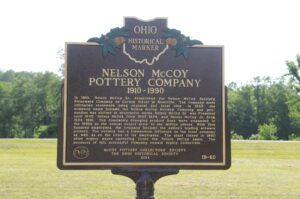
In 1910, Nelson McCoy Sr. established the Neleson McCoy Sanitary Stoneware Company on Gordon Street in Roseville. The company made utilitarian stoneware using regional and local clay. In 1933, the company name became the Nelson McCoy Pottery Company and production was shifted to decorative wares. Nelson McCoy Sr. was President until 1945, Nelson Melick from 1945-1954, and Nelson McCoy Jr. from 1954-1981. The constantly changing product lines were expanded in the 1950s as the annual output grew to ten million pieces. WIth five hundred employees, the company became the nation’s leading artware pottery. The pottery had a tremendous influence on the local economy as well as on the lives of its employees. The plant closed in 1990 after eighty years operating under the Nelson McCoy name. The products of this successful company remain highly collectible.