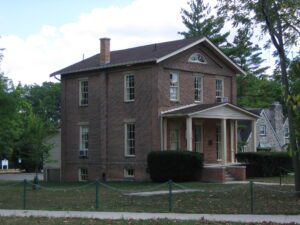
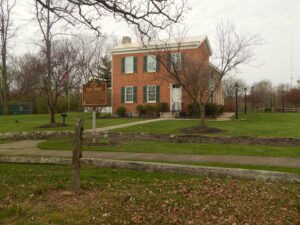
Reverend Lorenzo Langstroth, renowned as “The Father of American Beekeeping,” lived in this simple two-story, eight-room house with his wife, Anne, and their three children from 1858 to 1887. Unchanged externally, the Greek Revival cottage features brick pilasters and pediments and a fan-shaped front window. In his garden workshop, Langstroth made experimental beehives, established an apiary, and on the ten acres that surrounded his home, grew buckwheat, clover, an apple orchard, and a “honey garden” of flowers. He imported Italian queen bees in efforts to improve native bees and shipped his queens to keepers across the United States and around the world. The Langstroth Cottage was placed on the National Register of Historic Places in 1976 and designated a National Historic Landmark in 1982. (Continued from other side)
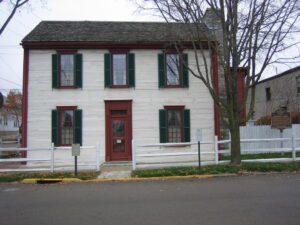
Benjamin Overfield (1774-1831), son of a Revolutionary War soldier, opened his tavern in this log house on September 13, 1808. Never moved, it is the oldest surviving building in Troy. The tavern provided food, lodging and space for business and social gatherings. Overfield agreed to let the county use a room on the second floor of the building as a temporary courtroom. Behind the tavern, Benjamin built a small log cabin that was home to his family. He prospered here until 1825 when he moved to the Public Square. Today’s structure includes the tavern, the cabin, and later additions. Used as a dwelling from 1825 until 1948, the building now houses the Overfield Tavern Museum. Benjamin Overfield and his first wife Mary are buried in Rose Hill Cemetery.
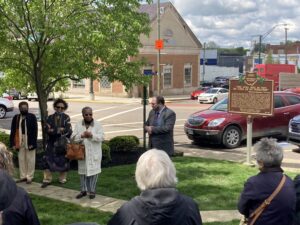
Ellamae Simmons, born and raised in Mount Vernon, became the first African American woman physician to specialize in asthma, allergy, and immunology in the country. Graduating in the top of her high school class, she dreamed of attending Ohio State University to become a nurse but was rejected as that program “did not have the facilities for training” the young black girl. Whenever Simmons encountered a barrier in life she refused to accept rejection, tenaciously steered the course of her own life, and blazed new trails for others. She ultimately earned degrees in nursing (Hampton, 1940), pre-med biological sciences (OSU, 1948), social work (OSU, 1950), and medicine (Howard University, 1959). Dr. Simmons again broke gender and racial barriers when hired by Kaiser Permanente in 1965. She practiced there until retiring in 1989. Simmons died aged 101.
Ebenezer Sheldon (1754-1825) was born in Suffield, Connecticut. On April 19, 1775, he answered the “Lexington Alarm,” fought in the Revolution, and, in 1789, was appointed a captain in Connecticut’s militia. Following the Revolution, Sheldon, like many others, suffered financial hardships and sought a new beginning in the Western Reserve. In 1799, he established a homestead in Aurora and returned to Connecticut the following year to bring his wife Lovee and their six children to the area. A family legend relates that when Lovee saw the family’s home she “shed a few tears over the cheerless prospects” of her new life in the wilderness.
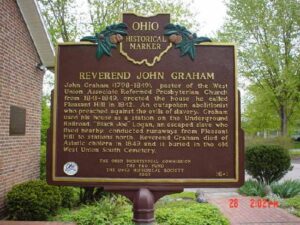
John Graham (1798-1849), pastor of the West Union Associate Reformed Presbyterian Church from 1841-1849, erected the house he called Pleasant Hill in 1842. An outspoken abolitionist who preached against the evils of slavery, Graham used his house as a station on the Underground Railroad. “Black Joe” Logan, an escaped slave who lived nearby, conducted runaways from Pleasant Hill to stations north. Reverend Graham died of Asiatic cholera in 1849 and is buried in the old West Union South Cemetery.
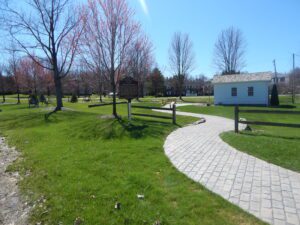
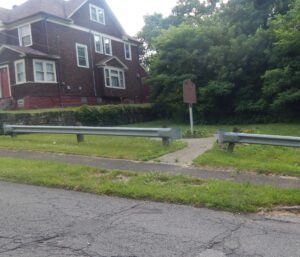
Oscar D. Boggess (1832-1907) was born in Virginia, the son of a slave and her master. He and his family were granted freedom in the will of his father and master. The will was contested up to the United States Supreme Court, which upheld Boggess’ freedom. Boggess moved to Pennsylvania at age 20, and during the Civil War, joined the 43rd United States Colored Troops. He earned the Butler Medal of Honor for bravery at the Battle of the Crater near Petersburg, Virginia, in July 1864. Boggess moved to Youngstown after the war, and worked as a stonemason. He was a charter member of Tod Post 29, Grand Army of the Republic, in Youngstown, and a co-founder of the Oak Hill Avenue African Methodist Episcopal Church, the city’s first African American religious congregation. The Boggess home, formerly located near this site, hosted the church’s first meetings in 1870.
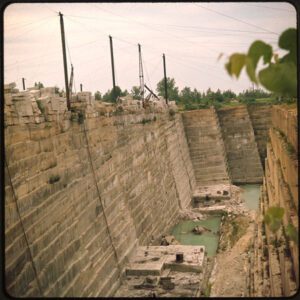
For more than ninety years, this area was the heart and soul of Berea’s sandstone quarries. In the early 1830s, John Baldwin discovered that the area’s sandstone deposits made superb grindstones and building stones. In the 1840s, thriving sandstone quarries developed and became Berea’s lifeblood. Searching for the “American Dream,” German, Irish, Italian, Hungarian, and Polish immigrants, among others, came here to work. The quarries eventually encompassed nearly 250 acres and consumed the fashionable houses of Berea’s “South Side” and the buildings of Baldwin University. The Cuyahoga County Court House, Ohio’s Capitol, and Canada’s parliament buildings are among many structures in North America and Europe constructed of Berea sandstone. Decreasing demand for sandstone and the Great Depression closed the last of Berea’s quarries in the mid-1930s.
Elisha Morgan purchased 48.6 acres in Fairfield Township, part of the Symmes Purchase, in 1817. The Farm Mansion was built shortly after he settled the land. The house incorporates two prevalent architectural styles in southwest Ohio in the nineteenth century. The original front portion is an example of Federal style architecture while the 1858 rear addition represents the Greek Revival style. Built earlier than most farmsteads in the township, the Mansion is a rare example of an early farmhouse that has survived despite suburban development. The Mansion is listed on the National Register of Historic Places.