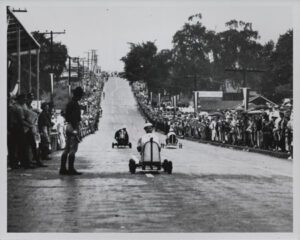
An annual summer tradition for American youth since the 1930s, the All-American Soap Box Derby was the concept of journalist Myron E. (“Scottie”) Scott, who covered an impromptu homebuilt gravity-car race in Dayton in 1933. Scott conceived and promoted a prize-awarding event later that year, and to his surprise 362 boys entered the race. Restrictions on material cost and participants’ ages widened the sport’s appeal; the Soap Box Derby held its first national championship in Akron in 1935, sponsored by the auto and rubber industries. Derby Downs, built as a public works project by the New Deal-era Works Progress Administration (WPA), has been the event’s home since 1936. The Soap Box Derby continues to promote the values of craftsmanship, sportsmanship, and perseverance for generations of American youth.
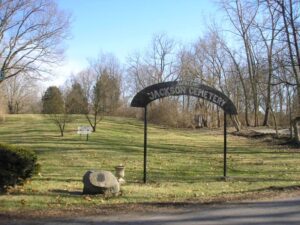
In 1833, John Randolph from Roanoke, Virginia, died leaving three wills that requested that all of his slaves be set free and that land be purchased for them. Although contested for thirteen years by his family, the slaves were freed and the executor of the wills, Randolph’s cousin Judge William Leigh purchased about 2,000 acres of farm land in Mercer County, Ohio. Traveling by wagon train, the freed slaves, 383 in all, reached their destination in 1846, but were forced to turn back by earlier established white settlers. They turned around and ended up north of Piqua where they purchased land and developed the Village of Rossville. Later some moved on to other places in Miami County and well as Shelby County. In Rossville, they established an African Baptist Church in 1869, cemetery in 1866, and public black school in 1872.
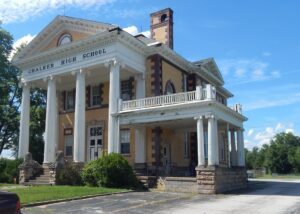
Southington native Newton Chalker built, furnished, and donated Chalker High School to his community in 1907. Chalker was born in 1842 in Southington Township and lived there until adulthood. He later built a prosperous law and real estate practice in Akron. Chalker’s dedication to improve educational opportunities in the township likely originated with his personal struggle to complete high school, which was repeatedly interrupted by financial concerns and family obligations. The Chalker High School building was designed in the Neo-Classical Revival architectural style which was favored for public buildings, churches and schools early in the twentieth century. The building exhibits Classical influences through the use of fluted columns that support a pedimented gable, resembling a Greek temple. Chalker High School and the Civil War Monument were listed in the National Register of Historic Places in 2010. (Continued on other side)
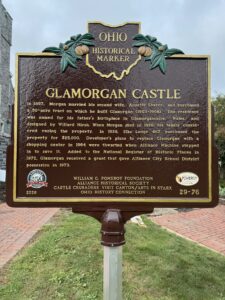
Colonel William Henry Morgan was born in Pittston, Pennsylvania, to parents Thomas Rees Morgan and Elizabeth Nicholas Morgan. The family relocated to Alliance in 1871. Educated in the Alliance Public Schools, Morgan completed his grade 12 exams and began working for his father’s engineering firm. Possessed of an inventive electrical and engineering mind, Morgan and his father patented the overhead traveling crane that revolutionized the steel industry. Upon his father’s death in 1897, Morgan became president of Morgan Engineering Company. He was appointed an honorary “Colonel” when Ohio Governor George K. Nash (1900-1904) made him an aide-de-camp on his staff.
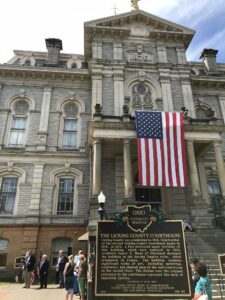
Licking County was established in 1808. Construction of the current Licking County Courthouse began in 1876. In 1879, a fire destroyed upper portions of this building, which was replaced in 1880. Architect Henry E. Myer of Cleveland designed the building in the Second Empire Style, which originated in France. The building contains significant works of art, including paintings, sculptures, and stained glass in the west courtroom on the second floor. The statues over the original entrances to the courthouse represent the ideal of impartial justice. (Continued on/from other side)
Known by the trade name Henderson’s Printing, the business was a mainstay of Dayton’s African American community for almost 60 years and became a printer of choice for everything from advertising materials, office forms, and a community publications called “housewife savers.” John William Henderson Sr. (1913–1991) purchased his first printing press and founded the business in 1941, bringing to it experience as an instructor of journalism and printing at Wilberforce University. The business’s first location was the family home at 421 Kearney St. After several moves, the business settled at 301 Washington Street in 1958.
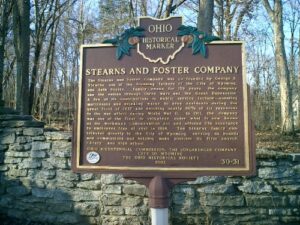
The Stearns and Foster Company was co-founded by George S. Stearns, one of the founding fathers of the City of Wyoming, and Seth Foster. Family-owned for 139 years, the company saw the nation through three wars and the Great Depression. A few of its contributions to public service include-donating mattresses and drinking water to area residents during the great flood of 1937 and devoting nearly 80% of its resources to the war effort during World War II. In 1911, the company was one of the first to volunteer under what is now known as the Workman’s Compensation Act and offered life insurance to employees free of cost in 1914. The Stearns family contributed greatly to the City of Wyoming, serving on boards and commissions and helping make possible its first church, library, and high school.
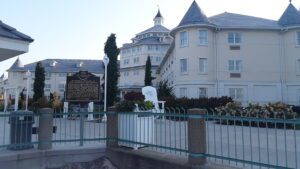
About 60 leaders of Ohio hospitals gathered at the Hotel Breakers on August 25, 1915 to form the Ohio Hospital Association (OHA), the nation’s first state hospital association. Established 15 years after the American Hospital Association, the OHA formed, in part, to address state legislation regarding hospitals and public health. Issues addressed in OHA’s first years included Ohio’s 1915 Nurse Practice Act, workers’ compensation rates, and the federal Harrison Narcotics Tax Act. A century later, OHA represents 220 hospitals and 13 health systems guided by a mission “to collaborate with member hospitals and health systems to ensure a healthy Ohio.”