Activity of the Underground Railroad is believed to have begun in Brookfield Township around 1838 with the first known runaway slaves, two women, to pass through in 1843. Freedom seekers moved north using a system of routes known by operators, or “conductors”. Trumbull County reputedly had over 150 miles of Underground Railroad routes, which would have made it the largest network in Ohio. The slaves that passed through Brookfield Township came mostly from the Youngstown, Poland, and the Canfield areas. From Brookfield they were sent north to Hartford, Kinsman, Burghill, and Vienna ultimately headed to Canada.
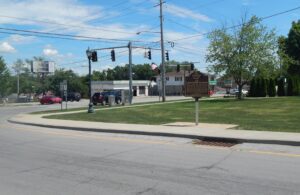
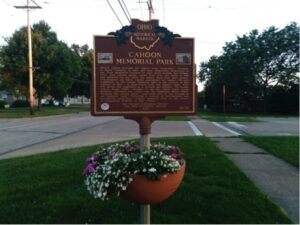
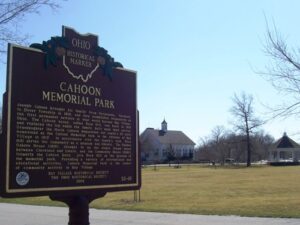
Joseph Cahoon brought his family from Vergennes, Vermont, to Dover Township in 1810, and they established themselves as the first permanent settlers in what would become Bay Village, Ohio. The Cahoon house, called Rose Hill, was built in 1818 and replaced the log cabin the family built upon their arrival. Granddaughter Ida Maria Cahoon bequeathed her family’s 115-acre homestead as the Cahoon Memorial Park to the citizens of Bay Village in 1917. In accordance with the family’s wish, Rose Hill serves the community as a museum and library. The Reuben Osborn House (1815), thought to be the oldest frame house between Cleveland and Lorain, and the Community House (1882), formerly the Cahoon barn, join Rose Hill on the grounds of the memorial park. Providing a variety of recreational and educational activities, Cahoon Memorial Park is the center of community activity in Bay Village.
Joseph Cahoon brought his family from Vergennes, Vermont, to Dover Township in 1810, and they established themselves as the first permanent settlers in what would become Bay Village, Ohio. The Cahoon house, called Rose Hill, was built in 1818 and replaced the log cabin the family built upon their arrival. Granddaughter Ida Maria Cahoon bequeathed her family’s 115-acre homestead as the Cahoon Memorial Park to the citizens of Bay Village in 1917. In accordance with the family’s wish, Rose Hill serves the community as a museum and library. The Reuben Osborn House (1815), thought to be the oldest frame house between Cleveland and Lorain, and the Community House (1882), formerly the Cahoon barn, join Rose Hill on the grounds of the memorial park. Providing a variety of recreational and educational activities, Cahoon Memorial Park is the center of community activity in Bay Village.
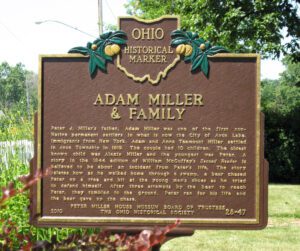
The Peter J. Miller House was constructed around 1830 and is one of the last remaining pre-Civil War lakefront houses in Lorain County. The architecture is Greek Revival. Peter Miller married Ruth Houseworth in 1828. They had five children. In 1851 Peter Miller died and it’s believed that his family continued to reside on the property until 1925. The City of Avon Lake purchased the property in 1962. The house was opened for tours, and restoration proceeded, as funds were available. In 1975 the water heating system burst and caused extensive damage. In 1985 a new committee took over and was successful in restoring the house. Volunteer trustees have overseen the operation of the house as a museum since September 1989.
Waldschmidt Cemetery is located on land purchased from former New Jersey judge and Congressman John Cleves Symmes in 1795 by Christian Waldschmidt, one of the first settlers in the Little Miami River Valley. Waldschmidt, from Lancaster, Pennsylvania, was a veteran of the American Revolution, and he and his family are buried here. During the Civil War this area, named for Governor William Dennison, served as a training site and hospital for the Union effort. A portion of the cemetery was the temporary interment site for 349 Union soldiers and 31 Confederate prisoners of war, most of whom died at the camp hospital. On July 4, 1869, the Union soldiers were moved to Spring Grove Cemetery in Cincinnati. About the same time, the Confederate soldiers were reinterred in Chase Cemetery in Columbus, Ohio.
In 1833, John Randolph from Roanoke, Virginia, died leaving three wills that requested that all of his slaves be set free and that land be purchased for them. Although contested for thirteen years by his family, the slaves were freed and the executor of the wills, Randolph’s cousin Judge William Leigh purchased about 2,000 acres of farm land in Mercer County, Ohio. Traveling by wagon train, the freed slaves, 383 in all, reached their destination in 1846, but were forced to turn back by earlier established white settlers. They turned around and ended up north of Piqua where they purchased land and developed the Village of Rossville. Later some moved on to other places in Miami County and well as Shelby County. In Rossville, they established an African Baptist Church in 1869, cemetery in 1866, and public black school in 1872.
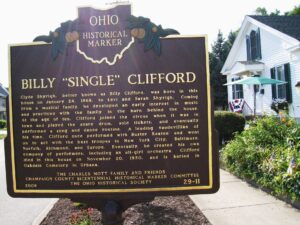
Clyde Shyrigh, better known as Billy Clifford, was born in this house on January 24, 1869, to Levi and Sarah Shyrigh. Coming from a musical family, he developed an early interest in music and practiced with the family in the barn behind the house. At the age of ten, Clifford joined the circus when it was in town and played the snare drum, sold tickets, and eventually performed a song and dance routine. A leading vaudevillian of his time, Clifford once performed with Buster Keaton and went on to act with the best troupes in New York City, Baltimore, Norfolk, Richmond, and Europe. Eventually, he created his own company of performers, including an all-girl orchestra. Clifford died in this house on November 20, 1930, and is buried in Oakdale Cemetery in Urbana.
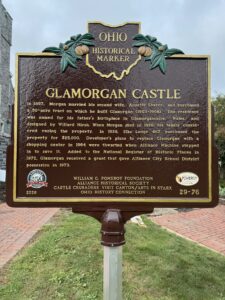
Colonel William Henry Morgan was born in Pittston, Pennsylvania, to parents Thomas Rees Morgan and Elizabeth Nicholas Morgan. The family relocated to Alliance in 1871. Educated in the Alliance Public Schools, Morgan completed his grade 12 exams and began working for his father’s engineering firm. Possessed of an inventive electrical and engineering mind, Morgan and his father patented the overhead traveling crane that revolutionized the steel industry. Upon his father’s death in 1897, Morgan became president of Morgan Engineering Company. He was appointed an honorary “Colonel” when Ohio Governor George K. Nash (1900-1904) made him an aide-de-camp on his staff.