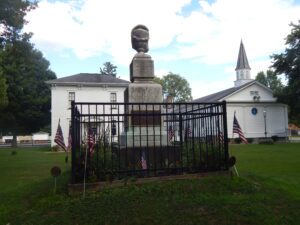
With the outbreak of the Civil War in 1861, many young men of Bristol Township enlisted in the army when President Abraham Lincoln issued his call to defend the Union cause. The death toll of some of these men at the Battle of Shiloh in Tennessee in April 1862 touched the local community as did the loss of Bristol Township lives at the Battle of Perryville in Kentucky, the Battle of Cedar Mountain in Virginia, and other theaters of war later in the year. The local citizenry responded to a plan for a lasting public memorial at the Town Park through a fund raising campaign. In 1863 the town square was transformed with a marble monument placed on an elevated mound at its center. The monument was designed by local artist Frank J. Hammond and manufactured by Myers, Uhl & Company of Cleveland at a cost of $500. [continued on other side]
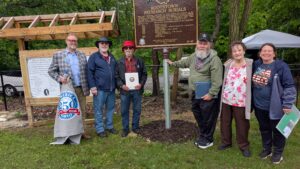
The Rootstown Old Cemetery (sometimes “Ye Olde Cemetery”) began as a two-acre parcel set aside on the Abram and Siley Reed Farm for use as a burying ground. County histories record that Nathan Chapman Sr. (1759-1809) was the first burial. Although the Reeds dedicated their parcel as a community cemetery in 1816, it was not until 1861 that Reed Family heirs sold the plot to Rootstown Township for the sum of $1. Old Cemetery remained an active burial ground for more than a century; farmer Frank Seymour (1861-1942) was the last burial. Cemetery researchers recorded three hundred and ninety-eight burials in Old Cemetery; one hundred and twenty-six of those graves were unmarked. The Rootstown cemetery is the final resting place for veterans of the American Revolution, the War of 1812, and the Civil War.
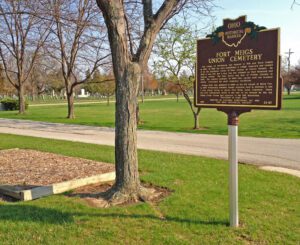
The village of Perrysburg was founded in 1816 and Wood County in 1820. In 1822 the town established a village cemetery and located it on the southwest corner of West Indiana at Cherry Streets. By 1848 it was full and a new one was created on West Boundary and Indiana Avenue. The first burial was that of William Cassady in 1849. The cholera epidemic of 1854 that caused over one hundred deaths, overloaded the small cemetery workforce. Potters Field was designed in 1868 on the NW corner of Block Two. In 1877 Perrysburg Township bought adjacent land in sections K and L and joined forces to create Fort Meigs Union Cemetery. There are nine underground vaults in the side of the terrace by the old Ewing Creek stream bed adjacent to the 1912 mausoleum.
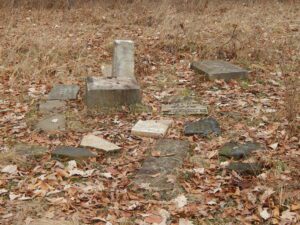
There are 48 known members of the Postle family buried in the cemetery. Their stories are interwoven with the history of Prairie Township, Franklin County, and Ohio. In 1810, Shadrach and Anna Stacia Postle were among the first settlers of Prairie Township. Their son Job was a veteran of the War of 1812 and later owned the Checker Inn, a popular stopping place on the National Road. In the 1860s, Smith Postle and his son, William Sylvester Postle, were some of the first manufacturers of clay drainage tile in Ohio. Their products improved drainage in farm fields and fostered the growth of the tile industry in the state. Gabriel Postle was the first Postle buried in the cemetery in 1829. Twelve graves are of children under the age of six, which testifies to the hardships endured by the area’s early residents. Other graves include those of John Whitehurst, a freed slave who lived with the family of the Job Postle and John Tracy, a veteran of the Civil War. In 1870, Nancy Postle was the last person buried in the cemetery.
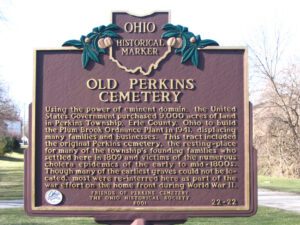
Using the power of eminent domain, the United States Government purchased 9,000 acres of land in Perkins Township, Erie County, Ohio to build the Plum Brook Ordnance Plant in 1941, displacing many families and businesses. This tract included the original Perkins cemetery, the resting-place for many of the township’s founding families who settled here in 1809 and victims of the numerous cholera epidemics of the early to mid-1800s. Though many of the earliest graves could not be located, most were re-interred here as part of the war effort on the home front during World War II.
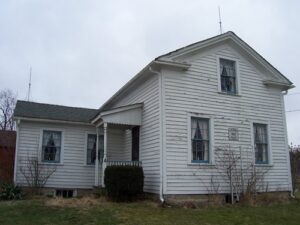
This 48-acre farm is the last remnant of an agricultural way of life that characterized Parma Township well into the 20th century. The farmhouse, built circa 1855 by Western Reserve settler Lyman Stearns, is representative of the Greek Revival style of architecture popular in this region prior to the Civil War. The “Yankee” style barn predates the house. Suburban development following World War II engulfed virtually all of this area by the 1950s. The Stearns Homestead was added to the National Register of Historic Places in 1981. (continued on other side)
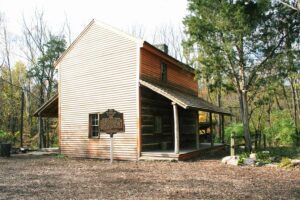
The 1804 Iddings House is the oldest structure on its original site in Miami County. A second generation American and cousin to General “Mad” Anthony Wayne, Benjamin Iddings brought his wife, Phoebe, and six of their ten children up the Stillwater River into Newton Township and constructed the log house in 1804. In 1976 the structure was placed on the National Register of Historic Places with an initial restoration in 1981. Thanks to community support, further restoration was completed in 2006.
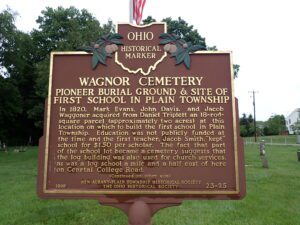
In 1820, Mark Evans, John Davis, and Jacob Waggoner acquired from Daniel Triplett an 18-rod-square parcel (approximately two acres) at this location on which to build the first school in Plain Township. Education was not publicly funded at the time and the first teacher, Jacob Smith, “kept” school for $1.50 per scholar. The fact that part of the school lot became a cemetery suggests that the log building was also used for church services, as was a log school a mile and a half east of here on Central College Road. (continued on other side)