

, OH
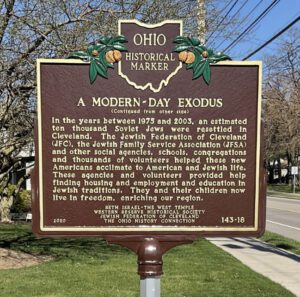
Here in 1963 congregants of Beth Israel-The West Temple, led by Louis Rosenblum, Herb Caron, and Rabbi Daniel Litt, founded the Cleveland Committee (later Council) on Soviet Anti-Semitism, the first American organization created to advocate for freedom for Soviet Jews. In 1970 this work led to the formation of the Union of Councils for Soviet Jews (UCSJ) under the leadership of Louis Rosenblum. The UCSJ, whose national office was located here 1970-1973, became the largest independent Soviet Jewry organization in the world. By the turn of the 21st century, the efforts begun here helped 1.6 million Jews leave the former Soviet Union. (Continued on other side)
, OH
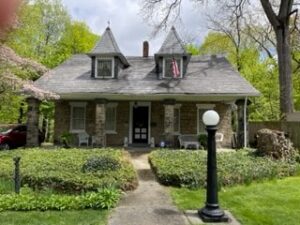
The Curtis-Preyer Stone House takes its name from two families associated with its early history. Richard and Clarissa Dille Curtis purchased 70 acres in the Connecticut Western Reserve from veteran Elias Lee in 1819. The Euclid Township “Turkey Knob” settlement soon thrived around Dugway Brook, springs sites, and an American Indian crossroads. The Curtis, Dille, Lee, and Stillman families, related by marriage, helped each other succeed by harnessing the creek to power their grist and saw mills and selling quarried stone and felled timber. Sometime between 1819 and 1835 Curtis built his stone house using the Berea sandstone quarried on site. The roof was created of ax-hewn “pegged” tree timbers, and the thick stone walls fashioned of uncoursed, chiseled stones. A central chimney fed seven fireplaces and a bake oven.

, OH
Cory United Methodist Church is an icon of Cleveland’s civil rights movement. As one of the city’s largest Black-owned churches during the 1960s, Cory hosted events for national, local, and grassroots organizations such as the Fair Employment Practices Committee, NAACP Cleveland Branch, Cleveland Chapter of the Congress of Racial Equality (CORE), and United Freedom Movement. Over 75 years later, Cory UMC continues its long tradition of community programming that promotes equity and education. Originally designed by architect Albert F. Janowitz to house the Anshe Emeth Beth Tefilo congregation, the building served as the Cleveland Jewish Center from 1922 to 1945. The Methodist congregation purchased it in 1946. Since 1961, the building has also been home to the Glenville Recreation Center. Cory UMC was designated as a local landmark by the Cleveland Landmarks Commission in 2012.
, OH
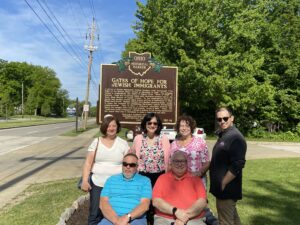
A group of Jewish immigrants fleeing Germany after Kristallnacht (The Night of the Broken Glass) settled in Cleveland in 1940. The refugees formed a congregation and named it Shaarey Tikvah, “Gates of Hope” in Hebrew. They met in private homes until obtaining premises above the Tasty Shop Bakery on Euclid Avenue. As the congregation thrived it moved and merged several times before settling in Beachwood in 1986. Rabbi Jacob Shtull, Shaarey Tikvah’s first English-speaking Rabbi, sought to honor the founders by establishing Cleveland’s annual Kristallnacht commemoration. “Face to Face,” a Holocaust education program that shares the refugee story with local schools, began in 1994. Today, this “Small Shul. Large Community” remains a tribute to the German immigrants that found their way to Cleveland to unite in friendship and faith.
, OH
Players of the Cleveland Browns gathered eleven Black professional athletes and future mayor Carl Stokes to discuss with boxer Muhammad Ali (January 17, 1942-June 3, 2016) his refusal to serve in the Vietnam War. After their private meeting on June 4, 1967, the twelve men decided to “support Ali on principle” and held a lengthy national press conference. The boxer, considered the “greatest heavyweight of all time,” garnered national scorn and paid a high price for his stance. Ali was arrested, found guilty of draft evasion, his passport confiscated, titles stripped, and U.S. boxing licenses suspended. The men in attendance also faced condemnation and threats. In 1971, the Supreme Court unanimously overturned Ali’s conviction. The Cleveland Ali Summit is considered “one of the most important civil rights acts in sports history.”
, OH
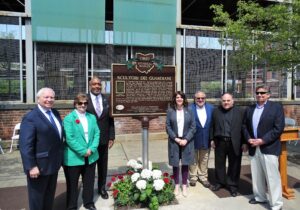
Guardians of Traffic,” four double-sided figural pylons towering over 40-feet above either end of the Hope Memorial Bridge, have connected Cleveland’s east and west side since 1932. They were designed by architect Frank R. Walker and lead sculptor Henry Hering. More than 20 immigrant stonemasons — many fromthe Italian village of Oratino — carved the figures at Ohio Cut Stone Company on Random Road from sandstone quarried in nearby Berea. The Italian sculptors lived or worshipped in Cleveland’s Little Italy. Each hand-carved Guardian holds a different vehicle, meant to portray the history of ground transportation. Voted “an outstanding architectural triumph” by the American Institute of Steel Construction in 1936, the bridge and its iconic Guardians were added to the National Register of Historic Places in 1976.
, OH
The Greater Abyssinia Baptist Church (GABC) organized with 250 members on December 16, 1945, at a Phillis Wheatley Association meeting. Led by its first pastor, Rev. John Rollins Plummer, the congregation raised $47,000 to purchase the Jewish Synagogue at East 105th Street and Tacoma Avenue from the Beth Hamedrosh Hagodel Beth Israel Congregation in 1946. It later purchased a parsonage, land for parking, and created a Federal Credit Union. Tragically, Rev. Plummer was killed in a car accident on October 22, 1951. The church’s lower auditorium was remodeled and dedicated as J.R. Plummer Memorial Hall. Honoring its missionary and pastoral care foundations, the church built a $3M senior citizens complex nearby. An endowment fund, instituted by its pastor’s savings in 1995, ensures that this commitment to civic leadership endures.

, OH
Prominent architect William S. Lougee designed the Woodland Public Bath House that opened in 1915 at a cost of approximately $90,000. The first floor of the facility included separate shower baths for men and women, an office, waiting rooms, and a gymnasium with a 53-yard running track. The second story was divided into four rooms: a club room, a small city library branch, a baby dispensary, and clinic. The basement featured an indoor swimming pool popular among adults and children. Like other public bath houses in Cleveland, the Woodland Bath House was an invaluable social space for its diverse community of largely Hungarian, but also Slovak, Bohemian, Italian, Lithuanian, and Jewish residents. In 1918, the City estimated that 254,508 residents had used Woodland Bath House facilities, enjoying classes, camps, baths, and clinics.