Hebrew Union College (HUC), founded in Cincinnati in 1875, is the oldest institution of higher Jewish learning in the United States. Its founder, Rabbi Isaac Mayer Wise (1819-1900), was a leading proponent of Reform Judaism in America. In 1950, the college merged with the Jewish Institute of Religion (JIR), a liberal Jewish seminary in New York founded by Rabbi Stephen S. Wise (1874-1949) in 1922. A third center opened in Los Angeles in 1954 to serve Jewry on the West Coast and, in 1963, a fourth campus opened in Jerusalem. As of 2003, HUC-JIR educates rabbis, cantors, communal, and educational professionals. It also offers advanced academic training for scholars of all faiths. The holdings of the school’s Klau Library constitute one of the most extensive Jewish libraries in the world.
Dr. Jacob Rader Marcus (1896-1995), pioneering historian of the American Jew, founded the American Jewish Archives (AJA) in Cincinnati in 1947. In the aftermath of World War II and the brutal destruction of European Jewry, Marcus anticipated the need to establish a central repository dedicated to preserving the history of North American Jewry. The AJA, which began with a few boxes of documents, has become one of the world’s largest catalogued collections of primary source material on the history of American Jewry. An international community of scholars, researchers, and students utilizes the AJA’s vast archival holdings.
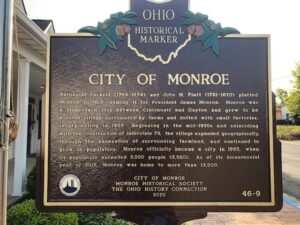
Nathanial Sackett (1768-1854) and John H. Piatt (1781-1820) platted Monroe in 1817, naming it for President James Monroe. Monroe was a stagecoach stop between Cincinnati and Dayton and grew to be a rural village surrounded by farms and dotted with small factories, incorporating in 1907. Beginning in the mid-1950s and coinciding with the construction of Interstate 75, the village expanded geographically, through the annexation of surrounding farmland, and continued to grow in population. Monroe officially became a city in 1995, when its population exceeded 5,000 people (5,380). As of its bicentennial year of 2017, Monroe was home to more than 13,000.
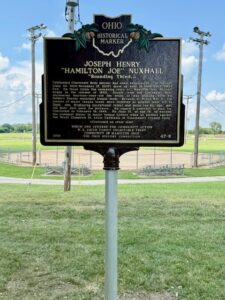
Celebrated Cincinnati Reds pitcher and radio broadcaster, Joe Nuxhall (July 30, 1928 – November 15, 2007) grew up here in Hamilton’s North End. On these fields the endearing story of “Hamilton Joe” Nuxhall began in the summer of 1943. Scouts from the Cincinnati Reds discovered fourteen-year-old Joe while he was playing with his father’s Sunday municipal league team. Because of World War II, the rosters of major league teams were depleted as players went off to fight. Joe, displaying exceptional talent and poise for his age, met the Reds’ dire need for pitchers. He signed a contract to play for Cincinnati on February 18, 1944. On June 10, at age 15, he became the youngest player in major league history when he pitched against the World Champion St. Louis Cardinals at Cincinnati’s Crosley Field. (Continued on other side)
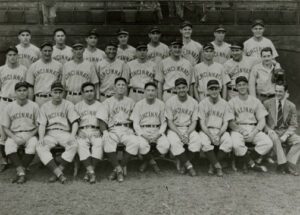
The 1869 Cincinnati Red Stockings made history not only as the most dominant baseball club of its time, but also as the first band of professional ballplayers. Cincinnati’s decision to pay players proved to be a success, and other cities soon began establishing their own professional clubs throughout America. In 1876, the Reds joined the newly formed National League. Baseball soon became one of Cincinnati’s most popular entertainment venues, aided in part by the team’s World Series titles in 1919 and 1940. Cincinnati’s “Big Red Machine,” featuring players such as Johnny Bench, Joe Morgan, and Pete Rose, dominated baseball in the 1970s, picking up additional titles in 1975 and 1976. A surprise wire-to-wire title again in 1990 strengthened the Reds’ legacy and helped ensure future generations of Reds fans.
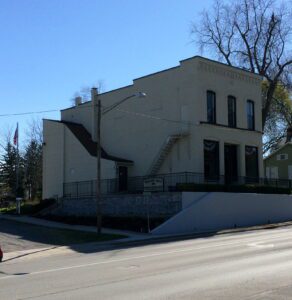
Henry Hanford Wakeman (1840-1879) of New York came to Waterville and became a successful businessman. He conceived the idea of a local Masonic Lodge, which became Wakeman Lodge No. 522 Free and Accepted Masons in 1879, and bequeathed $1,000 toward the construction of a meeting place. In 1880, a cornerstone was laid and this building was dedicated on October 21, 1881. For over 100 years, the Masons held their meetings upstairs while the lower floor was often rented out to a succession of businesses or used for public gatherings. Rising maintenance expenses and lower membership numbers caused the Masons to put Wakeman Hall up for sale in 1995. The Waterville Historical Society purchased the building in 1997 and spent several years rehabilitating it to serve as a local history archive and the Historical Society’s meeting place.
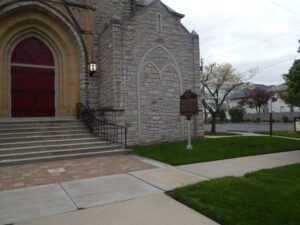
Saint Lucas Evangelical Lutheran Church, 745 Walbridge Ave
Toledo
, OH
In 1886, thirty-six members from Toledo’s downtown Lutheran church, St. Paul’s, met to form a German-speaking Lutheran congregation for immigrants from Pommern, Mecklenburg and Hanover. Initially worshipping at St. Stephen’s at the corner of Harrison and Oliver Street, the congregation built a frame church on this site in 1887. That same year St. Lucas pioneered an early form of health insurance, The Mutual Sick Benefit Society, that later became a larger fraternal organization called The Mutual Sick Benefit Society for Ohio and Other States. In 1999, after joining a program called Reconciling in Christ, St. Lucas became the first Lutheran congregation in northern Ohio to publicaly welcome the LGBT communities. Named after Saint Luke, the patron saint of physicians, the church’s history is one of healing.
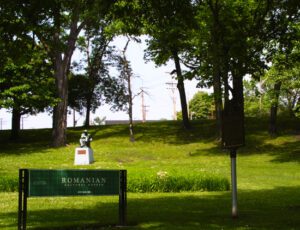
The Union and League of Romanian Societies, Incorporated was formed in 1928 from a unification of two separate fraternal organizations, the Union and the League. The Union, founded on July 4, 1906, was originally organized for the purpose of promoting the general welfare of its members through life insurance policies obtained through individual societies located in the United States and Canada. The societies of the Union and League offer social interaction within their local lodges and through the strength of the larger parent organization. The purpose of the current Union and League is to maintain and encourage Romanian cultural heritage by promoting interest in Romanian ethnic values through cultural activities and to sustain loyalty to the United States and Canada among its respective members.