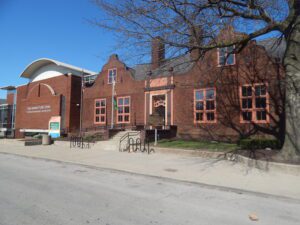
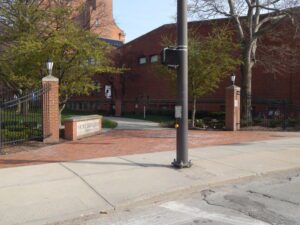
On November 12, 1913, the Board of the East Cleveland Public Library met in the office of the East Cleveland Board of Education, plans for a new Library were underway. The Carnegie Corporation of New York contributed $35,000 towards the cost of a new building. John D. Rockefeller contributed $3,600 to buy land for future expansion of the Library. National Electric Lamp Association, now GE Lighting, donated 129 light bulbs for fixtures in the building. The East Cleveland Public Library stands as an original Carnegie Library dedicated in 1916. The Library officially opened on May 29, 1916.
On November 12, 1913, the Board of the East Cleveland Public Library met in the office of the East Cleveland Board of Education, plans for a new Library were underway. The Carnegie Corporation of New York contributed $35,000 towards the cost of a new building. John D. Rockefeller contributed $3,600 to buy land for future expansion of the Library. National Electric Lamp Association, now GE Lighting, donated 129 light bulbs for fixtures in the building. The East Cleveland Public Library stands as an original Carnegie Library dedicated in 1916. The Library officially opened on May 29, 1916.
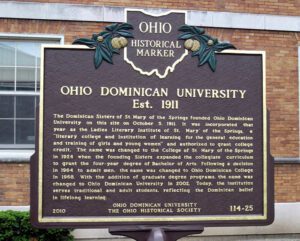
The Dominican Sisters of St. Mary of the Springs founded Ohio Dominican University on this site on October 5, 1911. It was incorporated that year as the Ladies Literary Institute of St. Mary of the Springs, a “literary college and institution of learning for the general education and training of girls and young women” and authorized to grant college credit. The name was changed to the College of St. Mary of the Springs in 1924 when the founding Sisters expanded the collegiate curriculum to grant the four-year degree of Bachelor of Arts. Following a decision in 1964 to admit men, the name was changed to Ohio Dominican College in 1968. With the addition of graduate degree programs, the name was changed to Ohio Dominican University in 2002. Today, the institution serves traditional and adult students, reflecting the Dominican belief in lifelong learning.
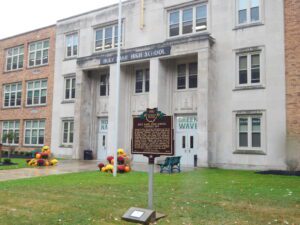
Founded in 1914, Holy Name High School was one of the first co-educational Roman Catholic high schools in Cleveland. Originally located at Harvard and Broadway Avenues, the school opened under the direction of Holy Name Parish with educational leadership of the Sisters of Charity from Cincinnati. In 1978, Holy Name High School moved to its present location in Parma Heights, the former home of Nazareth Academy. Throughout its history, Holy Name High School has served the community by providing a Catholic, college-preparatory education. The Holy Name spirit lives on through its alumni, who have made a difference around the world.
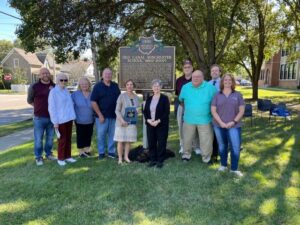
Over its 145 years, the Old Canal Winchester School building played a significant role in the community. The original four-room building opened in 1862 and its first high school class graduated seven in 1886. Canal Winchester’s growth is reflected in the school’s several additions, the first of which was in 1875. Other expansions include a separate high school building in 1909, a three-story connector in 1929 between the 1862 and the 1909 buildings, and elementary school wings in 1956 and 1967. The school was also the site of continuing education and vocational classes for adults in the 1930s and 1950s, agricultural programs for veterans after World War II, and a cannery from the time of that war to 1952. The school was added to the National Register of Historic Places in 2017 and it remains the district’s administrative center and a community gathering space.
In 1886, Bishop Richard Gilmour (1824-1891) of the Roman Catholic diocese of Cleveland requested that the Jesuit superior of Buffalo establish a high school on Cleveland’s west side. The Jesuits, an order of the Roman Catholic Church founded by St. Ignatius Loyola in 1540, sought to establish schools that instilled a zeal for the Gospel and a love of learning. Under the leadership of Father Henry Behren, S.J. (1815-1895), the twentieth Jesuit secondary school in the United States opened in September 1886. Named Saint Ignatius College, the school grew from 76 students in 1886 to 490 in 1924. In 1924, the College split into two separate institutions: John Carroll University, which moved to University Heights in 1935, and Saint Ignatius High School, which remains on its original site. (Continued on other side)
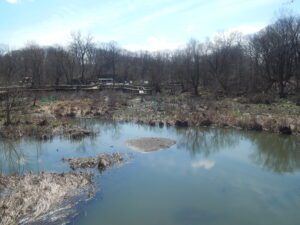
Around 1895 a park system was created connecting the corridor of Doan Brook from Shaker Lakes to Gordon Park on Lake Erie. In 1915, the Shaker Heights Land Company and Van Sweringen Company deeded property to the City of Cleveland for the park. In 1947, Cleveland leased to the cities of Shaker Heights and Cleveland Heights portions of the park within their boundaries. A proposed “Clark Freeway” (I-290) linking I-271 to downtown Cleveland through the park threatened the area in the 1960s. The proposal faced strong opposition from the Park Conservation Committee, a coalition of 30 garden clubs, the City of Shaker Heights, the Cleveland Heights PTA Council, the Shaker Historical Society, and other organizations. Governor James Rhodes withdrew the plans in 1970. The Clark Freeway was defeated and the park preserved.
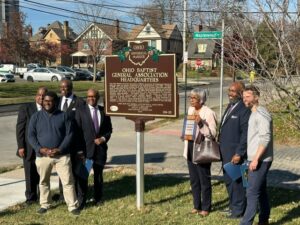
The Ohio Baptist General Association (OBGA) acquired 48 Parkwood Avenue in 1954 and used the former residence as its headquarters until 1996. Formed in 1896, the Association includes more than forty African American churches, many formed prior to the Civil War. Baptist general associations nationwide became an important voice during the 1960s Civil Rights Movement as they addressed the wrongs of racial violence and discrimination in business, housing, and education. The OGBA fought for the ideals of justice and freedom with its strongly-held Baptist beliefs. “America with her wealth as a great nation,“ OGBA President Wilber A. Page declared in 1957, “is well able to face integration and give a democracy to all her citizens.” The former Association Headquarters was listed in the National Register of Historic Places on December 3, 2020.