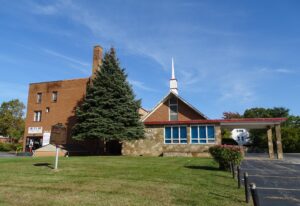
Bethel A.M.E. Church was the first African American church in Worthington. Black residents joined Worthington’s established churches as early as 1847 or worshipped together in their homes. Peter Banks with D.H. Taborn, Charles Kiner, J.T. Horton, and James Birkhead organized the A.M.E. congregation in 1896. Rapid growth moved their meetings to the Worthington Town Hall by 1897. A lot was purchased from Millie Alston on September 24, 1897, and a house relocated to serve as Bethel Chapel. Local carpenter Chester Hard constructed a new building that was dedicated as St. John A.M.E. in 1914. The church has served as the religious and social hub of Worthington’s Black community for more than a century. While St. John A.M.E. Church retains their original location, worship services moved to 7700 Crosswoods Drive in 2004.
Pleasant Litchford was born into slavery in Virginia in 1789. He purchased his freedom and moved his family to Ohio by 1831. A master blacksmith, Litchford bought a small farm four miles north of Columbus in 1833. By the time of his death in 1879, he was the fourth largest landowner in Perry Township. Described as “a man of iron constitution,” Litchford served as a lay-preacher, founding member, and deacon at Second Baptist Church. The church and James Poindexter, its pastor in 1847, provided an important voice during the anti-slavery movement. In 1869, Litchford sold, for $1, a parcel of land to establish a school for African American children. He was married three times and was survived by seven living children, twenty-five grandchildren, and three great-grandchildren. Pleasant Litchford was buried in the Litchford Family Cemetery.
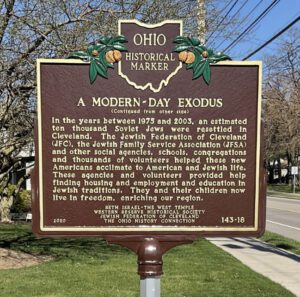
Here in 1963 congregants of Beth Israel-The West Temple, led by Louis Rosenblum, Herb Caron, and Rabbi Daniel Litt, founded the Cleveland Committee (later Council) on Soviet Anti-Semitism, the first American organization created to advocate for freedom for Soviet Jews. In 1970 this work led to the formation of the Union of Councils for Soviet Jews (UCSJ) under the leadership of Louis Rosenblum. The UCSJ, whose national office was located here 1970-1973, became the largest independent Soviet Jewry organization in the world. By the turn of the 21st century, the efforts begun here helped 1.6 million Jews leave the former Soviet Union. (Continued on other side)
“…on Sunday morning, especially in the African American community, you could go down the street and hear The Wings Over Jordan just coming from everybody’s house….” Glenn Brackens, 2017. Upholding the sanctity of traditional African American spirituals, believing in the power of radio to uplift listeners, and recognizing his choir’s rich talent, Rev. Glenn T. Settle (1894-1967), pastor of Gethsemane Baptist Church, originated the “Negro Hour” on Cleveland’s WGAR in 1937. The Sunday morning radio show featured the choir’s moving renditions of spirituals and was originally directed by James Tate (1918-1986). Williette Firmbanks Thompson (1910-1992) was assistant director and a soloist (Continued on other side)
Invited to speak at three Cleveland high schools, Dr. Martin Luther King Jr. delivered his powerful “Rise Up!” speech to students at Glenville High School on April 26, 1967. It signaled King’s opening drive to elect African Americans to prominent government positions in northern cities. Encouraging students to “develop a sense of somebodiness,” King challenged them to “work passionately and unrelentingly for first-class citizenship.” Recognizing the fear of racial unrest in the city, King underscored the significance of nonviolence. “Our power lies in our ability to say non-violently that we’re not going to take it any longer,” he asserted. Making Carl Stokes’ mayoral bid the focus of his push for Black voters to elect Black leaders, King urged Glenville’s students to join civil rights organizations and community action programs.
Civil unrest rocked the Hough neighborhood for five nights during the summer of 1966.When the white owners of the Seventy-Niners Cafe refused to serve a Black customer a glass of water, a sign bearing a racial epithet subsequently appeared outside the bar. Decades of institutionalized racial practices that had caused Hough’s substandard and overcrowded housing, high unemployment, economic exploitation, lack of access to quality education, and systemic police harassment sparked an urban uprising in response on July 18. Angry crowds gathered outside the bar only to be confronted by the owners brandishing firearms. When the police belatedly responded, tensions escalated into targeted firebombing, looting, and vandalism. On Tuesday night, July 19, Cleveland’s Mayor Ralph Locher requested that the Ohio National Guard restore order. (Continued on other side)
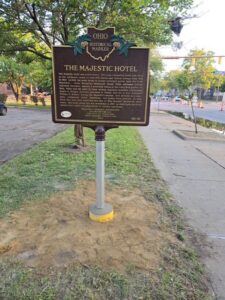
The Majestic Hotel was a five-story, 250-room residential hotel that stood on the northeast corner of East 55th Street and Central Avenue from 1902 to 1967. In 1924 the hotel began to accept overnight guests. Amid the Great Migration, owner Hungarian immigrant Joseph Weiss welcomed African American travelers, earning a perennial listing in the Green Book guides. In 1944, Weiss sold the hotel to three African American investors: businessman Alonzo G. Wright, attorney Lawrence O. Payne, and Call & Post publisher William O. Walker. During the Majestic’s heydey, such services as a pharmacy, restaurant, tailor, beautician, and barber were offered. Its Rose Room jazz club drew musicians and fans to “Blue Monday” parties for many years. The hotel closed and was demolished in 1967, as civil rights advances opened more public accommodations to African Americans.
Prominent architect William S. Lougee designed the Woodland Public Bath House that opened in 1915 at a cost of approximately $90,000. The first floor of the facility included separate shower baths for men and women, an office, waiting rooms, and a gymnasium with a 53-yard running track. The second story was divided into four rooms: a club room, a small city library branch, a baby dispensary, and clinic. The basement featured an indoor swimming pool popular among adults and children. Like other public bath houses in Cleveland, the Woodland Bath House was an invaluable social space for its diverse community of largely Hungarian, but also Slovak, Bohemian, Italian, Lithuanian, and Jewish residents. In 1918, the City estimated that 254,508 residents had used Woodland Bath House facilities, enjoying classes, camps, baths, and clinics.