Cory United Methodist Church is an icon of Cleveland’s civil rights movement. As one of the city’s largest Black-owned churches during the 1960s, Cory hosted events for national, local, and grassroots organizations such as the Fair Employment Practices Committee, NAACP Cleveland Branch, Cleveland Chapter of the Congress of Racial Equality (CORE), and United Freedom Movement. Over 75 years later, Cory UMC continues its long tradition of community programming that promotes equity and education. Originally designed by architect Albert F. Janowitz to house the Anshe Emeth Beth Tefilo congregation, the building served as the Cleveland Jewish Center from 1922 to 1945. The Methodist congregation purchased it in 1946. Since 1961, the building has also been home to the Glenville Recreation Center. Cory UMC was designated as a local landmark by the Cleveland Landmarks Commission in 2012.
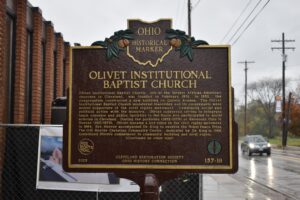
Olivet Institutional Baptist Church, one of the largest African American churches in Cleveland, was founded in February 1931. In 1950, the congregation constructed a new building on Quincy Avenue. The Olivet Institutional Baptist Church ministerial leadership and its congregants were ardent supporters of the civil rights movement. Combining social and political action with the ministry, Olivet supported sit-ins to integrate lunch counters and public facilities in the South and participated in social activism in Cleveland. During the pastorate (1952-1973) of Reverend Odie M. Hoover (1921-1973), Olivet became a key voice in the civil rights movement. In 1964, Rev. Hoover accompanied Dr. King to receive the Nobel Peace Prize. The O.M. Hoover Christian Community Center, dedicated by Dr. King in 1966, symbolized Olivet’s commitment to community building and civil rights. (Continued on other side)
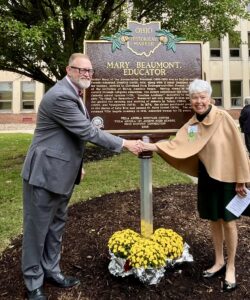
Mother Mary of the Annunciation Beaumont (1818-1881) was an English-born, French educated Ursuline Sister, she arrived in Cleveland from Boulogne-sur-Mer, France, in 1850, accompanied by three other Ursulines and a lay teacher. Invited to Ohio by Bishop Amadeus Rappe, the Ursulines vowed to improve society through religious education. That same year, Beaumont established the city’s first Catholic school (grades 1-12), “Ursuline Academy,” and dedicated it to teaching girls “to think for themselves.” Beaumont not only taught at area parishes, she ably guided the opening and staffing of schools in Toledo (1854), Tiffin (1863), and Youngstown (1874). In 1874, the Ursulines purchased property on the Shores of Lake Erie and opened St. Mary’s School (1878). The school, re-named Villa Angela Academy in 1941, educated women for 112 years.