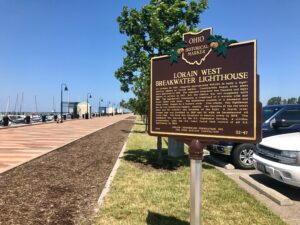
On October 22, 1913, Congress appropriated $35,000 to build a light-and-fog station at Lorain harbor. Construction began after plans were approved in 1916. The concrete structure was finished and light placed in service in 1917, but the station was not completed until 1919. The lighthouse’s foundation is comprised of a wooden crib and boxes filled with stone. The lighthouse consists of a basement and three floors, topped by a lantern room. Like others, this lighthouse had its own identifying signals, namely, the duration of the fog horn’s blast and the rotation and duration of the light. A fourth order Fresnel lens was installed in 1919 and lit with an incandescent oil vapor lamp. The lamp was converted to electric power in 1932. The lighthouse was manned by the U.S. Lighthouse Service, a civilian organization, until the U.S. Coast Guard took control of all U.S. lighthouses in 1939.
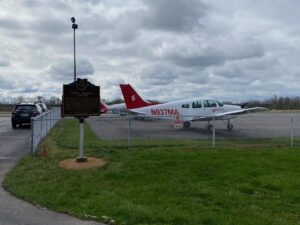
Lewis Albert Jackson (December 29, 1912-January 8, 1994) was an African American aviator remembered for training Tuskegee Airmen during World War II. As a teenager in Indiana, he began flight lessons and soloed in 1932, flying his own Waco 10. Jackson spent 1932-1937 barnstorming to save money for college while earning his Transport Pilot’s License. He re-rated to a Commercial License with Instructor Rating in 1939, and then completed advanced acrobatic training at Coffey School of Aeronautics. In late 1940, he was appointed Director of Training in the Army Air Force 66th Flight Training Detachment at Tuskegee Institute. After the war he moved to Ohio and served as an FAA Flight Examiner from 1947 to 1960. The Lewis A. Jackson Greene County Regional Airport was posthumously renamed to honor this true aviation pioneer.
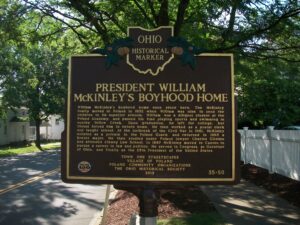
William McKinley’s boyhood home once stood here. The McKinley family moved to Poland in 1852 when William was nine to send the children to its superior schools. William was a diligent student at the Poland Academy, and passed his time playing sports and swimming in nearby Yellow Creek. Upon graduation, he left for college, but illness forced him to return home. He then worked as a postal clerk and taught school. At the outbreak of the Civil War in 1861, McKinley enlisted as a private in the Poland Guard, and returned in 1865 a brevet major. He then studied under Poland lawyer Charles Glidden and attended Albany Law School. In 1867 McKinley moved to Canton to pursue a career in law and politics. He served in Congress, as Governor of Ohio, and finally as the 25th President of the United States.
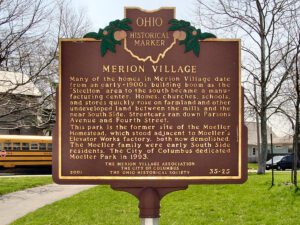
Merion Village was named for the Nathaniel Merion family, who in 1809 settled what is now the South Side of Columbus on 1800 acres of the Refugee Lands. Entrepreneur William Merion operated “Merion’s Landing” in the 1830s to capitalize on the canal trade from the Columbus Feeder Canal. This area saw a large influx of German immigrants as the South Side industrialized in the mid-nineteenth century. Later, many Irish, Italian, and eastern European immigrants who worked in the local steel mills and foundries made their homes here.
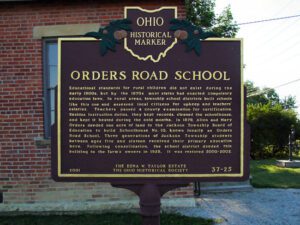
Educational standards for rural children did not exist during the early 1800s, but by the 1870s most states had enacted compulsory education laws. In rural areas, township school districts built schools like this one and assessed local citizens for upkeep and teacher’s salaries. Teachers passed a county examination for certification. Besides instruction duties, they kept records, cleaned the schoolhouse, and kept it heated during the cold months. In 1879, Allen and Mary Orders deeded one acre of land to the Jackson Township Board of Education to build Schoolhouse No. 10, known locally as Orders Road School. Three generations of Jackson Township students between ages five and sixteen received their primary education here. Following consolidation, the school district deeded this building to the farm’s owners in 1928. It was restored in 2000-2002.
Oran Follett constructed his Sandusky house between 1835 and 1837. The golden sandstone mansion was home to Follett and his family until his death in 1894. Sold to James Flynn and then the Krupp family, the house remained a private residence until rented to the Works Progress Administration in 1935. The Sandusky Board of Education purchased the house in 1939 and used it as the adjacent high school’s Home Economics annex, meeting space, offices, and occasionally as art gallery or dance venue. From 1958 to 1968, it housed the Sandusky School of Practical Nursing. The Sandusky Library took over management of the house in 1973, opening it as museum in 1976. Considered one of the finest Greek Revival mansions in Ohio, the Follett House was listed on the National Register of Historic Places in 1974.
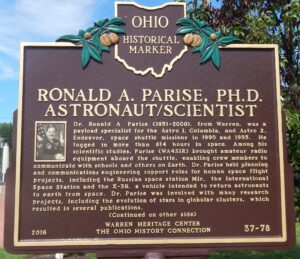
Dr. Ronald A. Parise (1951-2008), from Warren, was a payload specialist for the Astro 1, Columbia, and Astro 2, Endeavour, space shuttle missions in 1990 and 1995. He logged in more than 614 hours in space. Among his scientific studies, Parise (WA4SIR) brought amateur radio equipment aboard the shuttle, enabling crew members to communicate with schools and others on Earth. Dr. Parise held planning and communications engineering support roles for human space flight projects, including the Russian space station Mir, the International Space Station and the X-38, a vehicle intended to return astronauts to earth from space. Dr. Parise was involved with many research projects, including the evolution of stars in globular clusters, which resulted in several publications. (Continued on other side)
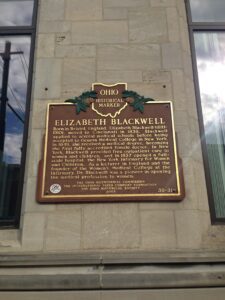
Born in Bristol, England, Elizabeth Blackwell (1821-1910), moved to Cincinnati in 1838. Blackwell applied to several medical schools before being accepted to Geneva Medical College in New York. In 1849, she received a medical degree, becoming the first fully accredited female doctor. In New York, Blackwell provided free outpatient care to women and children, and in 1857 opened a full-scale hospital, the New York Infirmary for Women and Children. As a lecturer in England and the founder of the Women’s Medical College at the Infirmary, Dr. Blackwell was a pioneer in opening the medical profession to women.