

, OH
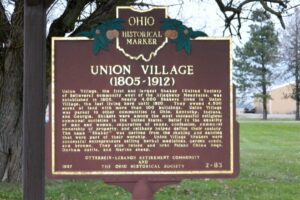
Union Village, the first and largest Shaker (United Society of Believers) community west of the Allegheny Mountains, was established in 1805. Nearly 4,000 Shakers lived in Union Village, the last living here until 1920. They owned 4,500 acres of land with more than 100 buildings. Union Village was parent to other communities in Ohio, Kentucky, Indiana, and Georgia. Shakers were among the most successful religious communal societies in the United States. Believe in equality of men and women, separation of sexes, confession, communal ownership of property, and celibacy helped define their society. The name “Shaker” was derived from the shaking and dancing that were part of their worship. Union Village Shakers were successful entrepreneurs selling herbal medicines, garden seeds, and brooms. They also raised and bred Poland China hogs, Durham cattle, and Merino sheep.
, OH
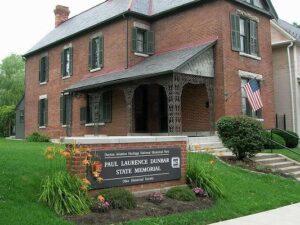
The first African-American to achieve prominence as a poet, Paul Laurence Dunbar was born and raised in Dayton, the son of former slaves. Working as an elevator operator while he established himself as a writer, Dunbar published his first book of poems, Oak and Ivy, in 1893. His third collection, Lyrics of a Lowly Life (1896) with an introduction by another Ohio-born author William Dean Howells, gained Dunbar widespread critical acclaim and popular recognition. Widely published in contemporary journals and literary magazines, Dunbar employed both turn-of-the-century African-American dialect and standard English verse to give a voice to the themes of everyday discrimination and struggles for racial equality. Tuberculosis cut his life short at age 33. Dunbar’s body of work includes twelve volumes of poetry, four books of short stories, a play, and five novels.
, OH
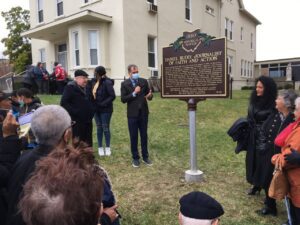
Daniel Arthur Rudd was born into slavery on August 7, 1854, in Bardstown, Kentucky. He became a newspaperman, lecturer, publicist, and tireless advocate for the Roman Catholic Church. After the Civil War Rudd moved to Springfield. Baptized and raised in Catholicism, he joined St. Raphael Parish, where the philosophy of racial equality offered by the church solidified his vision of justice. By 1885 he had established his own weekly newspaper, The Ohio State Tribune. He rebranded it The American Catholic Tribune (ACT) after moving to Cincinnati. Rudd claimed ACT was the only Catholic newspaper owned by an African American. At the height of its popularity in 1892, the publication had a circulation of 10,000. In 1893 Rudd was asked to chair the Afro-American Press Association, representing more than 200 black-owned newspapers.
, OH
“I say white brother, because I believe that to be the proper phrase, inasmuch as I believe in the principle of the fatherhood of God and the brotherhood of all mankind no matter what the color of his skin may be.” Richard L. Davis championed the cause of racial equality throughout the eastern coalfields, calling for an end to the color line and for all miners to unite against wage slavery. He was born in Roanoke County, Virginia in 1862 and arrived in racially integrated Rendville in 1882, where he became an organizer for the Knights of Labor. In 1886, a year after the Great Hocking Valley Strike, Davis wrote his first letters to the editor of the National Labor Tribune, establishing himself as voice for miners in the labor movement. (Continued on other side)
, OH
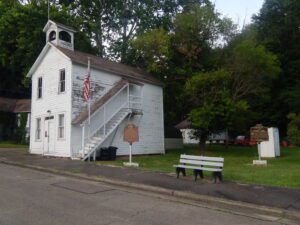
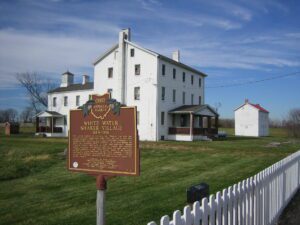
The United Society of Believers (or “Shakers,” as they are commonly known) established White Water, the last of four Ohio Shaker villages, in 1824. White Water flourished throughout the nineteenth and early twentieth centuries. At its peak during the 1850s, 150 Believers living in three semi-autonomous Shaker “families” farmed 1,300 acres of land in Crosby and adjacent Morgan townships. The Shakers were among the most successful religious societies in the United States. Belief in the equality of men and women, separation of the sexes, celibacy, communal ownership of property, and a distinctive style of worship — characterized by rhythmic movements and shaking — helped define the Shaker lifestyle. (Continued on other side)
, OH
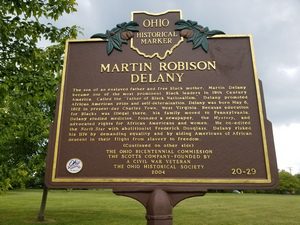
The son of an enslaved father and free Black mother, Martin Delany became one of the most prominent Black leaders in 19th Century America. Called the “Father of Black Nationalism,” Delany promoted African American pride and self-determination. Delany was born May 6, 1812 in present-day Charles Town, West Virginia. Because education for Blacks was illegal there, his family moved to Pennsylvania. Delany studied medicine, founded a newspaper, the “Mystery,” and advocated rights for African Americans and women. He co-edited the “North Star” with abolitionist Frederick Douglass. Delany risked his life by demanding equality and by aiding Americans of African descent in their fight from slavery to freedom. (Continued on other side)
, OH
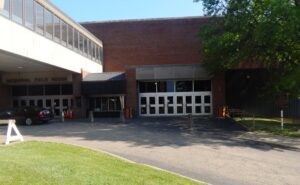
“All life is interrelated in today’s world. I can’t be what I ought to be until you are what you ought to be; and you can’t be what you ought to be ’till I am what I ought to be.” Dr. Martin Luther King Jr. spoke these words before 3,500 people while addressing a Freedom Rally here on March 20, 1964. His speech addressed issues of racial equality and unity, and urged passage of the Civil Rights Act. On July 2, 1964, President Lyndon B. Johnson signed the act into law, prohibiting discrimination based on a person’s race, color, religion, sex, or nationality.
, OH
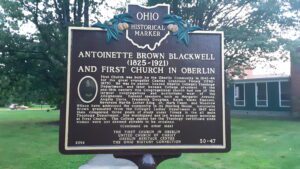
First Church was built by the Oberlin Community in 1842-44 for the great evangelist Charles Grandison Finney (1792-1875). He was its pastor, headed Oberlin College’s Theology Department, and later became College president. In the mid-19th century this Congregational church had one of the largest congregations and auditoriums west of the Alleghenies. Eminent speakers such as Margaret Atwood, Angela Davis, Frederick Douglass, Ralph Waldo Emerson, Reverend Martin Luther King, Jr., Mark Twain, and Woodrow Wilson have addressed the community in its Meeting House. Antoinette Brown graduated from the College’s Ladies’ Department in 1847 and then completed three years of study under Finney in the all male Theology Department. She worshipped and led women’s prayer meetings at First Church. The College denied her the Theology certificate since women were not deemed suitable to be ordained. (continued on other side)