

, OH
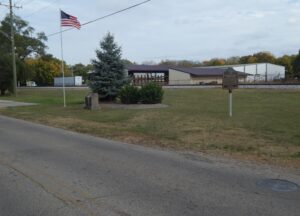
Carlisle Station Depot. The Carlisle depot for the Cincinnati, Hamilton & Dayton (CH&D) railroad was located nearby. The CH&D started operations in 1851 and was the second railroad through Warren County. Carlisle Station was a passenger and freight-shipping depot and was joined in 1872 by another, when Cincinnati & Springfield Railroad (later part of the Big Four and the New York Central Railroads) erected a depot in nearby Franklin. Carlisle was originally known as the “Jersey Settlement,” because many settlers in the early 1800s were from New Jersey. George Carlisle, vice-president of the CH&D, purchased a large tract of land here. After Carlisle and his wife Sarah donated a lot to the community in 1856, residents renamed the place “Carlisle Station.” The Carlisle Literary Association built a hall on the lot c. 1856, which, as of 2019, remains as the older section of Carlisle’s municipal building. Side B: Schenck-Stanton Rally, October 3, 1868.
, OH
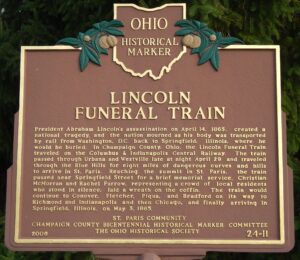
President Abraham Lincoln’s assassination on April 14, 1865, created a national tragedy, and the nation mourned as his body was transported by rail from Washington D.C. back to Springfield, Illinois, where he would be buried. In Champaign County, Ohio, the train passed through Urbana and Westville late at night April 29 and traveled through the Blue Hills for eight miles of dangerous curves and hills to arrive in St. Paris. Reaching the summit in St. Paris, the train paused near Springfield Street for a brief memorial service. Christian McMorran and Rachel Furrow, representing a crowd of local residents who stood in silence, laid a wreath on the coffin. The train would continue to Conover, Fletcher, Piqua, and Bradford on its way to Richmond and Indianapolis and then Chicago, finally arriving in Springfield, Illinois, on May 3, 1865.
, OH
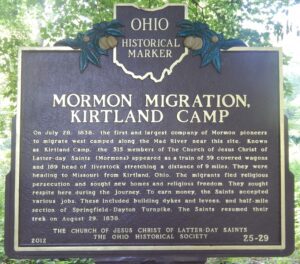
On July 28, 1838, the first and largest company of Mormon pioneers to migrate west camped along the Mad River near this site. Known as Kirtland Camp, the 515 members of The Church of Jesus Christ of Latter-day Saints (Mormons) appeared as a train of 59 covered wagons and 189 head of livestock stretching a distance of 9 miles. They were heading to Missouri from Kirtland, Ohio. The migrants fled religious persecution and sought new homes and religious freedom. They sought respite here during the journey. To earn money, the Saints accepted various jobs. These included building dykes and levees, and half-mile section of Springfield-Dayton Turnpike. The Saints resumed their trek on August 29, 1838.
, OH
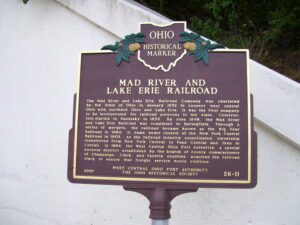
The Mad River and Lake Erie Railroad Company was chartered by the State of Ohio in January 1832 to connect west central Ohio with northern Ohio and Lake Erie. It was the first company to be incorporated for railroad purposes in the state. Construction started in Sandusky in 1835. By June 1849, the Mad River and Lake Erie Railroad was completed to Springfield. Through a series of mergers, the railroad became known as the Big Four Railroad in 1890. It came under control of the New York Central Railroad in 1905. As the railroad industry consolidated, ownership transferred from New York Central to Penn Central and then to Conrail. In 1994, the West Central Ohio Port Authority, a special purpose district established by the boards of county commissioners of Champaign, Clark, and Fayette counties, acquired the railroad track to ensure that freight service would continue.
, OH
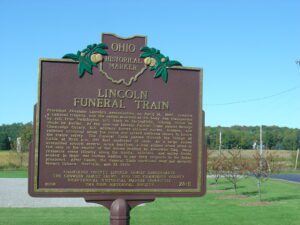
President Abraham Lincoln’s assassination on April 14, 1865, created a national tragedy, and the nation mourned as his body was transported by rail from Washington, D.C. back to Springfield, Illinois, where he would be buried. As the nine-car Lincoln Funeral Train passed through Champaign County, U.S. military forces secured curves, bridges, and railroad crossings along the route and spiked switches closed to insure the train’s safety. The Funeral Train passed through the Village of Cable at 10:13 p.m. 150 feet southeast of here. As a large crowd assembled around several large bonfires, a lone soldier stood alone in the rain in the center of the crowd holding an American flag. Many residents stood silently along the tracks, hillsides, and valley fields, soaked in their wet clothes waiting to pay their respects to the fallen president. After Cable, the Funeral Train continued west and downhill toward Urbana, Westville, and St. Paris.
, OH
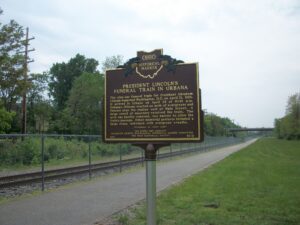
The nine-car funeral train for President Abraham Lincoln departed Washington, D.C. on April 21, 1865. It arrived in Urbana on April 29 at 10:40 p.m. Urbana’s citizens erected an arch of evergreens and flowers near the station west of Main Street. A large crowd of mourners received the train. The arch was hastily removed, too narrow to allow the train’s passage. Other memorial gestures included a large cross, entwined with evergreen wreaths.
, OH
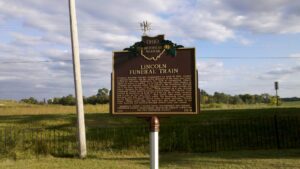
President Abraham Lincoln’s assassination on April 14, 1865, created a national tragedy, and the nation mourned as his body was transported by rail from Washington, D.C. back to Springfield, Illinois, where he would be buried. On its way the Funeral Train stopped in Columbus and Lincoln’s coffin was moved to the Statehouse Rotunda for a day-long viewing. From Columbus Governor John Brough and others changed the train’s route, which resulted in a trip through Champaign County where it stopped several times. The Funeral Train arrived in Woodstock on April 29 at 9:46 p.m. for a brief ceremony and to take on fuel and water. With nearly 500 people present, bouquets were laid on Lincoln’s coffin. The Woodstock Cornet Band, led by Warren U. Cushman, played hymns of grief, including “Pleyel’s Hymn.” Village bells rung and silent men and women stood as the train departed and traveled downhill toward Cable and Urbana.
, OH
Ice Age glaciers formed the distinct landscape of the Oak Openings Region, which is dominated by rolling sand dunes and wet prairies interrupted by clusters of oak trees. Although the sandy soil did not support agriculture well, the early settlers of Springfield Township and the Village of Holland raised cranberries and other fruits. Encompassing nearly 130 square miles, the Oak Openings Region was designated as one of America’s “Last Great Places” by The Nature Conservancy and is home to over 180 rare and endangered species. Local legend holds that prior to the Battle of Fallen Timbers in 1794, Miami Chief Little Turtle and Shawnee Chief Blue Jacket passed through the Oak Openings and met at a council with Wyandot chiefs on the hill near the Springfield Township Cemetery.