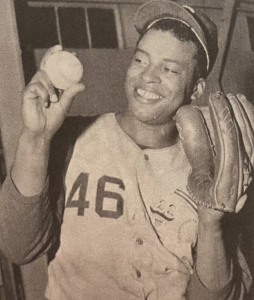
Ulysses Brooks Lawrence was born in Springfield on January 30, 1925. Nicknamed “The Bull,” he broke numerous color barriers throughout his baseball career. In 1976, Lawrence was the first Black player inducted into the Cincinnati Reds Hall of Fame. An all-around athlete at Springfield High School, Lawrence lettered in basketball, track, and football (the school’s first Black starting quarterback). After graduation in 1943, he was drafted into the U.S. Army and earned a Bronze Star in Guam during World War II. Lawrence enrolled at Ohio’s Miami University, becoming that school’s first Black baseball player (1947-1949), before signing with the Cleveland Indians. Acquired by the St. Louis Cardinals (1954), he was assigned to the Columbus Red Birds Triple-A farm team, breaking another team’s color barrier. (Continued on other side)
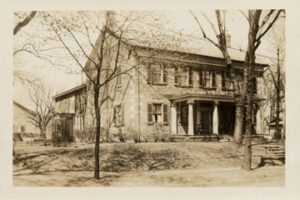
Constructed of sandstone quarried from nearby Putnam Hill, the Stone Academy dates to 1809. The Springfield School House Company erected the building, it is believed, to lure the statehouse from Chillicothe. However, when Zanesville was chosen as the capital the following year, the building was used for public functions and for its “intended” purpose as a school. The Ohio Anti-slavery Society held its state conventions here in 1835 and 1839, with prominent abolitionist leader Theodore Weld, among others, in attendance. The Stone Academy became a private residence after 1839. In the 1870s, it was the childhood home of Elizabeth Robins, the famed late-nineteenth and early-twentieth century actress, playwright, author, and activist. The Stone Academy was donated to the Pioneer and Historical Society of Muskingum County in 1981.
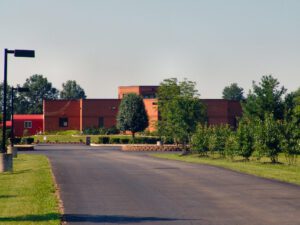
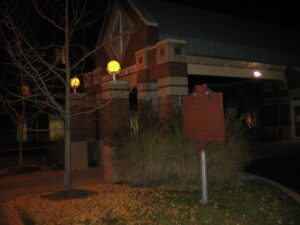
In 1985, Hindu immigrants from India formed a celestial organization, The Bharatiya Temple Society of Central Ohio, and through its membership adopted the Constitution and Bylaws and named the place of worship Bharatiya Hindu Temple. Later they bought a house at 3903 Westerville Road in Columbus for prayer and worship. In 1994, the membership moved to the current location and built this temple to serve the religious, spiritual, educational, and cultural needs of those who wish to live an active peaceful life in accordance with the Vedic dharma, philosophies, and traditions.
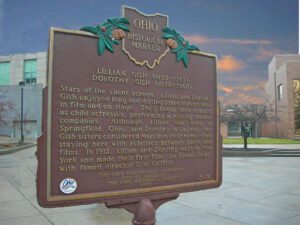
Stars of the silent screen, Lillian and Dorothy Gish enjoyed long and distinguished careers both in film and on stage. They began their careers as child actresses, performing in touring theater companies. Although Lillian was born in Springfield, Ohio, and Dorothy in Dayton, the Gish sisters considered Massillon their home, often staying here with relatives between plays and films. In 1912, Lillian and Dorothy went to New York and made their first film, An Unseen Enemy, with famed director D.W. Griffith.
A group of concerned Cincinnati women organized, in 1855, The Protestant Home for the Friendless and Female Guardian Society as a private, not-for-profit maternity home for destitute women and children. These public minded social leaders were aware that Cincinnati had grown beyond the time when the poor or unfortunate were cared for by their neighbors. The Home, which was funded through bequests and personal donations, was founded to care for poor mothers and babies, unmarried pregnant women, wanderers and strangers in the city, and to promote adoptions. (Continued on other side)
The Marlborough Society of Friends Meeting was established in 1813 by the Salem Quarterly Meeting at the request of the Springfield (Damascus) Meeting. The Marlborough Friends and Lexington Friends combined to become the Alliance Friends in 1865 and relocated to 322 East Perry Street in Alliance, which was the site of a Methodist Episcopal Church. The Marlborough Friends Meeting House and the burying ground were sold to W.W. Holibaugh in 1897 and remain in private ownership. When State Route 619 was widened in 1941, some burials were exhumed and re-interred
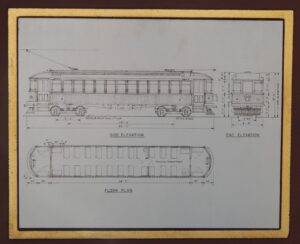
The Dayton, Springfield, and Urbana Electric Railway (DS&U) was an “Interurban” rail system that ran between the cities of Urbana, Springfield and Dayton. Its beginning can be traced to the franchise given to William H. Hanford to operate a single line of electrical railway between Springfield and the southern boundary of Champaign County in 1895. Hanford then sold his rights to John G. Webb of Springfield and Colonel Frederich Colburn of Kentucky, who along with other syndicate members formed the Dayton, Springfield, and Urbana Electric Railway. In 1897 Boston promoter Arthur E. Appleyard joined the syndicate and brought investment monies, organizational skills, and energy to the venture. He quickly became managing director/treasurer and the real driving force of the DS&U. The railway was organized into two divisions. One operated between Dayton and Springfield and the other between Springfield and Urbana. [continued on other side]
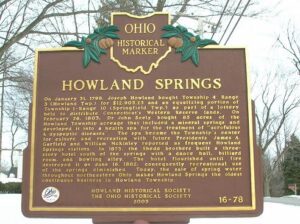
On January 31, 1798, Joseph Howland bought Township 4-Range 3 (Howland Twp.) for $12, 903.23 and an equalizing portion of Township 1-Range 10 (Springfield Twp.) as part of a lottery held to distribute Connecticut’s Western Reserve lands. On February 26, 1803, Dr. John Seely bought 85 acres of the Howland Township acreage that included a mineral springs and developed it into a health spa for the treatment of “scrofulous & dyspeptic diseases”. The spa became the Township’s center for culture and recreation with future Presidents James A. Garfield and William McKinley reported as frequent Howland Springs visitors. In 1873, the Shedd brothers built a three-story hotel south of the springs with a dance hall, billiard room, and bowling alley. The hotel flourished until fire destroyed it on June 16, 1882; consequently recreational use of the springs diminished. Today, the sale of spring water throughout northeastern Ohio makes Howland Springs the oldest continuous business in Howland Township.