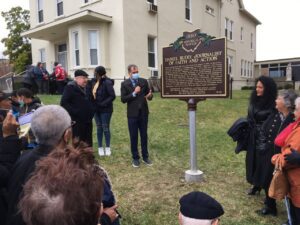
Daniel Arthur Rudd was born into slavery on August 7, 1854, in Bardstown, Kentucky. He became a newspaperman, lecturer, publicist, and tireless advocate for the Roman Catholic Church. After the Civil War Rudd moved to Springfield. Baptized and raised in Catholicism, he joined St. Raphael Parish, where the philosophy of racial equality offered by the church solidified his vision of justice. By 1885 he had established his own weekly newspaper, The Ohio State Tribune. He rebranded it The American Catholic Tribune (ACT) after moving to Cincinnati. Rudd claimed ACT was the only Catholic newspaper owned by an African American. At the height of its popularity in 1892, the publication had a circulation of 10,000. In 1893 Rudd was asked to chair the Afro-American Press Association, representing more than 200 black-owned newspapers.
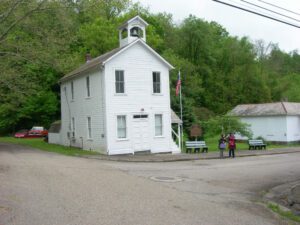
Established in 1879 by Chicago industrialist William P. Rend as a coal mining town, Rendville became a place where African Americans broke the color barrier. In 1888, Dr. Isaiah Tuppins, the first African American to receive a medical degree in Ohio, was elected Rendville’s mayor, also making him the first African American to be elected a mayor in Ohio. Richard L. Davis arrived in Rendville in 1882 and became active in the Knights of Labor. He was one of the labor organizers from the Little Cities of Black Diamonds region who helped found the United Mine Workers of America in 1890. An outstanding writer and orator, Davis was elected to UMWA’s national executive board and organized thousands of African Americans and immigrants to join the union. (continued on other side)
Virginia Hamilton was an author who was born in Yellow Springs in 1934, living and writing here for much of her life. She referred to her works as “Liberation Literature.” focusing on the struggles and journeys of African Americans. Hamilton published more than forty books in a variety of genres, including realistic novels, science fiction, picture books, folktales and mysteries. Some of her most beloved titles include The House of Dies Drear, M.C. Higgins the Great, Her Stories and The People Could Fly. Her books have had a profound influence on the study of race throughout American history, the achievements of African Americans, and the ramifications of racism. Hamilton received numerous awards for her writing before passing away in 2002. Her work is enshrined at the Library of Congress in Washington, D.C.
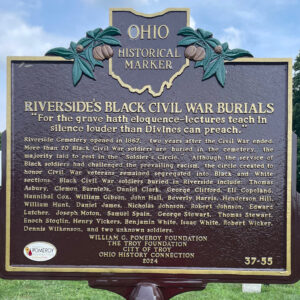
Black soldiers played a major role in the Civil War and more than 5,000 free Black Ohioans served in Union forces. While prejudice marginalized the Black man’s ability to serve early in the war, an 1862 Act of Congress authorized their admission into the Union Army and Navy. President Abraham Lincoln’s 1863 Emancipation Proclamation welcomed all freed men to join the fight. About 300 Black Ohioans joined the 54th and 55th Massachusetts (Colored) Volunteers – the first all-Black regiments raised in the North. Although offered $13 per month, the new recruits had to wait eighteen months to receive equal pay. In June 1863, Ohio’s Governor David Tod authorized a regiment of Black soldiers. The 127th Ohio Volunteer Infantry (OVI), the state’s first Black regiment, became known as the 5th U.S. Colored Troops (USCT).
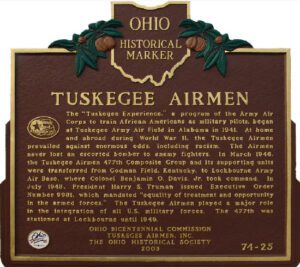
The “Tuskegee Experiment,” a program of the Army Air Corps to train African Americans as military pilots, began at Tuskegee Army Air Field in Alabama in 1941. At home and abroad during World War II, the Tuskegee Airmen prevailed against enormous odds, including racism. The Airmen never lost an escorted bomber to enemy fighters. In March 1946, the Tuskegee Airmen 477th Composite Group and its supporting units were transferred from Godman Field, Kentucky, to Lockbourne Army Air Base, where Colonel Benjamin O. Davis, Jr. took command. In July 1948, President Harry S. Truman issued Executive Order Number 9981, which mandated “equality of treatment and opportunity in the armed forces.” The Tuskegee Airmen played a major role in the integration of all U.S. military forces. The 477th was stationed at Lockbourne until 1949.
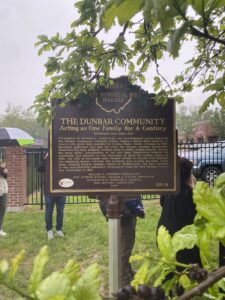
Dunbar, or Corsica Hollow, was an African American neighborhood on the western edge of Madisonville. Its streets and lots were laid out in 1886 after Mahlon and Anna Leonard subdivided their 10-acre tract near Duck Creek and sold lots to African Americans. Many early Dunbar residents were from the South; some born there prior to emancipation. Prominent early citizens included Harriet Deatherage, Elihu Parks, Gandison Embry, Thomas Duett, and James Murphy. Dunbar was home to the New Mission Missionary Baptist Church, founded in 1907. Originally meeting in a one-room building, the extant congregation relocated to Ravenna Street in 1963. By the late 1920s, Dunbar had about forty houses, a grocery run by Henry Lowman, and a hair salon run by Flora Hector. (Continued on other side)