

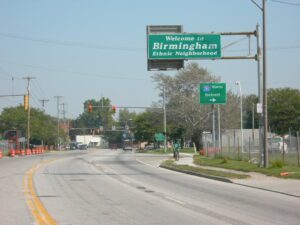
, OH
The Birmingham and Ironville neighborhoods were so named because of their early iron industries located along Front Street and the Maumee River. This became Toledo’s first area of heavy industrial development with iron manufacturing, coal shipping, oil refining, shipbuilding, and flour milling operations. In 1864 the Manhattan Iron Company built a charcoal blast furnace near the river’s mouth, securing fuel from nearby forests.
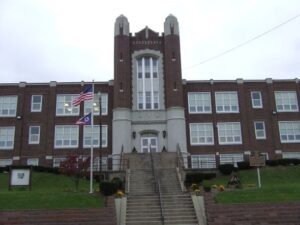
, OH
An October 23, 1927, ceremony was held for the laying of the cornerstone for the Dennison High School Building. It opened in the fall of 1928 and was called “Angel’s Castle” in honor of school superintendent William Hiram Angel. The building was designed by J.K. Griffin, an architect from Canton, Ohio, in a style that has the elements of Collegiate Gothic that was popular for school and college buildings during the early twentieth century. The distinguishing architectural features of the entrance towers enhance the school’s prominent location above the street level. Dennison High School is an important visual landmark in the community, as its towers are visible from the downtown area and surrounding neighborhoods. It has retained its integrity of location, materials, design, and association and conveys the early twentieth century ideals of education that the original design of the building was intended to inspire. (Continued on other side)
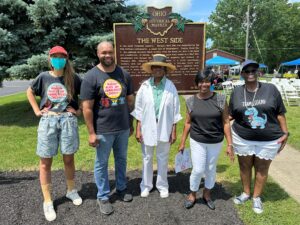
, OH
In the early twentieth century, Marion’s West Side was dominated by the Erie Railroad switchyards, a major hub of employment. During World War I, the railroad recruited Black workers from the South for jobs in its yards and roundhouses. In Marion, these workers made their homes in a West Side encampment that became the target of white suspicion and violence. In February 1919, following the unsolved murder of a white roundhouse worker’s wife and a separate alleged assault, a 300-man lynch mob smashed windows and occupied the West Side. All Black residents were ordered to leave the city by 6:00 pm the next day. Despite pleas to Governor Cox, at least 200 Black residents were forced to flee Marion. Marion’s anti-Black violence foreshadowed the nationwide “Red Summer” of 1919.
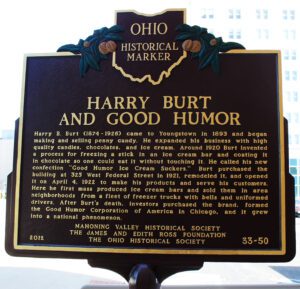
, OH
Harry B. Burt (1874-1926) came to Youngstown in 1893 and began making and selling penny candy. He expanded his business with high quality candies, chocolates, and ice cream. Around 1920 Burt invented a process for freezing a stick in an ice cream bar and coating it in chocolate so one could eat it without touching it. He called his new confection “Good Humor Ice Cream Suckers.” Burt purchased the building at 325 West Federal Street in 1921, remodeled it, and opened it on April 4, 1922 to make his products and serve his customers. Here he first mass produced ice cream bars and sold them in area neighborhoods from a fleet of freezer trucks with bells and uniformed drivers. After Burt’s death, investors purchased the brand, formed the Good Humor Corporation of America in Chicago, and it grew into a national phenomenon.
, OH
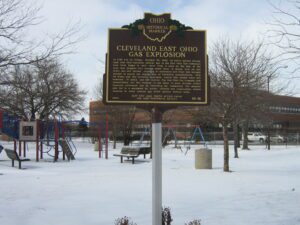
At 2:30 p.m. on Friday, October 20, 1944, an above ground storage tank that held liquefied natural gas in the East Ohio Gas Company’s tank farm began to emit vapor from a seam on the side of the tank that dropped into nearby sewer lines. It mixed with air and sewer gas and ignited, resulting in explosions and fires that brought damage to nearly one square mile of Cleveland neighborhoods. With 79 homes and two factories destroyed, nearly 700 people were left homeless, 131 killed, and 225 injured. The East Ohio Gas Company took responsibility for this tragedy to aid those in need through direct financial assistance and by rebuilding the community. The disaster also led to a movement by public utilities and communities across America to store natural gas below ground without tanks.
, OH
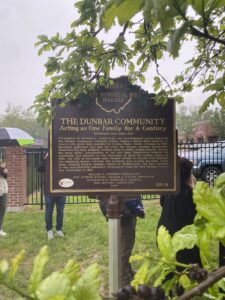
Dunbar, or Corsica Hollow, was an African American neighborhood on the western edge of Madisonville. Its streets and lots were laid out in 1886 after Mahlon and Anna Leonard subdivided their 10-acre tract near Duck Creek and sold lots to African Americans. Many early Dunbar residents were from the South; some born there prior to emancipation. Prominent early citizens included Harriet Deatherage, Elihu Parks, Gandison Embry, Thomas Duett, and James Murphy. Dunbar was home to the New Mission Missionary Baptist Church, founded in 1907. Originally meeting in a one-room building, the extant congregation relocated to Ravenna Street in 1963. By the late 1920s, Dunbar had about forty houses, a grocery run by Henry Lowman, and a hair salon run by Flora Hector. (Continued on other side)

, OH
The W. 76th and W. 65th Street tunnels survive today and symbolize the power of community action. In 1911, Cleveland City Council approved construction of elevated tracks by Lake Shore & Michigan Southern Railway Company. The tracks separated Cleveland’s neighborhoods from Lake Erie. In protest, West Side residents petitioned the council and the mayor to demand that safe access to the lakefront be restored. Council passed Ordinance 23308 to issue $85,000 in bonds to extend W. 76th Street and build a “subway” for vehicles and pedestrians. Obligating the railway company to pay half, the council approved Ordinance 28043 in February 1913 to construct pedestrian subways at E. 79th, W. 65th and W. 76th for $126,000. The E. 79th and W. 65th subways were constructed the same year, and W. 76th completed in 1914.
, OH
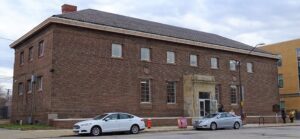
City architect Frederic H. Betz designed the St. Clair Avenue Public Bath House and it was constructed in 1919-1920 at a cost of $320,000. The facility included a large gymnasium, swimming pool, and laundry, in addition to showers. City Council dedicated the newly completed building to the late, beloved Cleveland Indians shortstop Raymond Chapman in 1920. The St. Clair Recreation Center, as it was later known, was in the impact zone and survived the East Ohio Gas Company disaster on October 20, 1944. The facility was remodeled in 1949 and subsequent renovations demonstrate the utility of the building. Edward J. Kovacic (1910-1974) was the superintendent of the bathhouse from 1933-1934 and served on the City Council from 1940-1953. In 1977, the facility was renamed to honor Kovacic’s contributions to the citizens of the St. Clair neighborhood and to the city. (Continued on other side)