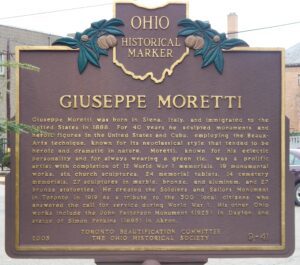
Giuseppe Moretti was born in Siena, Italy, and immigrated to the United States in 1888. For 40 years he sculpted monuments and heroic figures in the United States and Cuba, employing the Beaux-Arts technique, known for its neoclassical style that tended to be heroic and dramatic in nature. Mor etti, known for his eclectic personality and for always wearing a green tie, was a prolific artist with completion of 12 World War I memorials, 19 monumental works, six church sculptures, 24 memorial tablets, 14 cemetery memorials, 27 sculptures in marble, bronze, and aluminum, and 27 bronze statuettes. He created the Soldiers and Sailors Monument in Toronto in 1919 as a tribute to the 300 local citizens who answered the call for service during World War I. His other Ohio works include the John Patterson Monument (1925) in Dayton and statue of Simon Perkins (1895) in Akron.
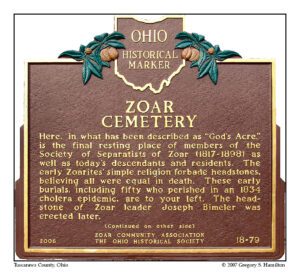
Here, in what has been described as “God’s Acre,” is the final resting place of members of the Society of Separatists of Zoar (1817-1898) as well as today’s descendants and residents. The early Zoarites’ simple religion forbade headstones, believing all were equal in death. These early burials, including fifty who perished in an 1834 cholera epidemic, are to your left. The headstone of Zoar leader Joseph Bimeler was erected later. (continued on other side)
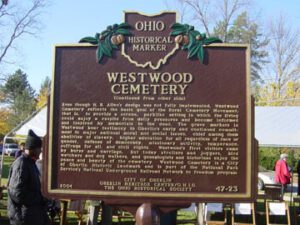
Shortly after Oberlin Colony was established in 1833, a two-acre burying ground was set aside south of Plum Creek in the area bounded by Main, Morgan, and Professor streets. By 1861, however, with the town and Oberlin College growing and the Civil War escalating, the need for a larger cemetery became clear. After an extensive search, 27.5 acres of land belonging to Henry Safford were acquired one mile west of the center of Oberlin. H.B. Allen was hired to create a design in the style of the Rural Cemetery Movement, and in July 1864 Westwood Cemetery was formally dedicated. Burials in Westwood had actually begun in August 1863, and over the next few years hundreds of remains were reinterred from Oberlin’s “Old Cemetery” and from burying grounds in surrounding communities. In the mid-1860s the cemetery was enlarged to its present 47 acres, and in 2004 burials and memorials were estimated to number almost ten thousand. (Continued on other side)
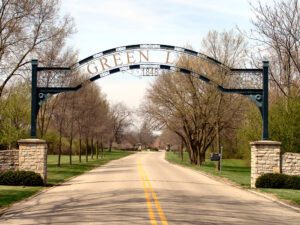
Landscape architect Howard Daniels designed the original portion of Green Lawn Cemetery in 1848. Noted Columbus architect Frank Packard designed Green Lawn’s Chapel mausoleum, the Hayden family mausoleum, and the Packard mausoleum. Spanning over 360 acres, the cemetery’s wooded setting provides a habitat for a variety of birds and other wildlife. The Chapel contains stunning stained glass windows and mosaic artwork by Tiffany & Company of New York. The monuments, obelisks, and memorials throughout the cemetery represent a wealth of artwork and a history of Columbus. As one of the oldest and largest cemeteries in Ohio, Green Lawn is the resting-place of many noted individuals who have made significant contributions to Columbus, Franklin County and the nation.