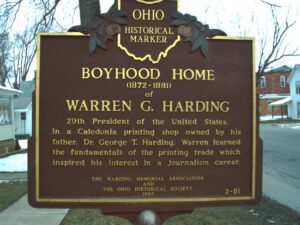
Boyhood home (1872-1881) of Warren G. Harding, 29th president of the United States. In a Caledonia printing shop owned by his father, Dr. George Tryon Harding, Warren learned the fundamentals of the printing trade which inspired his interest in a journalism career.
Acclaimed author, conservationist, and farmer Louis Bromfield was born in Mansfield in 1896. A graduate of the city’s schools, he went on to study agriculture at Cornell University in 1914, but left in 1915 to help run his family’s farm. In 1916, Bromfield enrolled in Columbia University to study journalism. As America entered World War I, he enlisted in United States Army Ambulance Service and saw action in seven major European battles. Determined to become a writer, Bromfield finished his education after the war and became a reporter. In 1921, he married Mary Appleton Wood and they would have three daughters. Bromfield’s first published novel, the Green Bay Tree (1924), was a critical and commercial success; his third novel, Early Autumn, won the Pulitzer Prize in 1927. The Bromfields moved to France in 1925 where they lived until 1938. In all, he published thirty books and authored numerous stories, articles, and screenplays during his writing career.
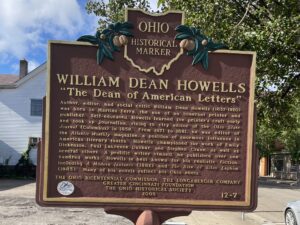
Author, editor, and social critic William Dean Howells (1837-1920) was born in Martins Ferry, the son of an itinerant printer and publisher. Self-educated, Howells learned the printer’s craft early and took up journalism, rising to city editor of the Ohio State Journal (Columbus) in 1858. From 1871 to 1881, he was editor of the Atlantic Monthly magazine, a position of enormous influence in American literary tastes. Howells championed the work of Emily Dickenson, Paul Laurence Dunbar, and Stephen Crane, as well as several others. A prolific writer himself, he published over one hundred works. Howells is best known for his realistic fiction, including A Modern Instance (1882) and The Rise of Silas Lapham (1885). Many of his novels reflect his Ohio roots.
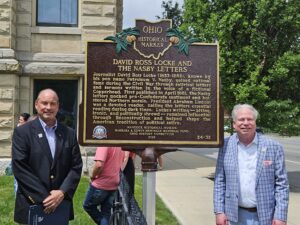
Journalist David Ross Locke (1833–1888), known by his pen name Petroleum V. Nasby, gained national fame during the Civil War through satirical letters and sermons written in the voice of a fictional Copperhead. First published in April 1861, the Nasby letters mocked pro-Confederate sentiment and bolstered Northern morale. President Abraham Lincoln was a devoted reader, calling the letters essential reading during dark times. Locke’s writing—biting, ironic, and politically shrewd—remained influential through Reconstruction and helped shape the American tradition of political satire.
Known by the trade name Henderson’s Printing, the business was a mainstay of Dayton’s African American community for almost 60 years and became a printer of choice for everything from advertising materials, office forms, and a community publications called “housewife savers.” John William Henderson Sr. (1913–1991) purchased his first printing press and founded the business in 1941, bringing to it experience as an instructor of journalism and printing at Wilberforce University. The business’s first location was the family home at 421 Kearney St. After several moves, the business settled at 301 Washington Street in 1958.
Charles Campbell Gard was born in Hamilton on January 13, 1895. He was the only child of Homer and Lutie Gard. His father, owner and publisher of the Hamilton Journal-News, taught him a love of the newspaper business and a devotion to public service. “Campbell” Gard graduated from Hamilton High School in 1913, attended Amherst College, and completed a one-year journalism course at the University of Wisconsin. After the U.S. entered World War I in 1917, the 22-year-old registered for military service. He saw active duty in Europe and was honorably discharged May 19, 1919. On October 25, 1921, while working at the Journal Publishing Company, 26-year-old Campbell Gard collapsed and died of myocarditis, an often-undetected heart disease, just days before marrying fiancée Helen Raymond. Gard was buried privately at Greenwood Cemetery two days later.