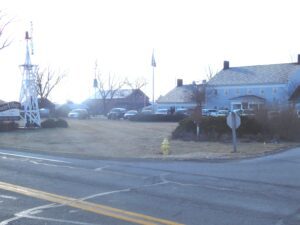
A pioneer furniture manufacturer and philanthropist, Erie J. Sauder (1904-1997) was born and reared on a farm in Archbold. With the help of his wife Leona, he began woodworking in their town barn in 1934. Crafting tables and church pews, the Sauder Woodworking Company grew quickly. Sauder’s 1951 invention of an easily shipped table kit heralded the modern ready-to-assemble furniture industry and firmly established the company as one of Fulton County’s primary employers. In 1976 Sauder founded the Sauder Village to interpret nineteenth century rural lifestyles in the Black Swamp region.
Granville T. Woods was a pivotal African American inventor during the late 19th and early 20th centuries. Woods’ invention of the telegraph device that enabled railway companies to know the location of each of their trains. This new technology greatly enhanced train scheduling and reduced the frequency of fatal collisions throughout the railway industry. From 1878 through 1880 Woods was a railroad locomotive engineer employeed by the Springfield, Jackson and Pomeroy Railroad Company and later by the Dayton and Southeastern Railroad. With frequent stops in Washington Courthouse and extensive leisure time, Woods learned telegraphy from a local telegraph operator. (Continued on other side)
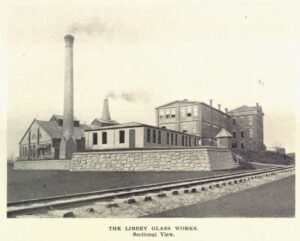
Attracted by the promotion of a civic group, as well as abundant fuel, Edward Drummond Libbey relocated his glass operation from Massachusetts to Toledo in 1888. His company was renown as a producer of fine art glass. Michael J. Owens, a Libbey Superintendent, developed the first fully automatic bottle-making machine in 1903. His invention revolutionized the industry and helped eliminate child labor in glass factories.
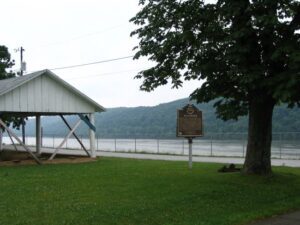
Manchester was founded in 1791 by Nathaniel Massie as a base to survey the land warrants of American Revolutionary War soldiers in the Virginia Military District. This bank of the Ohio River provided a secure site for the last civilian stockade built in Ohio. The natural protection of this fortification included marshland to the west and north and the river on the south. The nearby three islands provided a safe place for retreat in dangerous circumstances and also supplied an area to raise food in its rich bottomlands. The invention of the steam powered paddle wheel boat allowed the river to become the city’s main source of shipping and commerce in the nineteenth century. Manchester was an important port of call for provisions; the export of agricultural products; and the manufacture of goods such as pottery, furniture, and leather goods.
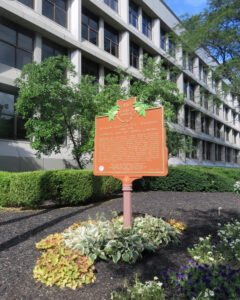
Industrialist and entrepreneur Franklin Augustus Seiberling (1859-1955) named his fledgling rubber goods manufacturing company “Goodyear” to honor Charles Goodyear, the man who invented the vulcanization process for curing rubber. Seiberling founded the company with his brother, Charles Willard, because of their desire to participate in an enterprise that afforded an “opportunity for invention.” Incorporated in 1898, Goodyear Tire and Rubber Company rapidly grew with the young automotive industry and helped establish Akron as the “Rubber Capital of the World.” Among Seiberling’s many significant inventions were the tire-making machine and the detachable wheel rim. He resigned from Goodyear in 1921 and went on to found the Seiberling Rubber Company. Stan Hywet Hall, F.A. Seiberling’s estate in west Akron, is a National Historic Landmark.
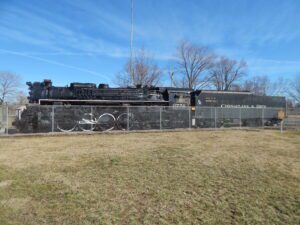
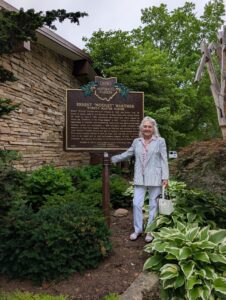
Ernest “Mooney” Warther was born October 30, 1885, near Dover, Ohio. He began to carve, aged 5, and did not set his knife down until shortly before his death on June 8, 1973. Fascinated with trains and steam engines he began his “Evolution of the Steam Engine” in 1913, hoping to convey the importance of invention and engineering. Each model was meticulously hand-sculpted, scaled, and mechanized. A 1923 newspaper article attracted the attention of New York Central Railroad and Warther was invited to tour on their Service Progress Special and later to exhibit at Grand Central Station. This success enabled Warther to quit his local steel mill job and to concentrate on his hobby and his own knife-making business. In 2023, his home, workshop, and museum were listed on the National Register of Historic Places.
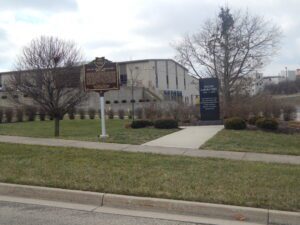
The facilities once here propelled the United States through the Nuclear and Space Ages and were named for the nearby pre-historic Miamisburg Mound. The Manhattan Engineer District of the War Department began construction of Mound Laboratory in 1946. The facility consolidated production of the nuclear-reaction initiators, developed for the United States’ first atomic bombs during World War II. Previously (1943-1946), the work to separate, purify, and process the element polonium used in these initiators occurred at facilities throughout the Dayton area. Mound Laboratory was the nation’s first permanent post-WWII Atomic Energy Commission site. Mound Laboratory had 116 buildings and at its peak employed approximately 2,500 scientists, engineers, and skilled workers. Contractors operating at the site were Monsanto (1947-1988), Edgerton, Germeshausen, and Grier (1988-1997), and Babcock and Wilcox (1997-2002). (Continued on other side)
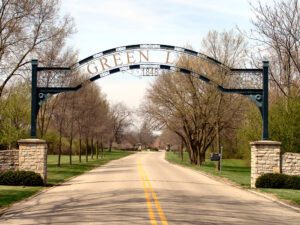
Landscape architect Howard Daniels designed the original portion of Green Lawn Cemetery in 1848. Noted Columbus architect Frank Packard designed Green Lawn’s Chapel mausoleum, the Hayden family mausoleum, and the Packard mausoleum. Spanning over 360 acres, the cemetery’s wooded setting provides a habitat for a variety of birds and other wildlife. The Chapel contains stunning stained glass windows and mosaic artwork by Tiffany & Company of New York. The monuments, obelisks, and memorials throughout the cemetery represent a wealth of artwork and a history of Columbus. As one of the oldest and largest cemeteries in Ohio, Green Lawn is the resting-place of many noted individuals who have made significant contributions to Columbus, Franklin County and the nation.