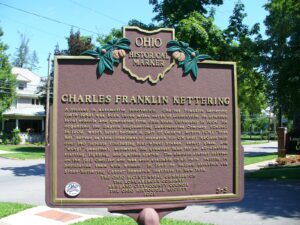
A pioneer in automotive innovation, Charles Franklin Kettering (1876-1958) was born three miles north of Loudonville. He attended local schools and graduated from Ohio State University in 1904. He organized the Dayton Engineering Laboratories Company (Delco) in 1909, which later became a part of General Motors (GM). “Boss Ket” served as vice-president of research for GM until 1920 and held over 140 patents (including four-wheel brakes, safety glass, and “ethyl” gasoline), achieving his greatest fame for an all-electric starting, lighting, and ignition system. The electric starter debuted on the 1912 Cadillac and was soon available on all cars, helping to popularize them with women. In 1945 he helped establish the Sloan-Kettering Cancer Research Institute in New York.
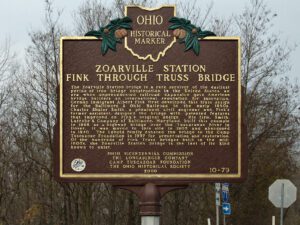
The Zoarville Station Bridge is a rare survivor of the earliest period of iron bridge construction in the United States, an era when unprecedented railroad expansion gave American bridge builders an international reputation for innovation. German immigrant Albert Fink first developed this truss design for the Baltimore & Ohio Railroad in the early 1850s. Charles Shaler Smith, a prominent civil engineer and Fink’s former assistant, designed the bridge with patented features that improved on Fink’s original design. His firm, Smith, Latrobe & Company of Baltimore, Maryland, built this example in 1868 as a highway bridge over the Tuscarawas River in Dover. It was moved to this site in 1905 and abandoned in 1940. The Lebold family donated the bridge to the Camp Tuscazoar Foundation in 1997 for preservation and restoration. Of the hundreds of Fink Truss bridges built in the mid-1800s, the Zoarville Station Bridge is the last of its kind known to exist.
Inventor, industrialist, and philanthropist, Harvey Samuel Firestone (1868-1938) was born on a nearby farm in 1868 and attended school in Columbiana. He founded the Firestone Tire and Rubber Company in 1900 and soon after developed a method for mass-producing tires for the infant automobile industry. Continuing innovation and steady contracts with large automakers led to the company’s lasting success. Firestone Park is his lasting legacy to Columbiana. The Firestone family’s monument is located in nearby Columbiana Cemetery.
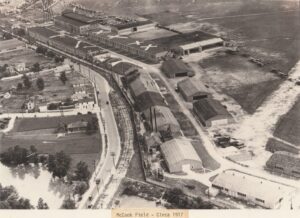
Interest in the new field of aeronautics grew dramatically when the United States entered the World War I in 1917. The army chose Dayton as the site for a research-and-development program for military aviation because of the area’s transportation links to major cities and its engineering and testing facilities. McCook Field, north of downtown between Keowee Street and the Great Miami River, was charged with researching, developing, and testing military airplanes and accessories. For nearly a decade, many advancements in aviation occurred at McCook Field. They included new aircraft, controllable-pitch propellers, bulletproof gas tanks, free-fall parachutes, and night-observation cameras. In the 1920s, larger and more-powerful aircraft overwhelmed the small field, which featured a large sign to warn pilots: “This field is small. Use it all.” In 1927, aeronautical engineering was transferred to newly-created Wright Field, now a part of Wright-Patterson Air Force Base.
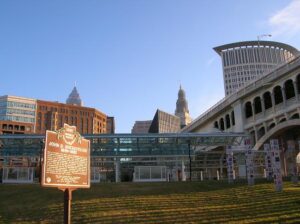
Born at Richford, New York, John D. Rockefeller moved to the Cleveland area with his family at age 14. He began his business career as a bookkeeper in 1855. From modest beginnings he became one of the richest men of his era by developing the world’s largest oil corporation, the Standard Oil Company, which was founded here in the Flats of Cleveland. Rockefeller moved to New York City in 1884 but maintained two homes in Cleveland, returning often with his wife Laura (1839-1915). Although he was a controversial businessman, Rockefeller donated millions of dollars to Cleveland charities and institutions, and land for Rockefeller and Forest Hills parks. John and Laura Rockefeller are interred in Lake View Cemetery.
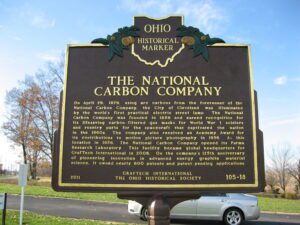
On April 29, 1879, using arc carbons from the forerunner of the National Carbon Company, the City of Cleveland was illuminated by the world’s first practical electric street lamp. The National Carbon Company was founded in 1886 and earned recognition for its lifesaving carbon-filtered gas masks for World War I soldiers and reentry parts for the spacecraft that captivated the nation in the 1960s. The company also received an Academy Award for its contributions to motion picture photography in 1956. At this location in 1956, The National Carbon Company opened its Parma Research Laboratory. This facility became global headquarters for GrafTech International in 2006. On the company’s 125th anniversary of pioneering innovation in advanced energy graphite material science, it owned nearly 800 patents and patent-pending applications.
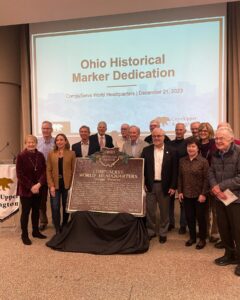
The world headquarters of CompuServe was located on the six-acre site at 5000 Arlington Centre Boulevard from 1973 to 2009. Incorporated in 1969, Compu-Serve Corporation (later CompuServe Inc.) was the first major online information services provider. Its subscribers were the first to have access to email, online newspapers and magazines, the ability to share and download files, and a variety of popular chat forums. One especially successful CompuServe innovation was the GIF graphics format. Increasing competition and a succession of corporate owners pressed CompuServe into the fate of many tech start-ups and it ran its course. It did, however, introduce millions of people to online connectivity, social networking, and laid the foundation for the widespread use of the internet.
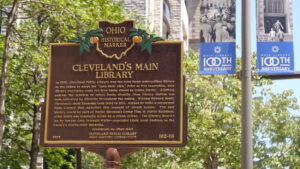
In 1890, Cleveland Public Library was the first large metropolitan library in the nation to adopt the “open shelf plan.” Prior to this innovation, only library employees could retrieve books stored in closed stacks. Allowing patrons the freedom to select books directly from library shelves was soon embraced by libraries throughout the nation. William Howard Brett, Cleveland’s chief librarian from 1884 to 1918, worked to build a permanent Main Library that embodied this concept of direct access. The new library would be part of Daniel Burnham’s Group Plan of Public Buildings. After Brett was tragically killed by a drunk driver, the Library Board — led by lawyer John Griswold White — appointed Linda Anne Eastman as the library’s fourth chief librarian. (Continued on other side)