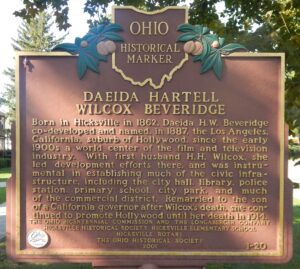
Born in Hicksville in 1862, Daeida H.W. Beveridge co-developed and named, in 1887, the Los Angeles, California, suburb of Hollywood, since the early 1900s a world center of the film and television industry. With first husband H.H. Wilcox, she led development efforts there, and was instrumental in establishing much of the civic infrastructure, including the city hall, library, police station, primary school, city park, and much of the commercial district. Remarried to the son of a California governor after Wilcox’s death, she continued to promote Hollywood until her death in 1914.
Near this site on July 4, 1825 ground was broken in Ohio for the National Road. The National Road was America’s first federally planned and funded highway and linked the east coast of the United States to Old Northwest Territory. Albert Gallatin, President Thomas Jefferson’s Secretary of the Treasury, conceived the idea for the road and advocated for it. Construction began in 1811 at Cumberland, Maryland, but was interrupted by the War of 1812. The road reached Wheeling in 1818, but was again delayed until 1825 because of debates over the constitutionality of federal funding for road and infrastructure projects. The National Road in Belmont County began at Bridgeport on the Ohio River and ran 28.5 miles to the western end of the county at Fairview.
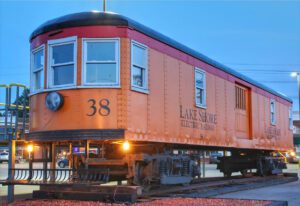
From the 1890s to the 1930s, interurban railways were an important form of travel in the Midwest. Beach Park Station had an interurban carhouse, where repairs were performed and passengers boarded. The Lorain & Cleveland Railway (L&C) built the 65½ by 200 foot brick station in 1897. By 1901, the L&C became part of the Lake Shore Electric Railway (LSE) and Beach Park became stop 65 on a line that ran from Cleveland to Toledo and then to Detroit. Requiring power and water, the LSE built an electric plant and water tower at Avon Lake. This infrastructure spurred the community’s development and growth. (Continued on other side
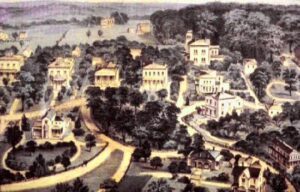
Established in 1851 after the addition of the Cincinnati, Hamilton, and Dayton Railway, Glendale incorporated in 1855 as Ohio’s first planned community and one of the nation’s first planned villages. The original planning included forested greenbelts and parks, curvilinear streets meandering around established trees, large lots, and superior building standards. Glendale is designated as a National Historic Landmark community from the Department of Interior and a Certified Local Government through the Ohio Historic Preservation Office, all owed to Glendale’s persistent adherence to the plan and faithful preservation of original infrastructure. Much of today’s preserved infrastructure includes the original 59 pivotal buildings, curvilinear streets, tree canopy, stone gutters, gas streetlights, and railroad depot.
Players of the Cleveland Browns gathered eleven Black professional athletes and future mayor Carl Stokes to discuss with boxer Muhammad Ali (January 17, 1942-June 3, 2016) his refusal to serve in the Vietnam War. After their private meeting on June 4, 1967, the twelve men decided to “support Ali on principle” and held a lengthy national press conference. The boxer, considered the “greatest heavyweight of all time,” garnered national scorn and paid a high price for his stance. Ali was arrested, found guilty of draft evasion, his passport confiscated, titles stripped, and U.S. boxing licenses suspended. The men in attendance also faced condemnation and threats. In 1971, the Supreme Court unanimously overturned Ali’s conviction. The Cleveland Ali Summit is considered “one of the most important civil rights acts in sports history.”