

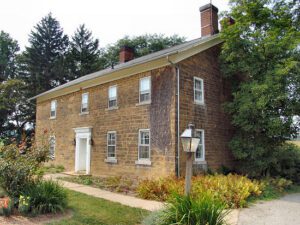
, OH
Frederick Rice was born on September 29, 1753, near Bethlehem, Northampton County, Pennsylvania and moved to Westmoreland County, Pennsylvania around 1766. During the American Revolution he served under George Washington at Valley Forge and fought in the Battle of Trenton on December 26, 1776, in which American forces surprised and captured 1,000 Hessian mercenaries. He served for two more years as a spy working against Native American tribes in western Pennsylvania. After his service he married Catherine Lauffer, and they raised eleven children to adulthood. Rice chose this 320-acre site, transferred to him in a deed signed by President James Monroe on May 21, 1821, because it offered excellent springs. He assigned the west half to son Simon and the east half to son Barnhart in 1822. Ownership remained in the Rice family until acquired for the Ohio Agricultural Experiment Station in 1891, renamed the Ohio Agricultural Research and Development Center in 1965.
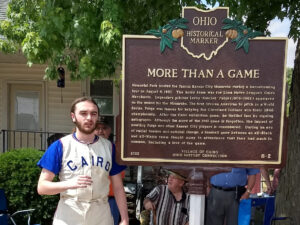
, OH
Memorial Park hosted the famous Kansas City Monarchs during a barnstorming tour on August 4, 1961. The home team was the Lima Metro League’s Cairo Merchants. Legendary pitcher Leroy “Satchel” Paige (1906-1982) appeared on the mound for the Monarchs. The first African American to pitch a World Series, Paige was famous for helping the Cleveland Indians win their 1948 championship. After the Cairo exhibition game, he thrilled fans by signing autographs. Although the score of the 1961 game is forgotten, the impact of meeting Paige and other Kansas City players is remembered. During an era of racial tension and national change, a baseball game between an all-Black and all-White team taught many in attendance that they had much in common, including a love of the game.
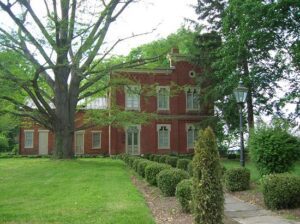
, OH
This classic Gothic Revival home built in the early 1850s, was one of Ohio’s early wineries with terraced hillside vineyards overlooking the city of Chillicothe. From 1919 until his death in 1966, it served as the home and working studio of noted American craftsman, artist, and historian Dard Hunter. A major artistic contributor to the Arts and Crafts Movement of the early twentieth century, Hunter gained international recognition when in 1916 he became the first individual in the history of printing to produce all aspects of a book by hand. Eight of the twenty books he wrote on the history of paper were printed at this site. Hunter is regarded as the world’s leading authority on the history of paper and his artistic achievements have had an enduring impact on American Graphic Arts.
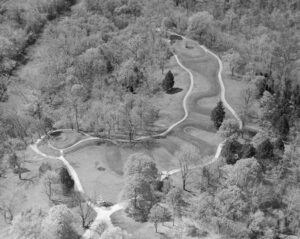
, OH
One of North America’s most spectacular effigy mounds, Serpent Mound is a gigantic earthen sculpture representative of a snake. Built on a spur of rock overlooking Ohio Brush Creek around 1000 A.D. by the Fort Ancient culture, the earthwork was likely a place of ceremonies dedicated to a powerful serpent spirit. The site is located on the edge of a massive crater, possibly formed by the impact of a small asteroid around 300 million years ago. Frederic Ward Putnam studied Serpent Mound between 1886 and 1889. Due largely to his efforts, Serpent Mound became the first privately funded archaeological preserve in the United States.
, OH
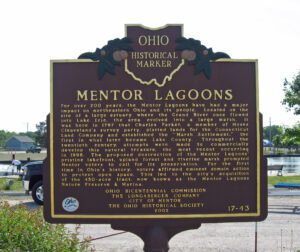
For over 200 years, the Mentor Lagoons have had a major impact on northeastern Ohio and its people. Located on the site of a large estuary where the Grand River once flowed into Lake Erie, the area evolved into a large marsh. It was here in 1797 that Charles Parker, a member of Moses Cleaveland’s survey party, platted lands for the Connecticut Land Company and established the “Marsh Settlement,” the first in what later became Lake County. Throughout the twentieth century, attempts were made to commercially develop this natural treasure, the most recent occurring in 1996. The proposed destruction of the Mentor Lagoons’ pristine lakefront, upland forest and riverine marsh prompted Mentor voters to call for its preservation. For the first time in Ohio’s history, voters affirmed eminent domain action to protect open space. This led to the city’s acquisition of the 450-acre tract, now known as the Mentor Lagoons Nature Preserve & Marina.
, OH
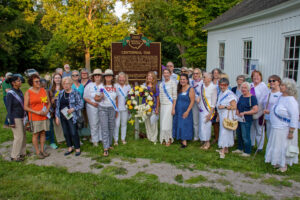
The Newbury Woman Suffrage Political Club, headquartered at Union Chapel, planted the Centennial Oak on July 4, 1876. The White Oak (Quercus alba) was chosen for its endurance, longevity, and beauty. The picnic and planting celebration included speeches, songs, fireworks, and a poem dedicated to the Oak written by local suffragist Anna Green. As the club gained national recognition, it attracted such notable suffragists as Susan B. Anthony and Harriet Taylor Upton as visitors and speakers. A Newbury gathering on August 23, 1919, held to celebrate Ohio’s recent ratification of the 19th Amendment, included suffragists Upton and Frances Jennings Casement. The last living founding member of Newbury’s Woman Suffrage Club, Dr. Julia Porter Green, led a parade from the chapel to Centennial Oak. There she placed a wreath of evergreen and goldenglow upon the tree.
, OH
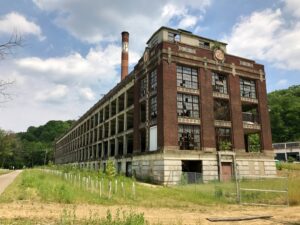
The Peters Cartridge Company was once a major employer in the region, providing munitions for Allied forces during World Wars I and II. Organized in 1887, it was the first ammunition company to produce machine-loaded shotgun shells. After an explosion in 1890 that killed 12, the factory was rebuilt at this site. By 1916, brick and reinforced concrete buildings had replaced wood structures and a taller shot tower had been erected. Sister company to the King Powder Company across the Little Miami River, 3,000 men and women at Peters produced 1,500,000 cartridges per day in 1917 to supply munitions during WWI. In 1934, Remington Arms bought the company, enlarged it, and then sold it in 1944. The shot tower and smoke stack stand as a reminder that Peters was once the leader in ammunition production.
, OH
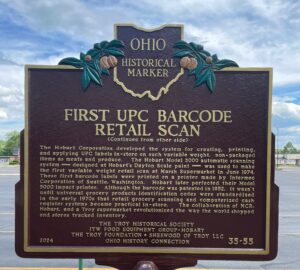
On June 26, 1974, the first retail scan of a product marked with a Universal Product Code (UPC or barcode) was made in the checkout line of Troy’s Marsh Supermarket located at 982 N. Market Street. A ten-pack of Wrigley’s Juicy Fruit chewing gum was scanned to simulate the purchase of a product. The barcode was scanned on the NCR 255 computerized check-out system developed by National Cash Register (NCR). The system featured a Spectra Physics Model A scanner and an NCR 726 in-store computerized cash register. The Troy grocery store, considered a “typical” American grocery, was conveniently located near NCR and Hobart facilities. Spectra Physics and NCR later donated one of the original scanners and cash registers used at Marsh’s to the National Museum of American History, Smithsonian. (Continued on other side)