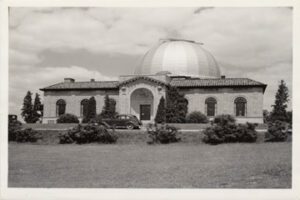
One-half mile east is the site of the former BIG EAR radio telescope. Designed by Dr. John D. Kraus, pioneering radio astronomer at Ohio State University, it had a collecting area of 340 by 70 feet (104 by 21 meters). The observatory was completed in 1963. The Ohio Sky Survey recorded here between 1965 and 1972 was the most accurate, reliable, and complete mapping of cosmic radio signals (the “radio sky”) for many years. BIG EAR gained fame for its ability to detect quasi-stellar radio sources, or “quasars,” and for its discovery of some of the most distant objects known. This observatory conducted a 24-year continuous search for evidence of extraterrestrial intelligence, during which the famous “Wow!” signal was received in 1977. BIG EAR was demolished in 1998. [“Wow!” signal graphic]
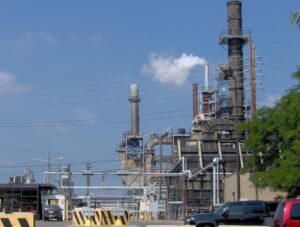
Oil became a valuable resource in Ohio when significant quantities were discovered in Lima in 1885. The discovery brought an economic boom to Lima and northwest Ohio. News of the Lima oil field spread, attracting the attention of John D. Rockefeller, co-founder of Standard Oil. Against the advice of his board, Rockefeller invested heavily in Lima crude, despite its high sulfur content and foul odor. Storage tanks and pipelines for the crude sprung up rapidly. Having great faith in the ingenuity of his engineers and scientists, Rockefeller stockpiled the crude and sent Standard’s chief refining specialist, J.W. Van Dyke, to Lima to construct and manage the new Solar Refinery. Together with Herman Frasch, a German chemist, the two men perfected the technique to desulphurize the crude and turn it into quality kerosene and fuel oil.
Main Street, across from the Deersville United Methodist Church
Deersville
, OH
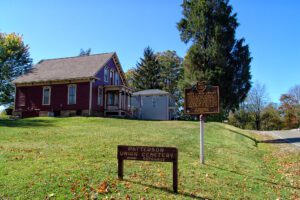
Mary Leonore Jobe was born on January 29, 1878, near Tappan, Harrison County, Ohio. She earned a bachelor’s degree from Scio College and master’s degree from Columbia University. While studying, she began a life-long career of exploration and natural history investigation. She first explored areas of British Columbia, Canada in 1905 and in 1916 started Camp Mystic, a summer camp in Connecticut for girls. She married explorer Carl E. Akeley in 1924 and completed an expedition to Africa when Carl died in the Belgian Congo in 1926. Honors include the naming of Mount Jobe in Canada to recognize her achievements and Belgium awarding her the Cross of the Knight, Order of the Crown, for her work in the Belgian Congo. She is known for her books and contributions to the American Museum of Natural History in New York. She died on July 19, 1966, and is buried in Deersville.
Behind the Cridersville Fire Department, 100 E. Main Street
Cridersville
, OH
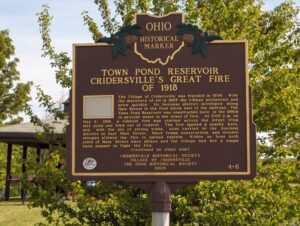
The Village of Cridersville was founded in 1856. With the discovery of oil in 1885 the village prospered and grew quickly. Its business district developed along Main Street in the first block east of the railroad. The Town Pond Reservoir was constructed here in the 1890s to provide water in the event of fire. At 3:00 p.m. on May 2, 1918, a rubbish fire was started across the street from this pond and blew out of control. The fire ignited a nearby barn, and, with the aid of strong winds, soon carried to the business district on East Main Street. Wood frame construction and wooden shingles allowed the fire to spread rapidly. Within an hour both sides of Main Street were ablaze and the village had but a single hand pumper to fight the fire. (continued on other side)
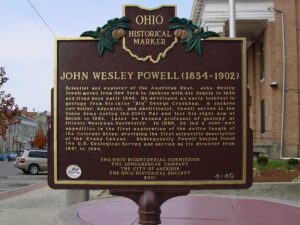
Scientist and explorer of the American West, John Wesley Powell moved from New York to Jackson with his family in 1838 and lived here until 1846. He developed an early interest in geology from his tutor “Big” George Crookham, a Jackson salt boiler, educator, and abolitionist. Powell served in the Union Army during the Civil War and lost his right arm at Shiloh in 1862. Later he became professor of geology at Illinois Wesleyan University. In 1869, he led a nine-man expedition in the first exploration of the entire length of the Colorado River, providing the first scientific description of the Grand Canyon. Subsequently Powell helped found the U.S. Geological Survey and served as its director from 1881 to 1894.
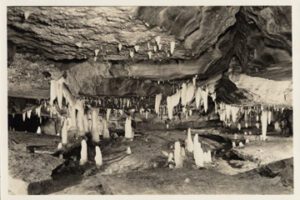
In 1897, a farm boy investigating the disappearance of water into a sinkhole in a nearby field discovered this system of subterranean passageways. Digging down a few feet, he found an opening to a cave that had begun forming perhaps several thousand years earlier during the Ice Age in soluble limestone bedrock that was approximately 400 million years old. Ground water dripping down from the cavern’s ceiling continues to form stalactites, stalagmites, and mineral coatings on the cavern’s walls, floor, and ceiling. A portion of Ohio Caverns near the discovery site was opened to the public in 1897, but that section closed in 1925 when a more extensive and geologically interesting part of the cave was discovered. Ohio Caverns is the largest known cave system in the state and is widely considered to be the most beautiful of all Ohio caves.
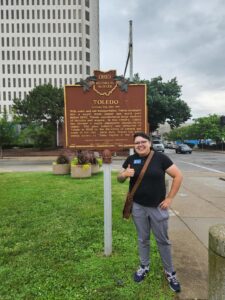
After consolidation of the villages of Fort Lawrence and Vistula, the City of Toledo was incorporated in 1837. Originally named “Toledo” in 1833, the site became part of Ohio when the “Toledo War,” a bloodless boundary conflict with Michigan, was resolved by Congress in 1836. Settlers were attracted by the commercial potential of the Maumee River, called “Miami of the Lake,” and later the Miami-Erie Canal. (Continued on other side)
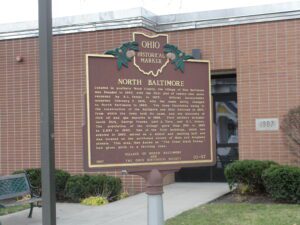
Located in southern Wood County, the village of New Baltimore was founded in 1860, with the first plat of twenty-nine acres recorded by B.L. Peters in 1873. Official incorporation occurred February 7, 1876, with the name being changed to North Baltimore in 1880. The town flourished owing to the construction of the Baltimore and Ohio Railroad in 1873, from which the town took its name, and the discovery of rich oil and gas deposits in 1886. First settlers included: Jacob Dirk, George Franks, Levi A. Tarr, and B.L. Peters. The population of the village grew from 700 in 1880 to 2,857 in 1890. One of the first buildings, which was erected in 1860, served as a school and meeting hall and was located on the northwest corner of Main and Broadway streets. This area, then known as “The Great Black Swamp,” had given birth to a thriving town.