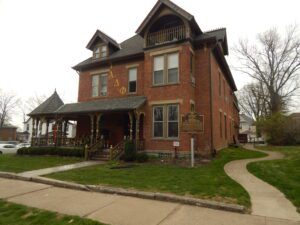
Built in 1842 in the Greek Revival Architectural Style for Alfred Avery from designs by Minard Lefever, the house subsequently served as a home for the Spelman (1845-1873), Downer and Cole families (1873-1902), the Phi Gamma Delta (1902-1930) and Kappa Sigma (1930-1956) Fraternities. This house was bequeathed to the Licking County Historical Society By Robbins Hunter Jr. (1905-1979) as a museum of the 19th Century. National Register of Historic Places.
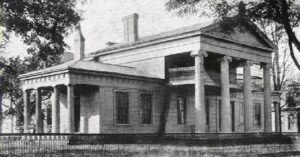
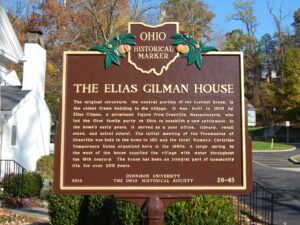
The original structure, the central portion of the current house, is the oldest frame building in the village. It was built in 1808 by Elias Gilman, a prominent figure from Granville Massachusetts, who led the first family party to Ohio to establish a new settlement . In the home’s early years, it served as a post office, library, retail store, and select school. The initial meeting of the Freemasons of Granville was held in the home in 1811 and the local Women’s Christian Temperance Union organized here in the 1880s . A large spring to the west of the house supplied the village with water throughout the 19th century . The house has been an integral part of community life for over 200 years.
In 1833, Samuel Eells founded Alpha Delta Phi (ΑΔΦ), the first fraternity west of the Allegheny Mountains and the first fraternity at Miami University. The formation of Miami’s Alpha (founding) chapters followed in the next two decades. In 1839 Beta Theta Phi (ΒΘΠ) was founded, Miami’s first Alpha chapter. Phi Delta Theta (ΦΔΘ) was founded in 1848 and Sigma Chi (ΣΧ) in 1855, completing the Miami Triad. Miami would become home to two more Alpha chapters with the creation of the sorority Delta Zeta (ΔΖ) in 1902 and what would become Phi Kappa Tau (ΦΚΤ), in 1906. Following Miami’s precedent, approximately 800 chapters of these five “Alphas” have been formed in the United States and internationally. Sharing the title with Union College in Schenectady, New York, Miami University is known as the “Mother of Fraternities”.
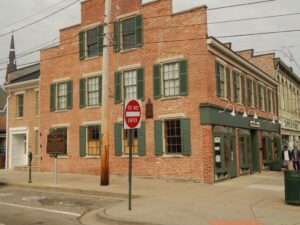
Thomas Cowan Bell, James Parks Caldwell, Daniel William Cooper, Isaac M. Jordan, William Lewis Lockwood, Benjamin Piatt Runkle, and Franklin Howard Scobey met in a second floor room of this building to found Sigma Chi (ΣΧ) in early 1855. All but Lockwood had been members of Delta Kappa Epsilon (ΔΚΕ) but left over a disagreement as to who should be elected poet of Erodelphian, one of Miami University’s literary societies. Runkle and Caldwell, who lived here, designed Sigma Chi’s badge, the White Cross. Reflecting the ideals of Friendship, Justice, and Learning, the Brothers donned the badge and established Sigma Chi on Commencement Day, June 28, 1855. The founding of Sigma Chi completed the Miami Triad, which includes Alpha (founding) chapters of Beta Theta Pi (ΒΘΠ, 1839) and Phi Delta Theta (ΔΘ, 1848). Miami University and Union College in Schenectady, New York are known as the “Mother of Fraternities.” (Continued on other side)
Ella Nora Phillips Myers Stewart was one of the first practicing Black women pharmacists in the United States. After she married William Stewart in 1920, the couple settled in Youngstown, then moved to Toledo where they opened Stewart’s Pharmacy in 1922. Having broken professional barriers, Ella Stewart became a tireless civil rights champion. Advocating for Black women she was active in the Enterprise Charity Club and was a 1937 charter member of Beta Lambda and Toledo Alumnae chapters of Delta Sigma Theta Sorority. She served on the National Association of Colored Women Clubs, the Women’s Advisory Committee of U.S. Department of Labor, and Pan-Pacific Southeast Asia Women’s Association. Toledo’s Ella P. Stewart Academy for Girls was named in her honor in 1961. She was inducted into the Ohio Women’s Hall of Fame in 1978.
Iuka Ravine, developed on land from the “Indianola Farm” that belonged to the Neil Family, is significant for its early 20th century architecture. The ravine’s natural beauty influenced architects to design homes for the upper middle class that incorporated “features of the old oak forest and glacial boulders.” Several ravine homes were designed by Frank Packard and Charles Inscho. Two classically-designed bridges built in 1912 insulated the area from traffic to create what became known during the 1920s-1950s as a “quiet professor enclave.” Iuka’s curvilinear street, one of the first in Columbus, as well as its stone walls, glacial erratics, and mature hardwoods created a “unique urban experience.” The Iuka Ravine Historic District was listed in The National Register of Historic Places in 1986 and added to the Columbus Register of Historic Properties in 1985.